
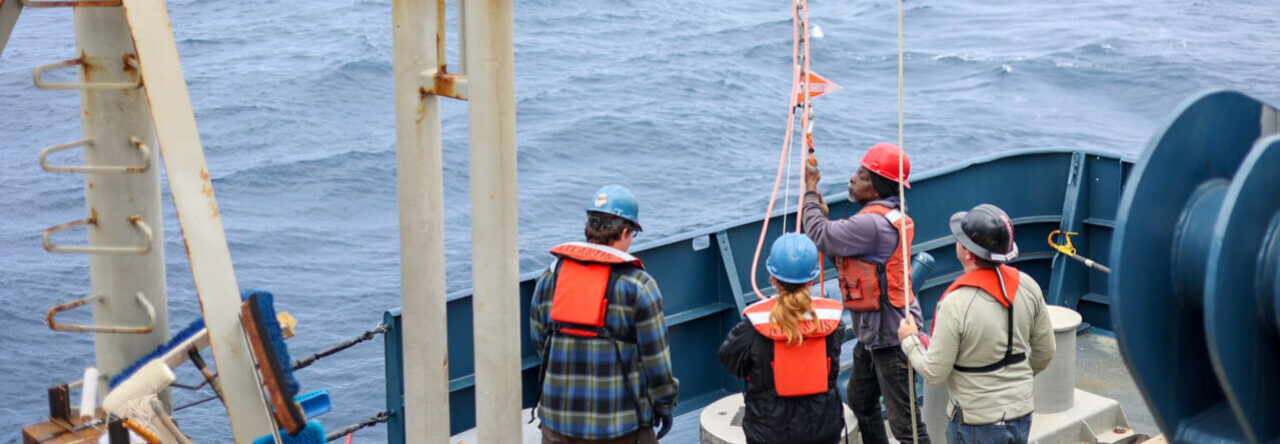
This week we did our load tests on the ship’s cranes. They need to be able to hold 125% of their load limit for 5 minutes to pass the test for our NSF inspection. We have giant wheels from train cars that weigh around 800 pounds each. These wheels are normally used to anchor buoys and are stored on campus. We only needed 5 and some extra smaller weights to get to 4,125 pounds. Both cranes were able to hold the wait and pass the test. 
Category: Host Page 40 of 85
During our trip we got a lot of lobster traps and fishing gear caught around our propellers. So we had to dive in today to cut off all the lines so we would be ready to go out whenever we needed to. We have dive gear on board the ship for this job and I have all my dive certifications. Each propeller had a lot more line on them than I thought they would. We cut and unwrapped all the lines. In some spots we had to use scrapers because the lines caused so much friction they melted to the prop shaft. We piled up all the cut lines up on the deck.
We changed the oil and serviced our starboard generator . We change out the raw water impeller. The old one looked like it was starting to crack. We took apart the air intake and the heat exchanger and cleaned them out. We also took a look at the turbo’s bearings to make sure they were ok. We then cleaned it up and did a little touch up painting.
I ended up working on our radar system on Sunday because it was not working and we were supposed to leave on Monday. I was not able to fix it on Sunday on my own. The trip ended up being pushed back a day. I spent the day on Monday working with the radar tech. I learned alot about the system. By the end of the day we found that it was the board and magnetron in the radar antenna. We replaced them and the radar fired right up.
We left on Tuesday morning. Once we got out to the gulf stream we did our first CTD cast. Unfortunately we started having problems with our oxygen sensors. We pulled the CTD back on deck and switched out the sensor with a spare we had on board. That did not fix the problem. We ended up using a different CTD port to see if that would fix the problem and it did. But we had to unplug something else to test the oxygen sensor. So we need to find what information the scientists didn’t need so we could remove that piece of equipment and have the port open for the oxygen sensor. We ended up eliminating our surface par. We did not have any more issues with the CTD for the rest of the trip. The trip went very smoothly after that. We had the same watch schedule as we had for when we did our tampa transit. We got back on saturday, but we had to keep an eye on the weather because it looks like another storm might be heading our way. We ended up not going up the river this time because the storm kept moving to the south so it was projected to miss us.
This week Denis and I needed to test the CTD because we are going to be using it on the 13th for our first real science trip since I’ve gotten started. We were having trouble with the CTD communicating with the computer. We need to test all the parts of the system between the CTD and the computer. We also decided to make a new termination for the sea cable. The CTD is lowered into the water using the sea cable, the sea cable has three power wires in the core and is wrapped with steel cable on the outside which gives the cable strength and also acts as the ground. We used a megameter to test all the wires. The megameter tests to see if there are any unwanted connections between weirs in the system. We tested the whole system and got a bad reading. So we had to break the system down into parts to narrow down the problem. We found a bad cable from the slip ring on the winch that goes into the winch cab. So we replaced that cable, but we still were getting a bad reading. We found some breaks in the weirs insulation on the weirs that run up from the CTD to the cable so we replaced them too. Once Denis and I finished the new termination we hooked everything back up and tested it out and it worked.
We left on our trip at about 7am. We just needed to go out to the gulf stream and do two CTD casts. One at 5 meters and another at 700 meters. We had a few issues with the CTD not communicating with the computer again. We narrowed the problem back down to the weirs that ran from the CTD to the sea cable. So we ended up removing them all together and attaching the sea cable directly to the CTD. We did our 5 meter cast and it seemed to work well. So then we lowered the CTD to 700 meters and we ran into more problems. We were not getting confirmation that the bottles were firing off or not. So we endup rebooting everything and we got it to work this time but we would have to look into it more when we got back.
On friday we ended up replacing the whole CTD with our back up so we would not have any problems for our next trip which was scheduled for monday. We got the new one installed and tested it and everything worked well.
The new repairs were all finished and we were put back into the water again. This time everything looked pretty good. We didn’t see any leaks so we were moved by tug over to the docks so we could spend the night then do a sea trial and vibration analytics the next day. The next day we were preparing to do the sea trial but we just kept running into problem after problem. The first thing was that we needed to bleed the air from all the sea chests so we would not get any air in our systems. One of the sea chests valves was seized and needed to be replaced but the problem is it is before the through hull valve so it could not be shut off to be worked on. Because I had to deal with a similar situation with the science water valve of working on the through hull without closing it, I helped out the chief engineer with that project. When we got the bleeder valve off we had to hammer a wooden plug into the hole to stop the water from filling up the engine room. Luckily found a new valve that fit, and we were able to reattach without getting too wet. We then were ready to start the engine, but our port engine would not start. We figured out the problem seemed to be a bad battery. We replaced the battery. We got the engine started, but then we found that where the cooling water goes over bord was leaking at the through hull. So we had to try and fix that. We spent most of the day on it but couldn’t get it to stop leaking. We had some of the pipe fitters from the yard come and finish it. While they were working on that we found that cooling water wasnt getting to our dripless seals. So we had to take apart the water system for that and clear it. The pipe fitters finished working on the leak at around 8:30 at night we were going to still try and do the sea trail but then we found that there was an issue with our steering system. We worked on it till 9:30 and decided to just finish it in the morning. The next day we started out working on the steering system. The problem was the angle of the rudders were not lining up with the controls. So we had to re-calibrate everything. We didn’t finish up with that until around 1PM. We then could get under way with our sea trial and vibration analysis to make sure everything was good.
We then headed back towards miami. We did the same watch schedule as before. The trip was pretty smooth with no issues. We arrived back in Miami on Monday morning. We spent Tuesday cleaning everything up. Then we had to prepare the ship to go again. There was a hurricane forming and it was projected to hit Miami by Friday or Saturday. On Thursday we took the ship up the Miami River to Merril Stevens. We have a spot reserved there for when we need to shelter from a storm. The storm ended up going to the east of us and we did not get much bad weather at all.
We were finally ready to put the ship back in the water. Everyone went around and checked everything on board. Then we were lowered back into the water. Pretty quickly we started to find some problems. I was called to the machine space which is on our lower compartment near the bow of the ship. One of the through hulls was leaking a bit of water. When I got to it I saw it was our science water intake. While we are under way on a trip we turn on a pump that pumps the sea water through different sensors and filters which measure temperature, selenity, the chemical makeup and the amount of CO2 in the water. This data is collected by a group of scientists at the end of each trip. The water can’t contact the metal of the through hull piping or it could contaminant the results. So this valve was specially fitted to have a piece of pvc pipe run through it. In case of an emergency and the valve needs to be closed the valve gate was sharpened and could cut through the pipe to seal everything off. Once this is done we need to wait till the ship can be pulled out of the water again and everything can be replaced. So it was this section of pipe that was letting a lot of water in. These valves had been taken apart and redone along with all the other valves on the ship as part of the inspection. I tried to tighten the part down but it was as tight as it would go. This part had not been replaced; it was an old plastic piece and that was part of the problem. Then it just broke all together under the straine. So now a lot of water was coming in. I had to close the valve but we had just put all this work into fixing and replacing the valve part so I didn’t want to just close it or we would not have that system until we had another dry dock. So I decided to work really quickly and take the fittings connected to the valve apart which would basically open the whole thing up and let the water just come rushing in. I was able to get to the pvc pipe and pull it out and close the valve without damaging anything. I managed to get it all closed up pretty quickly so we didn’t have too much water to pump out after, but I got pretty soaked. Now that I had everything out and the valve closed we could fix the section we needed to and nothing was damaged to where we would have to pull the ship back out of the water. I went back up to the main deck to let everyone know where we were at in that area, and to see how everything else was holding up. Unfortunately they found a small hole in the hull in the engine room. So we had to get pulled back out of the water anyway. We ended up needing to have a small section cut out and a new piece welded in. This pushed our launch date back another week.

 We added water to the ADCP wells to check for leaks. We had a couple of small leaks so I tightened down some of the nuts around the window and managed to get the leak to stop. We then left it overnight to make sure no more leakes appeared. In the morning we detected no new leaks so we decided we could install the transducers. Once they were bolted in place we could then add our pressurised water to the system. There is space between the transducer window glass and the transducer itself; this space is filled with pressurized water for two reasons. The first the transducer can be damaged if it were to send its signal in the air so it needs water to send its signal. The second reason we used pressurized water is to counteract against the force of the ocean acting against the glass at depth. In order to pressurise the water we have a hose that goes from the transducer well up to a head tank that is filled with water. The elevation of the water creates .433 psi of pressure per foot of water. Our tanks are about 13 feet above the window. This creates about 5.6 pounds of pressure per square inch pushing down on the inside of the window. The pressurised water was added and the fore window started to leak. This was really bad because at this point there is not much we can do to stop the leak. We thought about it over night and we came to the conclusion we would have to pull the whole thing apart again and start from scratch. This was tough because not only was it a week’s worth of work getting it done but we would now be delayed getting the ship put back into the water. So we were going to have to work as quickly as we could and figure out a quick way to test the new window without having to put the whole transducer back in test. It is a trick too because between each step there are different cure times for the adhesives we use which can be over 24 hours. We pulled out the transducer and window as quick as we could and cleaned it all up which was not not easy because it was all secured with a permanent adhesive called 5200. Once everything was cleaned up and a new gasket was created we set to work installing the window. We took special care to make sure everything was perfect. We had inspected the window that had leaked when we had pulled it out to see where it might have failed. It looked like part of the problem was the gasket itself might have been too wide; it was hanging over the edges and this could have kept the window from getting a good seal. For our new gasket we made it a lot more narrow. As we were working on the window we had the shipyard machinist fabricate a metal blank with two air fittings so we could add air pressure as our window test. Once everything was finished we installed the blank and added pressurized air to the window. The tecs wanted to test the window with 10psi. Because that’s what they thought the pressure of the tanks were. We had a small leak so I took off the blank, tightened some of the nuts and reinstalled the blank for another test. Before we did the next test I had been thinking about the pressure we were using and I felt it seemed a little high. So I looked up the formulas myself and re-did the math and I got the 5.6 psi myself which is the calculation I mentioned earlier. So not only was the pressure a lot less than we were testing at but no one took into account the fact that the ship was out of the water so it didn’t have any of the counter pressure of the ocean pushing back. The window normal sits at a depth of 5ft so that’s about 2.2 pounds of pressure pushing back up against the window. while the window is in the water the pressure pushing out against the glass is about 3.4 psi. So I brought this to the attention of the tecs saying that we were putting too much pressure on the window causing it to fail. So instead of testing it at 10psi we tested it at around 4psi. The window passed our last test. We then reinstalled the transducer. And decided not to add the pressurized water till we went back into the water.
This week I was put in charge of the crew that was reinstalling the ADCP windows. It was more challenging than I was expecting. I had to really watch what the crew was doing to make sure everything was right and they were doing it exactly how we wanted. The first step was to put contact cement down on one side of the gasket to stick in place on the bottom of the hull. Then 5200 was put on the gasket and the glass was pressed on to it. There were then 30 though bolts put on. This was tricky because some had to be down in the transducer well putting on the nuts while some else was outside the hull torquing down the bolts. Once all the bots were in place the outer edge of the window was filled in with 5200. We had two of these windows to install. Once the 5200 cures we will fill the well with water to test for leaks. If there are no leaks then we will mount the transducer. 
I went into the transducer well to clean up all the leftover adhesives and grind everything down so we would have a good clean surface to remount the transducers. I used a weir wheel to clean up all the mounting bolts for it as well.
We are using one of the university’s vans while we are here so we can get around to get supplies as we need them. The van hadn’t been starting all the time but we were able to jump it. It would have this problem about half the time, but then other times it would be fine. I decided to see if I could fix it. I used a multimeter to run some tests and I narrowed the problem down to a bad alternator. There was a NAPA close by but by this time the van got worse and could not even stay running at this point. So I took a bicycle to the store and picked up a new alternator. I installed it that night and the van has been great since.
We have also had problems with our air conditioning on the ship this week. It stopped working all together at one point. Normally when we are in the water we just pump the sea water right from the hull and through the AC system but because we are up high out of the water we have to have hoses run up from the ocean and water is pumped up to the ship. We have to match the water pump’s pressure with the ship’s AC pump. Too much pressure and the pipe could rupture, and not enough it could burn out our pump. We had pressure but not too much but the system was still not working and pipe connections were starting to fail and leake. We ended up checking the whole system and found down below off the ship the outlet hose had become kinked which was putting a ton of back pressure on the system. We unkinked the hose and fixed all the leaks and the AC started working well again.
We finished getting everything ready and we departed for Tampa on the 20th at 7:00am. The weather was calm. Once we were under way we started our watch schedules. My shifts were alternate to the chief engineer. When I was on watch I would do an hourly check on the engine rooms if I wasn’t already down there working. It took us about two and a half days to get to the shipyard. The seas were very calm for the whole trip. The trip was a lot of fun and it felt really good to get out on the water.
Once we arrived in Tampa we docked for the night. The next day the ship was dry docked. The ship yard’s drydock is like a floating barge. Ballast water is pumped into it and it sinks then we are pushed over it by tugs. Divers go underneath and set blocks for the ship to sit on. Then the ballast water is pumped out of the dock and it floats up thith the whole ship supported up on the blocks.
Work began on the ship the next day. I decided to take on one of our big projects which was removing two of our large transducers. They each weigh about 150 pounds each. They are set into the bottom of the hull. To remove them they need to be pulled out from inside the ship. I had to climb down into the transducer wells and un bolt them from the hull. Then I set up a lift point where I could hook up a chain fall that I attached the trancedusers to to pull them out. Once I got them out they were cleaned up anong with their hard wear. One of the transducers had a lot of pitting and needed to be sent out to california to be worked on.
I also have been helping out and supervising a lot of the other jobs going on. We had our rudders and propellers pulled out so they could be worked on. We’ve had all the through hulls removed so they could be inspected. The ABS inspector has also been going around the ship checking the entire structure of the ship.


