To say the second week aboard the Marcus G. Langseth was turbulent is an understatement! Acclimating to life aboard the ship was a bit odd at first, but I’ve since grown accustomed to the rocking and swaying of the vessel…at least in normal conditions. During the period between the first blog entry and now, the Atlantic grew tumultuous with not one, but three different tropical systems! Hurricane Franklin, Hurricane Idalia, and Tropical Storm Jose, oh my! Their proximity near the lines (referring to the data points we want to record) influenced the weather over the Atlantic Ocean, impacting the experience. The tropical systems agitated the waters of the Atlantic and caused a mixed swell period along with seas of 6 to 9 feet! Fortunately, the Langseth is quite sturdy as no instruments nor equipment was damaged during this active period. Though rough, it was an incredible experience to feel the vehicle lurch and roll from the traversing the choppy waters!
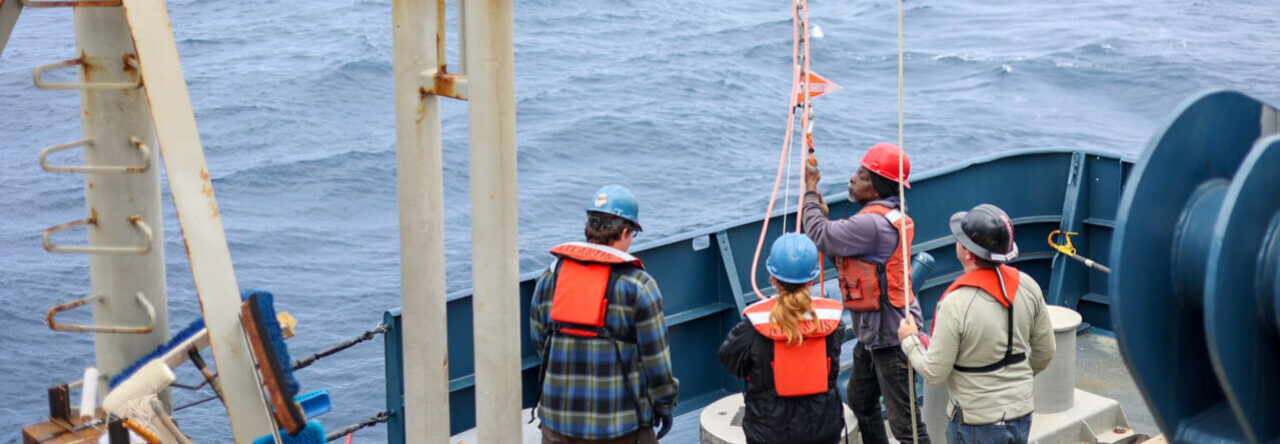
I digress from the main topic though: OBS Recovery. After escaping the confluence of the three systems, the ocean was in a far better condition to recover the devices in despite its continued roughness. Recovery of an OBS can be rather tricky, requiring coordination from those in the bridge and the main deck to spot and maneuvur towards the equipment. Using large rods that can be equipped with rope, it’s fishing time! Not really, the rods are used to attach ropes, or tag lines, to the OBS that allows the device to be pulled onto the deck via a mechanical winch and pulley system. Once on deck, the device is wheeled into the Wet Lab where it is fully disassembled and put away for future use. Hiccups can occur during this part such as the device being too far on the Langseth’s approach or the device requiring more time to respond to the release command sent by instruments onboard. Despite these difficulties though, the crew of the Langseth persists and has successfully completed 2 of the 3 lines required for research!
Of course, not all of the time aboard the ship is dedicated towards the OBS’ deployment and recovery. The periods of time during transit are usually spent for improving the vessel’s functions, diagnosing problems and finding solutions, as well as leisure. This can be as minor as fixing a certain phone falling in the Wet Lab in rough conditions (thanks Riley, rubber bands are very helpful!) to larger projects such as installation of antennae for improved equipment range. There’s also plenty of places to explore on the ship during downtime from the Theatre Room to the Gym; boredom is hard to achieve while on the Langseth.
We are transiting to the 3rd and final line planned out for this voyage. After the deployment of the OBS devices onboard, we’ll be able to utilize the airguns by streaming them behind the boat and firing over the devices. The percussive effect generated will be collected and interpreted by the OBS devices, allowing for the synthesis of seabed imagery! This will take place later into the week; I’ll make sure to go further in detail when the airguns are deployed, stay tuned!
The Mighty A-Frame

Spotting the OBS (Alan, Nick, and Leon)


