One week later and I still find remnants of my internship in my pockets. A shackle pin, zip ties, soldering wire and lots of used electrical tape. Looking back it all happened so fast but it was an amazing experience.
On September 5th at 0400 the silence was broken by the sound of the main engine that was just ignited. Half an hour later I get up excited about the work we had to do but sad since it was my last day on the Oceanus. I have been fortunate to squeeze in one last day cruise before the end of my internship, the objective being to retrieve two science buoys and two gliders.
Mooring work, I believe, is one of the most exciting things the marine tech gets to do. It takes focus, vigilance and excellent communication skills. You have to be aware of your surroundings at all times, ready to foresee what might go wrong.
About half an hour before the retrieval we had a meeting on the bridge with the captain and all the people involved. The head marine tech, Dave, went through each step of the operation making sure that the captain, whose primary concern is safety, agrees all the way through. If not, adjustments are made in the sequence of events or methods used.
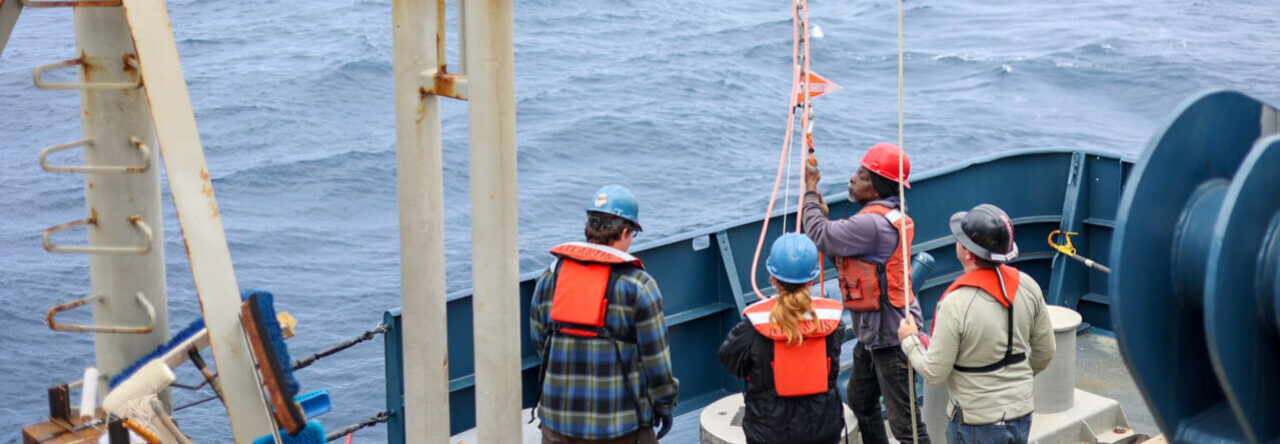
After that, we went down to the aft deck where Dave assigned us specific tasks; who is going to be tagging which of the three lines, who is going to be tending each one, who is going to operate the crane, the A-frame, winch, and capstan, and who is going to strap down the buoy on deck.
What I find most amazing is that eleven people managed to work in unison on our small aft deck through a web of lines and trip hazards, and safely secured a 700 lb buoy that was hanging from the crane, 12 feet in the air and swinging with the swell.
Which brings me to the most important aspect of my internship; the people I had the opportunity to meet and work with. From our stewards Joy and Sean that always prepared fabulous food, the Able Bodies: Doug, Mark, and Patrick who taught me how to work safely on deck, the engineers: Chip, Jay Bart and Dave, who kept me alive in the transducer well and provided all their technical knowledge, the mates: Tony and Todd and captain Jeff Crews who welcomed me onboard and let me hang out on the bridge.
Of course I cannot thank enough my mentors and marine techs Johna, Dave and Toby who were always there to answer my questions and provide all the insights of their profession. I also feel fortunate to have met the science groups from WHOI, Scripps, Oregon State University, the University of South Florida and the University of Washington, who gave me the unique opportunity to learn about ocean bottom seismometers, moorings, oceanographic buoys and internal waves.
Lastly I would like to thank Tami Lunsford and Nandita Sarkar from the MATE program that made this experience happen and arranging for me to work with the R/V Oceanus group.