Author: Jessica Gronniger

Week 3 Aboard the Walton Smith: Everglades, waterways, and CTDs

A new cruise is underway and we were loaded up and off the docks by 7:00 am. This week we are back to CTD measurements, but this time we are doing shallow water deployments down along the Florida Keys and in the Gulf. The objective of this cruise was to characterize changes in water quality and conditions along the Everglades outlets by measuring oxygen content, salinity, temperature, and collecting planktonic samples for later processing. The majority of data collection was gathered from flow through surface measurements. We spent our first day sailing down the keys and occasionally deploying the CTD. However, we quickly found out that the altimeter mounted on the CTD was faulty and was off by 10 meters, which we unfortunately discovered when the CTD hit bottom. Once we recovered the CTD we visually inspected the sensors for damage and flushed them out with fresh water. Luckily, it looked like we pulled the CTD off the bottom fast enough to prevent any damage.

The treat of the day was getting to release a tiny baby loggerhead turtle into the wild for the Seaquarium. We waited until we were in relatively shallow waters and around a decent seaweed trail and gingerly lowered the little guy into the water. We all watched as the tiny turtle swam away quickly disappeared into a little pile of sargassum.  


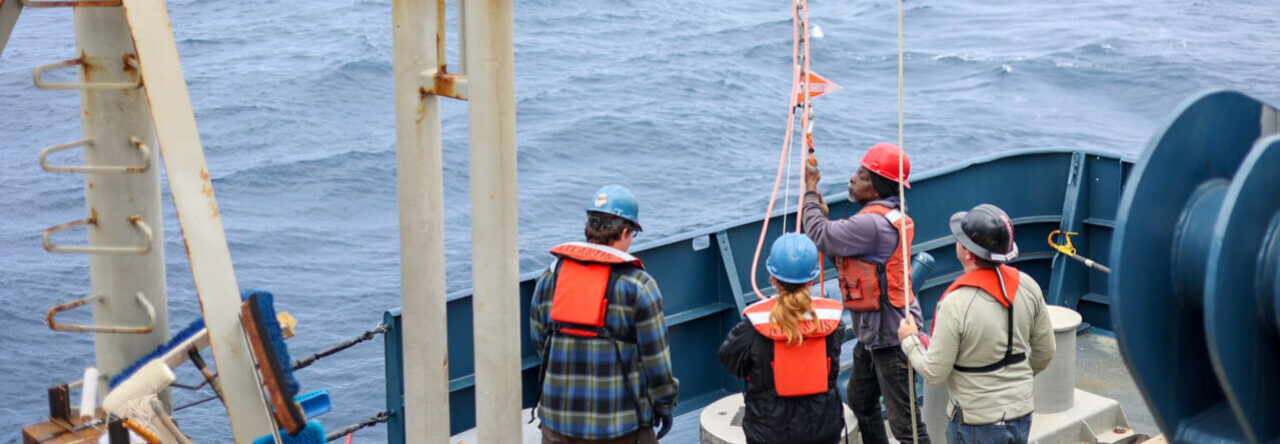
Since a significant amount of data was being collected from surface flow, I got an opportunity to learn to troubleshoot the salt-water intake. We observed a drop in the intake on the computer display and went down into the bow to shut off the intake for a couple minutes. Since we were sampling so close to shore, debris, sargassum, and seagrass can often clog the intake valve, so simply turning off the suction should clear the intake, and indeed it did. We also had some slightly rougher weather, which complicated CTD deployment and recovery. We had to set up a cleat on the back deck and run a tag line through it. Once we did that it was much easier and safer to control the wildly swinging CTD as we tried to drag it back on board.

The week seemed to fly by in a series of rapid-fire CTD deployments interspersed with flow-through measurements. The majority of stations were no deeper than 10 meters so the CTD measurements never took long.

We did have a bit of good luck while out by Shark River on the southern coast of Florida as several dolphins started following the boat around. Crew and scientists alike crowded to the back deck to watch the dolphins play in the wake of the boat. It was a great experience and very fun to watch. Eventually the dolphins got distracted by something more entertaining and were off to other endeavors, and the crew and scientists followed in suit.

On the longer transits between station, Don took some time to walk me through the Seabird software and the sensor outputs, teaching me the electronic side of CTD deployment and data collection. It was fascinating to see the real-time data outputs and the ease with which the software allowed us to trigger the Niskin bottes for water sampling.


We also got our first swim call on this cruise when we found ourselves in calm waters near shore. Since we had to take out the dingy to ensure it was still fully operational, I got a quick ride out around the boat and manage to get a great picture of the Walton Smith out on the water before joining the rest of the scientists on the refreshing and much needed swim call. 

The technical highlight of this trip was that, after assisting with several CTD deployments, I was allowed to run the deck and, under Don’s supervision, I was in charge of deploying and recovering the CTD. I learned all the hand signals to direct the crane operator, the safety measures taken to ensure none of the equipment was damaged, and how important communication is for successful deployment and recovery. I felt like a true marine technician.

On the last couple of days of the cruise I took the opportunity to hone my skills with the CTD. Don walked me through all the sensors again and the expected outputs. We also tried to fix the altimeter but to no avail. While waiting to arrive at each of the final CTD stations I helped the engineers on board check and perform some maintenance on the ship’s air conditioners. I also had the opportunity to speak with the scientists onboard about their projects, which ranged from physical oceanography and marine biology.


Once we were done with the CTD stations and making our way back up the Florida coast, I spent some time up on the bridge where I got my final lesson on knots. I learned several ornamental knots, such as the Turks Head know and Carrick Bend. I also helped the first mate make new mooring lines for the ship, which turned out to be a great opportunity to learn the eye splice.

We made it back to the docks that afternoon and as we helped the scientists unload all their gear I was hit with a bittersweet sensation. That had been my last time out at sea, perhaps for a while, and I will truly miss the sensation of a swaying boat at sea. The internship was an invaluable experience full of lessons learned, skills acquired and amazing characters met, all of which will not soon be forgotten.

Week 2 Aboard the Walton Smith: Tucker Trawls, Shrimp, and Bioluminescence

One week down and two to go. This week we set off on a five-day cruise to collect deep-sea, pelagic zooplankton using a tucker trawl. A group of about 10 graduate students and professors from three different universities came on board and brought along a fully stocked field lab. We spent Monday loading up the gear, setting up the tucker trawl and planning the deployment schedule. I worked with Denis to securely fasten the CTD to the tucker trawl frame, a complicated task as the CTD would be dragged through tons of water for several hours. With the help of several bolts, screws, washers, electrical tape and countless zip ties, Denis and I were finally satisfied that every wire, connector and plug was securely fastened. 


Our first deployment was early the next morning. I groggily climbed out of bed at 4:00 am and made my way to the deck, where scientists and marine techs alike were congregating in preparation for our first deployment. We all worked together to make sure the Tucker Trawl was properly assembled, the CTD and release timer securely fastened, and the net untangled and ready to deploy. Finally, we were ready to toss it into the water. Using the hydraulic crane and several lines, we slowly lifted the frame off the deck, lowered the collection tube into the water and swung the frame off the deck. The last step was to pull the securing line which release a set of cables and opened the net as it sunk into the depths of the ocean. The trawl was going to be dragged along behind the boat for six hours between 500 and 700 meters. As the cruise was accommodating three separate projects, the scientists on board were hoping for an eclectic sample of zooplankton and pelagic, deep-sea organisms. Primarily, the projects involved collecting various species of bioluminescent shrimp so as to dissect and analyze the bioluminescent component of their physiology.

While we waited for the trawl, I was enlisted to assist with the cleaning and waxing of the awnings on the top deck, a tedious but necessary task for the proper maintenance of the boat. The first mate then requested my help to organize the navigation charts, which was the perfect opportunity to learn a bit more about the different kinds of charts and how to read them.

At last, the six hour trawl was complete and the net was dragged back on board and greeted by an enthusiastic swarm of scientists, all eager to see what treasures the extensive trawl had gathered. I can honestly say the crew of scientists was not disappointed as they dragged bucket after bucket of a thick soup of organisms and seaweed into the lab. The next few hours were spent sorting the shrimp, fish, and other invertebrates into neat groups by species, and often, subspecies. They were kind enough to tolerate me as I excitedly buzzed around the lab asking several questions about the nature of bioluminescence, its purpose and the underlying physiology. I even got to observe larval shrimp under a microscope as a professor enthusiastically explained the nature of a double retina in the developing shrimp. Much to my delight, the trawl had also gathered several types of bycatch, many of which were adorable, miniature versions of marine animals. My favorites were the tiny, larval squid and on occasion, the smallest larval crab I have ever seen. Luckily, I was surrounded by a group of biologists that were all eager enough to teach me about the nature of these fascinating deep-sea organisms and their unique biological adaptations.

And so the cruise continued as we tossed the trawl back in the water and waited with baited breath for the next haul of organisms.


After deploying the trawl three times throughout the day and night, we came across our first technical problem. The timed release mechanism that was mounted on the frame of the tucker trawl and provided the crucial function of sealing the collection chamber at the end of the net and protecting sensitive bioluminescent organisms from excessive exposure to sunlight stopped working. It turns out that water got into the previously watertight chamber that housed the batteries and electrical trigger mechanisms and fried the entire system. Luckily, we have highly qualified and capable engineers and marine techs on board that were happy to attempt to fix the problem. We took the trigger mechanism apart, piece-by-piece, and replaced the corroded battery circuit with a new one. I had an opportunity to hone my wire stripping, crimping, and replacing skills as we rebuilt the mechanism.


After waiting a few hours for the silicon holding the circuit in place to set we finally got a chance to test it out. Unfortunately, despite our optimism, it did not work. It looked like the engine in the trigger mechanism itself was damaged so we decided to replace the entire engine, which of course meant undoing all our previous work. But, step-by-step, we took the machine apart and replaced the centrally located engine. After several cut and crimped wires and even threading new holes for the screws (we think there was a manufacturing error where the bolt holes on top of the casing for the engine had no threading) the trigger mechanism was finally fully rebuilt and once again we waited with bated breath to see if our efforts would pay off. Thankfully, it turned out that the engine was once again fully operational, much to our and the scientists delight.

 Much like the days before, the rest of the week involved a series of trawl deployments, monitoring, and recovering. However, on Thursday, the scientists on board allowed me to assist with the sorting of the organisms they collected. They gave me a pair of forceps and a tray of deep-water pelagic organisms and patiently taught me to distinguish between several fish, shrimp, and other amphipods. I spent the day working the trawl and picking through marine organisms, sargassum and debris. The experience was fascinating as I got to observe several deep-sea organisms that few people get to witness in person.


Our final day had a very early morning start that resulted in a pleasant surprise. I joined the scientists in the dark room on their last trawl collection and was delighted to sea the Acanthephyra purpurea, a fascinating shrimp that spews a cloud of bright blue bioluminescence to distract predators, and we were even lucky enough to see it spit out a beautiful bioluminescent cloud. I also got to se several luminescent copapods, pyrosomes, and jellyfish. It was an awe-inspiring experience to see so many deep-sea and elusive organisms up close and personal.

The rest of the day was spent honing my amphipod sorting skills and learning about several new animals, including my new favorite, the phronima, a tiny parasitoid that lives inside a hollowed out salp and supposedly inspired “alien” from the movie by the same name. The cruise was an incredibly mix of technical skills and biological research and was a incomparable learning opportunity that I took full advantage of. A cruise I will certainly not forget any time soon.

Week 1 Aboard the Walton Smith: Knots, Navigation, and CTDs

After making the trek from Nicaragua to Miami I finally arrived at the F.G Walton Smith, a ship that fully lived up to its expectations. Arrival was followed by a whirlwind tour of the boat and a speedy introduction to the crew. Denis, the marine technician on board and an individual who clearly loves what he does, was eager to show me all the tech on board. Within my first hour on the boat I was already learning about the different kinds of servers, connecters and circuits that keep the ship running and reliable.

By the second day on the Walton Smith it already felt like home. An early morning breakfast was followed by a new lesson, this time about the engine room and the ship’s communication methods. A tour of the engine room revealed the complexity of the ship’s inner workings. Huge rotating gears connected to metal casings that house the very guts of the ship fill the engine rooms and intimidate any aspiring engineer. Since the engines seemed to be fully functional and smoothly operating I turned to a new task. The horn on the aft deck was heavily corroded and barely functional so I was given the task of replacing it with a new one. Thus I received my first hands-on lesson on wire stripping, threading and replacing. And so, step by step, I removed the old horn, wires and all, and replaced it with a shiny new one.

Our first cruise was a short one, only two days long, and had the objective of assisting NOAA with a long-term project monitoring and collecting CTD data along a transect of the Gulf Stream off the coast of Florida. On Thursday morning, the ship was fully loaded with equipment and off the docks and into open water by 6:00 am and within a couple hours we were surrounded by nothing but beautiful, deep-blue sea. Since it took several hours to arrive at the first station, where we would be deploying the CTD, I spent the day in the bridge with the captain and second mate where I learned everything from knot tying to celestial navigation. The knots started off easy with a granny knot, but I quickly worked my way up to the significantly more complex Spanish bowline knot. We then moved on to learning about the mechanics of steering a ship, covering everything from pitch directionality to throttle and speed. Finally, we moved onto celestial navigation where I learned the difference between variation and deviation and how to spin a compass to determine the degree of deviation due to the mechanical components aboard the ship. Scrutinizing navigation maps led to celestial navigation and the applications of a sextant. With a huge assortment of eclectic information swirling in my head, I was happy to spend a few hours relaxing on the bow and watching the boat gently sway about on the ocean swells.

After several hours navigating along the Florida coast, we finally arrived at our first station where the NOAA team planned to deploy the CTD. I watched as the CTD was slowly lowered with the hydraulic crane into 600 meters of water. Once at the bottom of the water column, the CTD was slowly pulled through the water, stopping at periodic intervals to collect water samples using a trigger mechanism connected to the fiber optic cable found within the cable used to hoist the CTD. As the massive contraption was dragged through the water column it also collected and transmitted real time conductivity, temperature, and depth readings, which the NOAA scientists eagerly monitored on a screen in the dry lab.

Once the CTD was back on the deck, water samples were partitioned into oxygen content readings, organic compound samples, and salinity samples, all of which were carefully collected, processed, and stored away for future analysis. Since there wasn’t much to do in the way of mechanics or engineering, my role was to assist in the collection and processing of the oxygen content samples, which primarily involved carefully filling bottles with aliquots of water samples and adding two compounds that helped quantify oxygen content.

The NOAA crew was also working on deploying a series of three different drifters; floating computers that use satellite GPS systems to track current speed and directionality. In this case, they were not only testing the efficiency of three different styles of drifters, but also collecting data on the Gulf Stream to assist in calibrating measurements obtained from a submerged telephone cable that measures current flow and speed by recording fluctuations in electromagnetic currents as currents pass over the wire. The team was only too happy to let me assist in throwing the massive computers off the deck and into the Gulf Stream, where we watched them float away with surprising velocity. We started deploying the CTD and the drifters around 6:00 in the afternoon and were not done until about 7:00 the next morning. It was a long and exhausting night, but one full of learning opportunities and unforgettable experiences.


Before the internship aboard the F.G Walton Smith

My name is Jessica Gronniger and I have had what most people would consider an unconventional life. I am half Brazilian and half American but I was born in Italy. Growing up I moved around a lot as my father worked in international education. At 23 years old I have already learned four languages and lived in nine different countries. Perhaps the toughest question I have to answer is “where am I from?” and it’s a question I seem to have to answer a lot. Well, in a life rife with change there are very few things that have remained constant. Among them is my passion for the ocean and a life on the water. No matter where I found myself in the world I always managed to find a way onto the water. I’ve lived aboard a 30 foot catamaran for a month with 17 other people, kayaked through tropical mangroves in Honduras, and spent hours with my college sailing team out on Lake Norman in North Carolina and yet I get the feeling that my previous adventures will pale in comparison to the F.G Walton Smith.

A year ago, I graduated from Davidson College with a B.S. in biology and I now find myself living in Leon, Nicaragua where I am collaborating on Zika research. While intellectual curiosity has often driven me towards lab work I have learned these past few years that I can’t spend my life locked in a laboratory. So, here I am, exploring a way to mix my passion for science with my love of the ocean, and being a marine technician seems to be the best of both worlds. Hopefully this will be the first step towards a future in marine research and a life at sea. I am incredibly excited about this opportunity and I hope I can make the absolute most of it. As my supervisor said, my job now is to be a sponge, and a sponge I shall be.

So here I sit, after a two hour bus ride on a highway that twists between active volcanos, lakes, and quaint rural towns I am finally in Managua (Nicaragua’s capital and location of one of the few international airports in the country) in an airport hotel eagerly awaiting for this new adventure to begin. So stay tuned as my latest journey unravels. I’m sure more exciting developments are yet to come.

Powered by WordPress & Theme by Anders Norén