Author: Chris Horvath

Icelandic Culinary Delights

Before I delve into this blog entry, there are a couple things I’d like to address:

First, in the last entry I detailed our gravimeter aboard the boat and identified it as a Lacoste & Romberg G237 unit, which is in fact the portable unit I will be using when we land back in Iceland.  That unit is taken to various control points around the world where the exact gravity has been surveyed in using some other very sophisticated equipment.  The Science Techs and myself will be taking the G237 to two control points in Reykjavik:  At the University of Iceland; and, outside the Hallgrímskirkja (giant Irish Lutheran Church in the center of town).  The data we get from those points can be compared to the calibration of the Lockheed Martin B210 unit that is secured in the Main Lab aboard the ship.  All the data we collected during the cruise can then be confirmed as accurate and true; though, calibration is done before the cruise as well, and the B210 is monitored throughout our cruise.

Second, there is a website devoted to this cruise, which also includes some blog entries by other members of the team:   

R/V Langseth – Reykjanes Ridge Cruise

I highly recommend that you check it out for some different perspectives.

Iceland is well-known, as most cold-climate Northern European countries are, for its penchant to age fish for long periods of time prior to consumption.  It seems there are a couple methods of doing this that date back to times well before the Vikings settled this island.  So, it can be surmised that they brought these methods with them; though, it is common knowledge that the Inuits of Greenland have enjoyed a fermented dish of birds called Kiviak for countless generations.

The preparation for Kiviak begins when seal meets club.  After much ado about seal clubbing, a small party of Inuit men (likely said clubbers of seals) scale sheer cliffs,  armed with loosely woven nets on 20ft flexible poles and recently acquired seal-skin sacks.  It is nesting season in the Arctic and these cliffs are choice real estate for Arctic Auks.  One-by-one as the birds leave their roosts, they are snared in the nets and brought back to Earth, where the Inuit men promptly break both wings and stuff the living birds into the sack.  This technique is repeated until about 500 flopping auks have been wrangled.  The sack is then sewn shut, buried under rocks so as to keep at bay the hungry mouths of Polar Bears and Arctic Foxes, and left until Winter where they are brought out for only the finest of occasions (weddings, birthdays, and – I imagine – the occasional bachelorette party).  

But, I digress…

In Iceland, one method for aging fish is to hang the catch on hooks, in an open shelter with a roof but no walls.  This method made sense during the first days of settlement, since the largest predator on the island were foxes; and, hanging the meat high enough significantly reduced the number of thefts and fox-sized bites missing from the wettest, smelliest portions of the fish.  At times however, ice floes brought with them the very same Polar Bears from Greenland, who were now quite ill-tempered having wasted a good portion of the prior year trying to get a mouthful of rotting auk.  Also, the limited number of catches made in a season made it less amenable to advertise your food stores for all neighbors to see, since disagreements over property were typically settled with the meeting of axes.

So, burying fish became all the rage.  As a result (it’s assumed that) dinner parties were cancelled, invitations “lost in the mail”, and the off-shoot stationary shops of the seal-skin industry went by the wayside.  This method was quite simple:  find sandy hill; dig shallow hole in hill; toss fish in hole; bury with sand and gravel; top off with stones – so as to press out the juices; dig up in several weeks; Bon Appetite!

Whether by accident or insight, this method produced an altogether wonderful (or terrible) discovery, depending on your predilection for all things putrid.  Greenland Shark, or Hákarl as it’s known locally, is common in the waters off Iceland; but, the meat is naturally toxic due to the high concentrations of urea and trimethylamine oxide.  The elevated level of these chemicals make shark blood mostly isotonic to their environment, allowing them to maintain osmotic balance with seawater.  While it’s true that most shark meat contains the same chemicals (see Bullshark, and River Shark), the Hákarl is particularly dangerous.

*Strangely enough, the most common shark steaks you will find served in restaurants in other parts of the world belong to the families Alopiidae and Lamnidae (Thresher, Mako, Salmon, and Great White Shark) which are partially warm-blooded due to aerobic red-muscles connected to the core of the shark that generates heat through counter-current exchange.  Evolution – wee!

The typical preparation involves beheading the shark, then burying in similar fashion, only with much larger stones on top, for 6-12 weeks.  When Hákarl is aged in the burial process it is called Kæstur Hákarl.  The meat is then chopped into large chunks and hung up to dry for several months.  Of note, during the fermentation process the urea is broken down by happy little bacteria who produce ammonia as their waste.  This provides a not so palatable balance between ammonia and rotting fish – though I’m told it’s quite a treat.

It is also worth noting that whale is sometimes aged in this process; though, I’ve only found melted whale fat, and fresh-caught seared whale steaks.

Now, I must address the many suggestions put upon me by several of you regarding the indelible Puffin.  Yes, Puffins are cute.  Yes, Puffins are numerous.  But, no they are not here right now.  They aren’t nearly as big as on TV.  And, it’s going to be pretty darn hard to find a Puffin Burger (Lundi) out of season.  Though, I’ve heard tell of a place…I’ll have to get back to you on that one.

Possibly more than you wanted to know about what we do

Contrary to popular discussion overhead in the galley, there is a point to all this drifting and isolation.  We are here to affirm assumptions from lands far away.  To stand firmly on ground never before tread upon – so to speak.  To discover the secrets of a land not yet explored.   At least so I’m inclined to believe.

My job is fairly straightforward.  I stand watch over the scientific equipment collecting various types of data, by monitoring the computers designed to record the data in real time and help troubleshoot and launch the equipment required to retrieve said data.  I suppose a brief walk-thru is in order to fully understand what we are collecting and how it can be considered accurate and true.

We are here to map, analyze, and determine the differences in how the earth’s plates are interacting south of Iceland along the Mid-Atlantic Ridge, in an area known as the Reykjanes Ridge.  To quote the Project Summary for per Hey, Ramirez, Hoskuldsson:  

“The project is month-long marine geophysical expedition to collect the multibeam, magnetic & gravity data that would provide a definitive test between the fundamentally different thermal & tectonic hypotheses for exactly how the Iceland plume caused the reorganization of the Mid-Atlantic Ridge south of Iceland.”

In layman’s terms:  When thermal and tectonic forces are acted upon this ridge, how do they interact over time and situation, and is there a pattern to this interaction by which we might change the perspective of the scientific community for how Iceland has formed and will continue to form in the future.

In the short term, this can have significant impact on Iceland’s economy.  You see, there is an invisible barrier around every country bordering a body of water touched by another country.  It is called the Exclusive Economic Zone (EEZ), and limits all commercial offshore activity within the zone to the country of ownership.  This is pretty darn important when you consider that Iceland is in the middle of the North Atlantic, about the size of Indiana, and only about 40% of it is reasonably inhabitable.  It’s so important that the country’s governing body for all things related to geology, geophysics, and plate tectonics sent a representative (his name is Sigvaldi) on the Langseth to develop a case for Iceland to expand its EEZ to include the Reykjanes Ridge all the way southwest to our survey location and beyond.  This would be a huge development as Norway, Scotland, and Denmark all are looking to exploit these waters for their potential as sites with huge deposits of oil and heavy metals, fishing, shipping routes between Europe and Greenland/Canada/US, strategic military advantages, and (to a lesser degree) whaling.

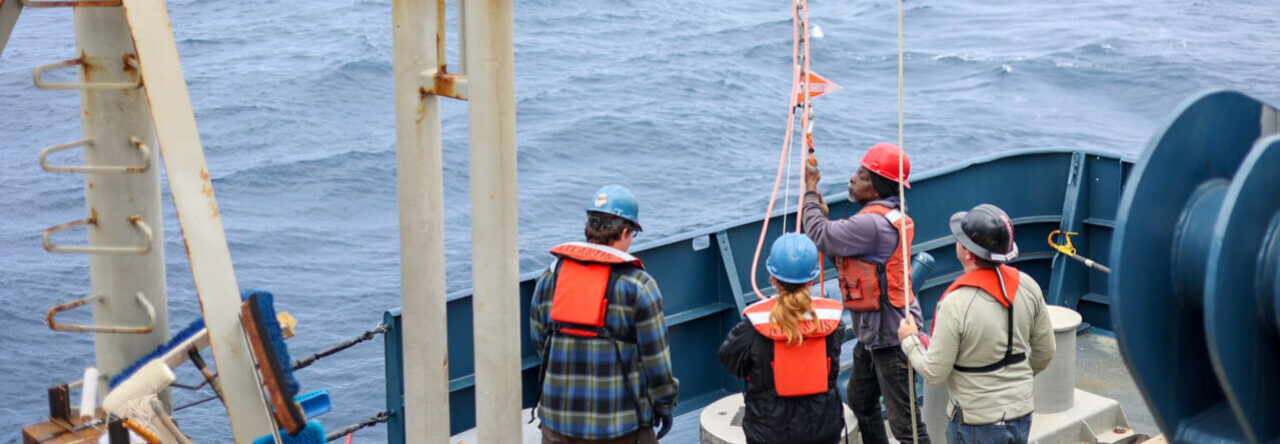
The first type of data we collect is magenetic, and we do this by deploying a tethered Geometrics G-882 Cesium Marine Magnetomoter.  “Maggie”, as she is affectionately called, resembles a stinger missile with a bonnet on her noggin.  She is launched from the Main Deck, Starboard Aft of the Stern, by at least two technicians:  One to apply the Van Sumeren technique of “gently” heaving her overboard; the other to man the hydraulic winch, which spools out the designated 200m of powered cable.  Due to our optimal surveying speed over ground of 10.5kts, she rides quite high in the water as she measures the magnetics being emitted into the water column.  This is done by recording the changes in pressure that occur in a Cesium vapor vaccuum-sealed cylinder within Maggie.  Typically she is reading the magnetics from the earth’s crust some 1000-3000m (3000-9000ft) below where she rides in the water column.

The Earth is magnetically polarized, like a battery, with a positive and a negative point existing typically near the North and South poles.  Over time, the magnetic field surrounding the Earth can swap polarity, and has done so since its inception with little fanfare.  Newly created or recently exposed crust will take on the polarity characteristics relative to its proximity with the poles.  Over time, these values can diminsh.  This constantly updated/recorded reading from Maggie can tell us two things when values elevate:  That there is thermal activity due to volcanism occuring that is creating new crust, such as in the deep trench located in the middle of the ridge where there are hundreds of volcanoes seen in a single pass of the vessel (we call this location the Axis, as pertains to the meeting of the Eurasian and American plates); or, when the values abnormally shift over locations outside of the Axis, where we can sufficiently determinwthat there has been tectonic reorganization occuring, which leads to much older layers of the Earth’s crust being exposed next to relatively new ones.

Maggie is a delight to work with when she is attached to the boat, but is tempermental with heavy seas and high winds and attempts to retrieve her must be done in the worst and most dangerous of conditions.  I say attempts because after retrieving all 200m of cable early last week when we stopped getting magnetic data, there was no Maggie.  $20,000 in the drink.  Luckily we had a spare onboard, but should this happen again we would be unable to record this very important data.  So, when storms sweep through, we pull her out of the water.

Side note on storms, of which we have weathered three major systems.  Last week there was flash flooding, baseball sized hail, and 60+mph winds back home in Traverse City.  On average, storm systems take between 3-6 days to reach us, and those that pass through the Great Lakes are almost guaranteed to head right for us after leaving North America.  It’s not so much the precipitation that we worry about, but the high winds.  That same storm system hit us strongly a day and a half ago, resulting in sustained 50kn winds and waves as large as 9m (30ft!) until early this morning.  Because of the length of time of said winds, we are projected to have 4-6m waves for the next four days – uggggh.  That means everything you care about needs to be strapped down, walking down hallways is a workout, and sitting in a chair during watch can be hazardous to your health.  That also means sleeplessness and seasickness rear their ugly, conjoined heads.  It’s best to sleep wherever you can whenever the moment takes you; be it barricaded (taco’d) in your bunk, in the Movie Room, or even in the Main Lab (though, sleeping during your shift is highly frowned upon).

The second type of data we collect is gravity.  It is far less elegant and far more complicated than magnetic.  In the Main Lab there is a Lacoste & Romberg G237 Gravimeter, basically an encased gyro with various sensors measuring roll, pitch, heave, as well as several other values, and most importantly the strength of gravity in a given location of time and space.  The data is constantly being updated/recorded and helps us determine one of two things:  Either the thickness of the Earth’s crust; or, the density of the materials that make up the layers of the crust.  Combined with a extremely low frequency sonar system (called a Sub-Bottom Profiler) and core sampling, can provide an incredibly accurate picture of the geology and geomorphology.  Unfortunately, the latter requires that we stop moving and, due to time constraints from bad weather, has been scrapped for this cruise; and, the former (Our Knudsen 3.5kHz Sonar) had to be turned off when the bottom became drastically uneven, providing poor quality data, and also operates at a frequency that can cause problems with our EM122 Multibeam Sonar used for Bathymetric data.

Which brings me to our third type of data, the one I was trained in at Northwestern Michigan College, and consequently the reason why I was selected to be a part of this cruise:  Bathymetric data.  This is collected using our Kongsberg EM122 Multibeam Sonar operating around 12kHz.  The sonar has an encased piezoelectric crystal that vibrates hundreds of thousands of times per second when electricity is applied to it, sending out that energy in the form of measureable acoustic pulses.  These pulses reflect off targets in the water column and return to the sonar where they are “heard”, and provide us with an accurate measure of depth in a given point on Earth.  As with the prior two systems, knowing our geographic location on Earth is essential to collecting accurate data; and, they are all integrated with our multiple GPS/Satellite-based positioning systems located at unobstructed points on the top of the vessel.

The more depth measurements we can collect with each ping of the multibeam the more defined picture we can see of the shape of Earth’s crust.  This is by far the most interesting data to stand watch over, as it is projected on the monitors in a three-dimensional (and very busy) display.  Not only are we keeping an eye on the 3-D Terrain Modeler, but also the 2-D Geographical (Seafloor Map), the black and white 2-D Seabed Imagery, the convuluted Water Column display (which provides us with backscatter data – used to see thermal activity in real time), and various readouts of motion and Sound Velocity which help determine the quality of data being collected.  Sound Velocity (or the speed of sound in water in this context) is extremely important as its measure allows for us to calibrate the sound pulses on the fly so that they return to us in a straight line rather than with a bend (which would give the illusion that the distance to the bottom is longer/shorter and in a different location than it really is).

We take measurements of Sound Velocity on this cruise by launching XBT’s manufactured by Lockheed Martin Sippican.  It is a bullet-shaped lead weight attached to two thin copper wires within a plastic mortar tube that is released from the Streamer Deck.  Those wires are linked to a powered cable that connects to the lab, where measurements of Temperature, Salinity, Pressure, and Depth are recorded.  Typically, we use the T-5 model which is rated to 2500m.  It falls quite rapidly and within five minutes has reached the end of its wires, whereupon the wires are severed and the probe lost to the deep.  Two important things to remember when launching an XBT:  First, don’t let the wires touch any metal or it will short out (everything is metal on a boat); and second, don’t fall overboard!

Thank you for bearing with me in this blog as I delved into the depths – so to speak – of what I do while working aboard the R/V Langseth.  Future entries will cover the leisurely options I have to pass the time.

Settling in New New York

It’s about 65 steps from my room to the Lab, when the weather is good; or, somewhere in the neighborhood of 85 when the seas are unsettled.  The ship can be quite large if you don’t know where you are going, and 65 steps can very easily turn into 500+, which consequently is how I spent most of the first two days – aimlessly wandering the hallways, walking down the same pathways from different directions, and generally having a real hard time keeping a face like I knew what I was doing as I passed by the same deckhand for the fourth time.  It’s truly a maze of watertight doors and bulkheads.  To get from one place to another, chances are there’s at least 7 different ways to go about it, but only a couple that make sense.  The good news is that it’s only temporary, and with a little patience and some proper emulation of those in the know, you can figure out the errors of your ways in quick fashion.  Truth be told, once you know where you’re going, it can really be a small (small, small, small!!!) space.  But, let me not get ahead of myself, this is my home for 4.5 weeks and I am the new roommate, nervous to intrude on common spaces and make them my own.

There is an established order to things around the ship, and the Main Lab is no different.  There’s the Science Tech lead, Bernard, son of an Irish immigrant and native of New York.  He works in the lab with Bobby the IT Tech, a Texan who lives in Jersey.  And, Rob the Temp Tech who usually works on a different research vessel, but was brought in for this cruise due to his experience with Kongsberg multibeam sonar systems.  Rob also is from New York.  I can sense a trend here.  Work on a research boat, and chances are you’ll be near NYC.  There are other options in Virginia or all along the West Coast, but I gotta admit that it’s kind of refreshing to have this New York attitude in the workplace.

My shifts have been set, and I’ve been able to settle into a rhythm quite nicely.  I work two 4 hour stints in the lab, both from 8-12.  This gives me a fair amount of time to eat, sleep, clean, do some laundry, and a couple of hours to find peace of mind – which I’m finding is quite essential to maintaining a comfortable shipboard environment.

Beyond personal space, I’m finding that the little things begin to make a huge difference.  Hot water in the showers, ample supplies of bacon for breakfast, that feeling I get when I take off my boots at the end of the day, a working thermostat in my room, and an ice cold can of Coca Cola that the cooks sneak me during dinner.  I cannot emphasize the meaning of the last item in the list enough.  A can of Coke is worth it’s weight in gold on a ship at sea.  You can horde it, drink it, trade it with other crew for any number of stashed luxury items, and with a little finesse – flaunt it.  Money means little out here, reduced to equals we share the same ambitions in life – eat, sleep, Coca Cola.

Speaking of the eating, the food has been very filling and pretty good.  It is a bit heavy, and so my appetite dwindles at times.  I’m beginning think that serving potatos and gravy with every meal is a national past time in the Philippines.  But, the ice box filled with Snickers Ice Cream bars kinda makes everything okay.  There’s Herwin, the Costa Rican chef who truly lives the ‘Pura Vida’ lifestyle.  And my main man June from the Philippines, who cooks great Thai food.

Whether it’s Chili Lime Salmon with Beans and Cilantro, or a good ole American French Bread Pizza, where the cuisine goes – so goes the general mood of the crew.  And, let me tell you these guys are good at predicting what the crew wants.  Crave Philly Cheese Steak sandwiches and chances are you will see its kin in the galley within two days.  The dark art of ESP is real and it’s being practiced openly in the presence of the pyre, and the townsfolk could not be happier.  Oil soaked torches ready to light timber become red and white cans raised in a unison, and accusations of witchcraft or black magics become songs of praise, valor, and jalapeño cheddar poppers.  And I revel in every last bite.

Welcome to Iceland

*This post was written on the 12th of August but did not post due to technical difficulties.

It’s been 95 days since I accepted this amazing opportunity to work aboard the R/V Marcus G. Langseth out of Reykjavik, Iceland.  Sandwiched in the wait was a 19 day delay due to the ship succumbing to engine troubles.  The trip took 15 hours to get from door to door.  And, I had gotten exactly 1 hour of sleep by the time I touched down in Keflavik at 9:00AM local time.

In my limited experience travelling abroad, I have realized that often times in life, slowing things down makes a big difference in the long run.  Wary from travelling, I decided it would be best to park myself in a quiet corner of the airport floor and double-check my trusty Lonely Planet guide to Iceland for travel arrangements.  It turns out that the private busing companies offer very comfortable trips in motor coaches directly to your destination in Reykjavik.  They even have WiFi on the bus!

www.longitudebooks.com/images/book_large/ICL06.jpg

It must have been due to some subconscious need for a feeling of home in a strange land that the first two people I met in Iceland (outside of the amazing staff at Loft Hostel) were from California.  I was Feeling pretty exhausted from the combination of nerves and excitement, so I spent most of my first full day in Iceland stumbling repeatedly up the stairs from my room to the backpackers lounge and back down again.

On the second day, I rolled out of bed around 10:00AM and fought off the urge to go back to sleep.  I’ve travelled all this way to a place so remote, there was no way that I was going to miss the opportunity to experience the amazing things this island nation has to offer.  I packed a day bag, and put boot to pavement on a self-guided sightseeing tour.  If there’s one thing I can impart to others, it’s that following your heart will unexpectedly you in remarkable situations.

I could feel that there was something pulling me West, and as I walked I felt that I was being funneled ever downhill (It’s ridiculous to think that all the roads in Iceland only go downhill – but it sure feels that way).  Before I knew it, I found myself crossing a busy highway and standing before a nature preserve in downtown Reykjavik.  The preserve is a series of marshes and ponds that provide habitat for nesting migratory birds.  In cheeky Icelandic style they have added touches like this bird-listening chair: Basically you seat yourself in between two cone-shaped listening devices attached to articulated arms, place them up to your ears, and aim that at your desired wildlife.  I must have looked ridiculous sitting there in the rain; but, it was totally worth putting my ego aside and trying something new.

Most of the buildings surrounding the preserve had a very careful blending of old and new architecture.  One in particular stood out more than the rest and I could feel that there was something waiting for me inside.  So, I quickly shuffled over to the entrance and not knowing what the letters on the outside read, I promptly smashed my nose into a sliding glass door.  Use the other door…got it.  As it turns out, this was the Building of Administrative Offices for the University of Iceland.  Dr. Ármann Höskuldsson, Volcanologist and the Co-Chief Scientist on my upcoming cruise had an office in here.  I figured, what the heck, I obviously came here for a reason.  I tracked down some very helpful faculty who let into a back hallway.  Fortune was smiling and I managed to catch Dr. Höskuldsson shortly before he left for the weekend.  He entertained my questions about the cruise, and when we began to share “sonar war stories” I was shocked to find out that he and his students use the exact same Kongsberg EM3002 multibeam sonar system that we use at Northwestern Michigan College.  To the gang back at the Great Lakes Water Studies Institute, we need to get convince the board to purchase us a helicopter.  They air drop their survey vessel in inland lakes!  I’ll see if I can get a copy of the video from Dr. Höskuldsson for a future post.

I can’t help but think that I was in the exact place I was supposed to be.

Fast forward through the days in Reykjavik to the final night on shore before we set sail.  (I will revisit my charming experiences during those days, in future blog entries)  This ship is so much bigger in person.  The sheer amount of equipment, cables, catwalks and portable laboratories leaves this feeling that the sides were peeled away, exposing the insides of a great mechanical monster.

There is so much going on that it was easy for me to feel lost; the maze-like corridors often lead you right back where you came from.  I surmise that I got lost at least a dozen times in my first five hours on the boat.  Out of the generosity of the crew and science team, I was given a 3 person room with an ocean view all to myself.  I feel very humbled and a tad embarrassed about the whole thing; but, after sleeping in a room with 7 other people at the hostel (including one night where I had to wake up a stranger sleeping in my bed), I’m not complaining one bit!

Everyone currently on-duty deck side is on edge.  Apparently, Iceland Harbor is at high risk of stowaways.  Ha ha!  Little do they know that we’re headed right back to Reykjavik in a month.  Perhaps they think that if it worked for Leo, it can work for them…then again, he didn’t have the best ending to his story.

As I sit in my berth and think about all the amazing people I’ve connected with in the past year, the support of my friends, family, and my girl, and the incredible opportunities that the hard-working people at Northwestern Michigan College and the Marine Advanced Technology Education Center have given me, I can’t help but feel as though I’m not alone on this trip.  On that note, it’s time to go up top to catch the Perseids Meteor Shower and wish someone special back home a very Happy Birthday.

Powered by WordPress & Theme by Anders Norén