Author: Cameron Carbone

Stateside

Local Time – 1130


As the majority of the heavy lifting comes to an end, both teams from Scripps and WHOI were pleased with the amount of work completed in the last week considering the challenging time loss to the original schedule. Despite a MOVE recovery and a few PIES that have to live a little while longer at the sea floor, the team was still able to recover the data from the last MOVE sight which was significant.

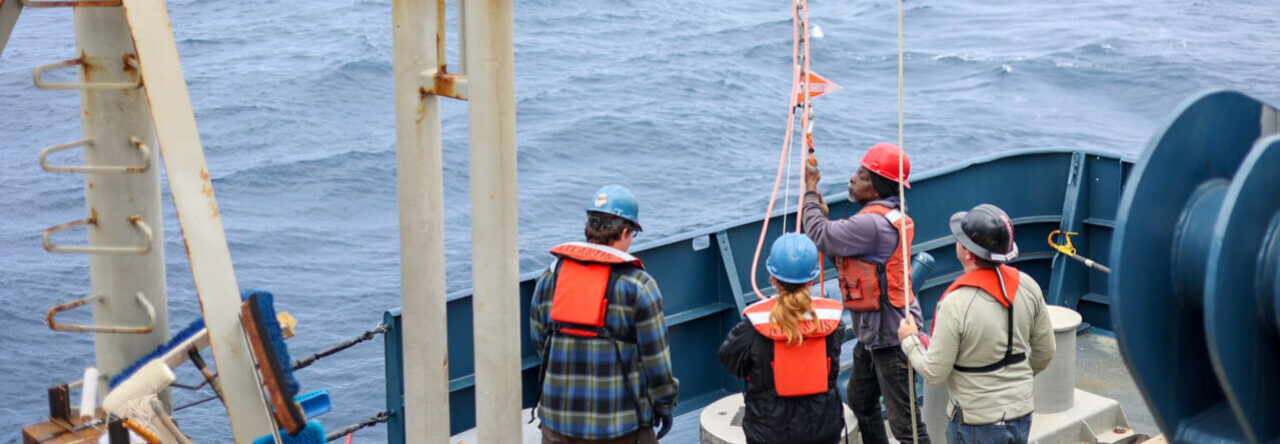
WHOI’s NTAS buoy recovery op was successful again with no injuries or major damage to any of the instruments. Below you can see the method of recovery through the A-Frame of the stern rather than using the crane on the port side of the ship as performed during deployment. The A-frame has played a huge roll in just about any op where gear was moving in or out of the water. It is truly an incredible piece of engineering, for just about every major oceanic research vessel is equipped with one usually located off the stern.

When approaching the buoy for recovery we met some of the locals that used mass of the buoy as protection and or a feeding ground. BIG mahi-mahi, tripletail, triggerfish, and many more species of fish accumulate underneath these buoys over time. The smaller fish use it as a source of cover and the larger fish use it as feeding territory as there are so many smaller fish around. As a kid growing up in central mass, I am rarely exposed to these species of fish so it was very cool to see so many of them around the boat during the duration of the recovery op.

In addition to all the deck work exposure, I was given the opportunity to drive the Deck Box to release a MOVE mooring. The concept of acoustic communication with our equipment several thousand meters below the surface is pretty wild. When listening for return pings from the release transducer, I was able to hear what was most likely dolphins communicating as well. With the hydrophone picking up all major ambient noise in the general vicinity of the boat, it’s incredible how loud the ocean is.  

When evaluating all data for completeness, just about every instrument (for both parties) demonstrated a proper log history with the appropriate time range of data. This was very pleasing to see as these instruments spend roughly 12-24 months in the water. Upon return of the scientists to their home campuses, the data will be further analyzed and added to the long-term curve, for these projects have been going on for many years now.

As the Pisces makes its steam back to port in Morehead City, NC a little bit of down time has been well rewarded to the crew. It has been a pleasure and an amazing opportunity to work amongst some of the leading scientists in oceanographic research. I have learned so much over the last three weeks and will be bringing this knowledge and experience with me to the Arctic in the fall aboard the USCG Healy for the SODA project (Stratified Ocean Dynamics of the Arctic).

Ironically the medical officer on board the Pisces used to live in Alaska for 9 years, so I was able to speak with him regarding some good fishing waters and must see places in Anchorage and Dutch Harbor. I’ve never been farther west than Montana so I am very excited to see what life is like in the higher latitudes. Virtually opposite to this tropical voyage, Alaska will be quite the turnaround for temperatures and dynamics of the elements.

In several hours we will be docking in Morehead City, NC and I will be stepping on land for the first time in twenty-three days. That should be interesting. We will offload all the gear to their respected homes on either the west coast to Scripps or the east coast to Woods Hole.

This experience has been an opportunity of a lifetime and I wish the best of luck to any and all future student that finds him or herself aboard a research vessel for a MATE internship.

– Cam


All Hands On Deck

– Local Time 22:13 –

As we headed into our second week of our tropical voyage, both Scripps and WHOI teams knew that a lot of hard work was on the horizon. Due to several unexpected detours to the original travel plan, the ship is running roughly 4-5 days behind schedule. But like any experienced scientist or engineer knows, one must adapt to variability and even more importantly look for new solutions to the existing problems.

That being said, all personnel on the ship have been dialed into making the most of daylight (and sometimes hours into darkness) to ensure that the projects at hand will be completed, new equipment will be deployed, past gear will be recovered, and all data will be properly logged.

Following arrival to WHOI’s NTAS 17 drop site coordinates (approximately 15 Degrees N, 51 Degrees W), it was time for everyone to get their game face on. Roughly 4600 lbs of buoy, state of the art weather instruments, 5 miles of cable and rope, and a 9,000 lb anchor made of stacked locomotive wheels all had to be attached flawlessly and sent over the side of the ship for its yearlong vacation in the Atlantic Ocean.

This WHOI surface buoy is equipped for meteorological and oceanographic measurements to further evaluate air-sea interaction processes that relate to climate variability. NTAS, or Northwest Tropical Atlantic Station is one of three surface buoy sites that provide the sea-level and subsurface weather driven data to Woods Hole for further analysis. Dominant forces acting upon the buoy in this particular location are the Atlantic trade winds, convergence of waves along the equator, and heat exchange between the ocean’s surface and the earth’s atmosphere.

The operation was extensive but with Ben playing QB everyone was able to successfully play their role and do their job to ensure execution of the task without any injury to the crew nor the buoy. As the huge mass was very carefully craned over the port side of the main deck, I had the job of tag lining the canopy of the structure as it was slowly meandered off the side of the ship. It was pretty cool (and little nerve racking) to be given a significant role during arguably the most critical point in the operation. Once Ben pulled the release clamp to slam dunk the buoy into the water, my tag line was connected to the overhaul ball, or better known as the “headache” ball, that had to be immediately pulled away from the top instruments to ensure nothing was hit.

The NTAS buoy’s canopy houses instruments that measure elements like wind speed and direction, precipitation levels, barometric pressure, relative humidity and temperature, as well as short and longwave solar radiation. All instruments provide data with “near real time” telemetry back to Woods Hole, MA at an hourly rate. Regular sample rate data is storred on a central logger within the buoys chamber and is evaluated once the buoy is recovered. Wave height and direction as well as subsurface currents are broadcasted on a near real time scale also. 

In addition, the scientific project composed by Scripps called the MOVE project, or Meridional Overturning Variability Experiment, was the other major theme of this voyage. It is controlled by a set of subsurface moorings that monitor the mass, heat energy, and freshwater transports ranging the entire water column of the Deep Western Boundary Current of the Atlantic Ocean. Anchored to the sea floor, the cable is stabilized by articulated sections of glass balls where the top element sits roughly 30 meters below the surface. A cable is the backbone of the mooring spanning its entire length, serving as a means of inductive communication between all instruments. It primarily logs the oxygen rich deep water flowing down from the arctic amidst its role in the atlantic circulation which turns into the gulf stream heading back north as warm water.

Equipped with microcats measuring salinity, conductivity, and depth, the mooring can reverse engineer a mass value of water moving between the two sites as a function of density at various depths. This mass flow rate of water is measured in Sverdrups (Sv), where one Sverdrup = 1,000,000 cubic meters per second. The cable also houses a controller with a modem for logging data and can serve as a relay station for acoustic communication as well. During this leg of the trip, it was deemed that the boat would not have enough time to recover one previously deployed mooring, so it was decided that we would hover over the site to acoustically retrieve the data.

Similar to using the Deck Box when talking to acoustic releases, we can hang a transducer over the side of the ship and can send specific frequency commands to the modem to retrieve the data accumulated over the last two years. This was crucial considering the ongoing time crunch to fit in as much significant work as possible, for it is unclear when the next available time to physically retrieve the mooring would be.

The crew has put in some serious work days the past week to make up some time. It has been a grind for the majority of time spent off the deck was consumed primarily of eating and sleeping. It’s been a fun grind though because every op has been successful and once we finish each one it is apparent how much teamwork is required to put a piece of science in the ocean that’s consumed countless hours of preparation and building. These instruments have traveled thousands of miles on land and then a few thousand more on water to their chosen deployment sites. Once they are finally in the water it is a great thing to see and feel.

– Cam


Smooth Seas and Proper Preparation

Local time 2230

Greetings – 

The first week of sailing has given us nothing but incredible weather and relatively calm seas. Getting to meet and know the crew has been very cool. It seems like there is a good dynamic of relationships between the crew whether it be returning personal or newcomers like myself. There is definitely a strong sense of humor buzzing around the ship. It seems like holding a solid dose of humor each day is key to making long trips at sea that much more enjoyable so I’m loving the vibe. 

I am learning new things every day from various crew members, not just only the scientists. Due to a solid amount of transit time during the first leg of the trip, there has not been a lot of extensive work to be done, however, I have been able to fill voids with some acoustic testing, preparation for future operations, and some initial calibration tests to some of the major scientific equipment. 

I had the opportunity to acoustically test the functionality of six acoustic release mechanisms that are used to secure subsurface moorings attached to an anchor on the sea floor. These underwater moorings span the majority of the water column when in position but do not actually hit the surface. The top elements of the mooring lines sit roughly 30 meters below the surface when most stable. A series a glass ball floats are attached to the line in an articulated fashion to stabilize the entire length of the structure. Various external forces such as strong currents however can push the entire mooring to some significant angles off axes to its theoretical position of being perpendicular to the sea floor. We will be replacing three of these moorings that Scripps are using to conduct circulation flow patterns of the Atlantic.

In addition to some acoustic testing, I was able to help mount radio, strobe, and GPS beacons to the top elements of the new Scripps subsurface moorings. These are used as ways of communication if for some reason the cable of the mooring broke during its service time. This way once it reaches the surface, the beacon would begin to transmit where Scripps or another party could formally be able to recover and locate the gear safely. 

Another significant apparatus on board are Pressure Inverted Echo Sounders, or PIES. These PIES sit mounted within a barred frame that is firmly mounted to these rather bulky and heavy tripod stands. When placed in their desired locations on the sea floor, the tripods act as a stabilized anchor for which the echo sounder can properly send its soundwaves safely from a slightly elevated platform off the bottom. A total of two PIES will be deployed on the latter half of the voyage. 

Furthermore, the team needed to unspool several thousand meters of cable from the wooden spools to the ships main trolling winches.  When deploying these long cables beneath the main structures, the large winch allow for an easy path through the A-Frame above the stern. The angle of deliver keeps tension and dynamic loading at an optimal factor of safety value. Very similar to spooling an arbor with fishing line, properly distributing the line from end to end of the winch is essential for managing the given space as well as making life much easier when deploying the line during an opp. Much of the gear communicates inductively, so it is vital that this wire is secured properly to all significant pieces of gear that goes overboard. This system enables you to mount and safety check any desired apparatus to the mooring cable during the operation of deployment. 

Prior to making a pit stop in Puerto Rico to pick up a medical officer and another engineer, a primary CTD test was required. Two separate dives were performed, one accompanying WHOI’s three acoustic release mechanisms, and another holding Scripps acoustic releases, as well as 14 “microcats” that will be recording CTD data along mooring cables at various depths within the water column.  

Nothing but low 80’s, mostly sunny, and variable winds in the forecast. As a Massachusetts native, consistent weather is in England is about as likely as the Browns producing a winning football team. Yeahhh I know I’m a spoiled Bostonian with sports, but this level of consistency of weather is something I have yet to experience. It’s been absolutely unreal. 

Currently in route to WHOI’s surface buoy, I’ll have plenty more to share after the 4-day steam and the recovery/deployment. Stay tuned!

-Cam

P.S. The lone beach chair in the crow’s nest cargo bin was a clutch find. Great place to write a blog and let the wheels breathe after a long work day. We’ve been blessed with some killer sunsets on these Caribbean waters. This one is setting behind the southernmost island of Turks and Caicos about 10 nautical miles beyond the horizon. 

Ready to Depart!

All packed and ready to make the trip to the naval base where the NOAA Pisces, the research vessel we will be traveling on, is stationed preparing for its 3 week trip out to sea. Just spent my first night in Jacksonville at a local hotel. Never had a king bed to myself before!

I can’t wait to see the Pisces in perosn and get to meet some of the crew today as we will head to the base for the first time. Today we will be making last minute cargo additions as well as preparing final paperwork and reviewing the project objectives to be completed at sea. 

Sunshine has broke through this morning as the tropical storm Alberto pushes up onto land after making its way through the gulf waters. Hopefully the weather will hold off as we depart tomorrow morning. All packed and ready to go! Can’t wait to be apart of some great work that will be conducted over the next few weeks. 

Powered by WordPress & Theme by Anders Norén