Author: Amber Batts

Multibeam/Coring Cruise

Well, we are currently heading back to Lewes, Delaware after completing leg two of the Navy Multibeam/Coring cruise.  As always, the science team was awesome.  We had terrible weather and had to spend a night at the docks at Woods Hole but still managed to get more than enough data needed from the coring.  Unfortunately our Vibracorer was too large so we were only able to use the gravity corer and the multicorer.  Either way, we collected lots of mud!  And worms!

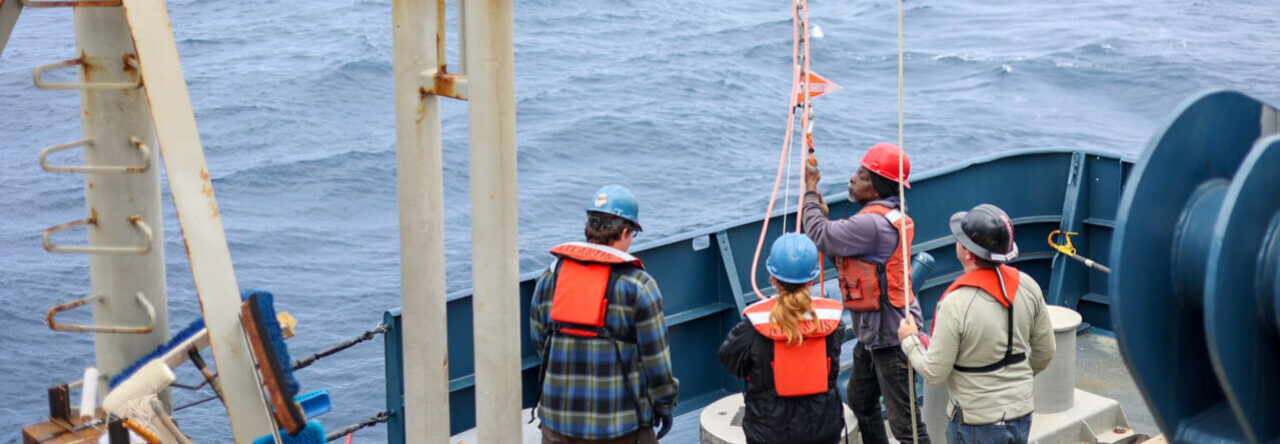
 Operating the A-Frame

I was very fortunate to meet family I had never met while we were docked in Woods Hole.  They happened to be there for a week and my mom sent them to the boat.  They showed me around and gave me information of the marine biology family history I have there.  It goes back five generations.

While at Woods Hole we ran into the crew of the NOAA vessel The Bigelow and were given a tour of the ship.  It’s so large and overwhelmingly confusing for your first run through.  I was very intrigued and plan to look into a few jobs through NOAA once we arrive back at the dock.  Just being within this community has opened a lot of doors I wouldn’t have had access to without this internship.  I owe MATE a huge thanks for that!

Crew of R/V Sharp on NOAA’s Bigelow


I didn’t blow up the ship!

For the past week on The Sharp we have been on a 24 hour multi beaming mission.  Today we recovered the mooring we deployed on July 24th and the next few days we will begin to fill in missed or ruined (by dolphins) data.  

Amber Batts and Mohsen Badiey (University of Delaware Dean) getting ready for mooring deployment (07/24/15)

One thing I can say about being on a ship is….things are constantly breaking.  For example, one of the monitors used (for navigation software) on the bridge decided it no longer wanted to turn on.  Thankfully there are two.  A replacement monitor was ordered and should be at the dock when we return on Monday (even though I entered in the wrong credit card number – a big oops).  Today, an external hard drive being used by the data processor for CARIS decided to freeze up.  It is the hard drive that contains the past ten days worth of processed data from the multi beam survey.  And even during recovery of the mooring, the acoustic release gave out an error that slightly held up operations.  

Point being….one should always be prepared to solve a problem quickly!  

I am on day 36 and cabin fever may be setting in but I do appreciate the ability to communicate via satellite internet!  That definitely helps.  I am at the halfway point of my internship and I believe my favorite part of this experience is getting to know some of these scientists.  There are some very interesting people on these cruises and I enjoy hearing stories of how they ended up in their chosen fields.  I don’t have anywhere near as interesting a story to tell back to them but it doesn’t matter.  

I’ve learned how to turn on a generator, which is actually quite easy, but nerve racking at the same time.  Well, for a first timer at least.  I was told if I didn’t do it right…..I’d probably blow up the entire ship 🙂

Hence the look on my face in the picture.  Needless to say, nothing blew up today. 

Turning on generator #2 for mooring recovery 07/30/15

New England Mud Patch

We arrived in Lewes, Delaware last Saturday and had a few days at dock preparing for the next deployment.  Three separate winches had to be added to the back deck.  We also added a side frame, combustion chamber and CHIRP to be used on the cruise.  

Searching for Deep Sea Prey

I am one week into cruise 1 of 3 that I will be on during my internship. This cruise began in Nassau, Bahamas where we picked up the science crew.  From there we have spent the last seven days traveling up and down the islands at a Navy base (AUTEC) with an AUV (autonomous underwater vehicle) collecting acoustic data.  The AUV is deployed at 0600 and goes underwater along a pre programmed route that we follow so we can pick it up in the afternoon. 


At the same location we deploy the AUV, a CTD scan is done at 600 meters to collect data about the water profile such as water temperature and salinity.  Immediately after, a trawl is put out and pulled behind the vessel at a depth of about 1700 meters.  The catch is used to determine the deep sea prey of whales.  A hydrophone is also dropped into the water and pulled along behind the stern to pick up any sounds of whales.  We do this entire process twice a day, putting the AUV back on board just before sunset (we tried once in the dark; QUITE difficult). 


So far things have been operating smoothly.  There was an issue with the CTD cable which was producing 9 modulo errors on a single cast, so the technician and I went up and pulled out the slip ring to the sea cable termination and soldered several wires and everything worked perfectly afterwards.  Definitely a good learning experience for me.  Other than that, the days are going by without any problems.  I’ve also been learning a little bit from the engineers whenever I have a chance.  I watched them fill up the hydraulic oil reservoir and operated the winch for the A frame today.  I figure anything I can learn will be useful.  


All together I have been on this boat for 15 days straight and still haven’t lost my mind or gotten sea sick so I think all is well!  I still love it and I have so much more to learn.  There are two people on this cruise that are former MATE interns.  The Chief Scientist, Chad Waluk and the Marine Science Technician, Kenneth Fairbarn.  


First Week at Sea

The first few days on board were typical sailing days and a good time for me to get familiar with the ship and the daily operations.  Because the ship was in transit there were no technicians on board so I was able to learn and perform the duties on my own.

Friday through Monday were designated for getting the boat from Lewes, Delaware to Fort Pierce, Florida.  We ran into some pretty nasty weather (winds at 57 knots and we pushed through about a dozen 20 foot waves) which pushed us back 24 hours so we didn’t actually arrive in Fort Pierce until late Tuesday afternoon.  We switched out a few crew members and moved on to Nassau, Bahamas where we picked up 8 scientists.  Over the next 15 days we will be working around the Bahamas at the Atlantic Undersea Test and Evaluation Center (AUTEC) which is controlled by the U.S. Navy.  

There are a few things on this ship that were new to me.  I’ve never seen a hydraulically operated keel that deploys sonar before and definitely didn’t know how to operate one until I learned on this vessel.  I also have never seen a Caley system which is the equipment the CTD is housed within.  Everything else I’ve had to do has basically been an extension of the marine technology program at CFCC.  I have felt well prepared for what has come my way so far.

We have mobilized the vessel and are ready to begin science.  Because of the international rates I can’t upload my pictures at this time but I have plenty!  I will have more to report in the following week.  Other than that, the weather is beautiful here and the water is warm!

Also, I can’t say enough about the crew.  I have been the only female on board and they’ve welcomed me and made me feel comfortable from the first day on.  I look forward to the following two months. 


Pre-Internship Hello

Hello!

My name is Amber Batts.  I’m a recent graduate from the Marine Technology program at Cape Fear Community College in Wilmington, NC.  I’ve been working towards this opportunity since my first semester at CFCC in August of 2013 so I couldn’t be more honored and proud of being selected for this internship!  I hope I represent the Marine Tech program well.

I’m simultaneously in the process of moving out of my apartment the same week I’m scheduled to leave for Delaware; so I’m anxious and excited (slightly nervous) about the next several months.  But if anyone is familiar with the program at CFCC, then you know we have all been trained to keep our cool under pressure; thank you Mark Miller 🙂

I do love to photo document everything so I look forward to sharing my learning experiences aboard the Sharp!

Amber Batts


Powered by WordPress & Theme by Anders Norén