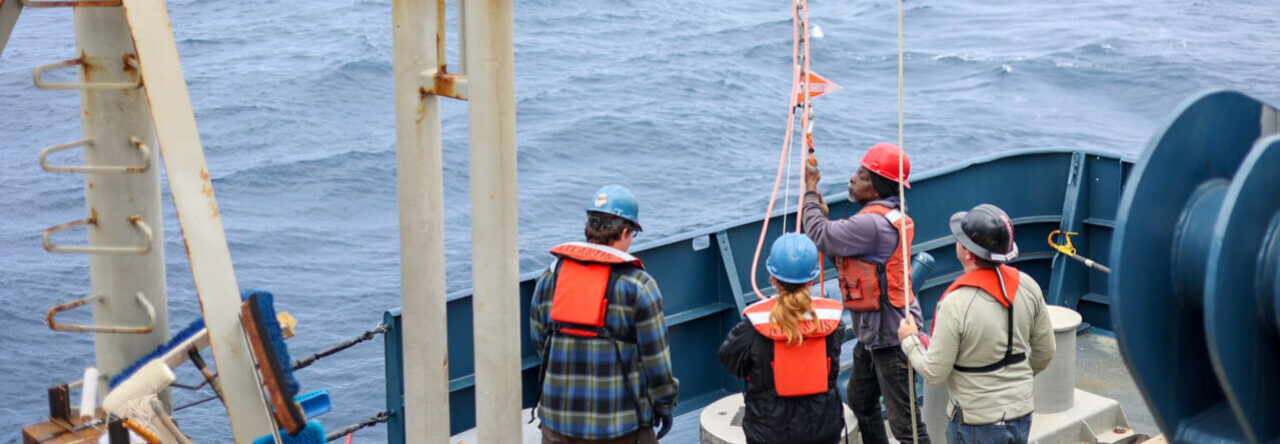
It has been a busy second week. This week I finally got to see the launch and recovery process of Alvin, which was amazing. The weather was ideal at first, with very calm seas—almost flat for the first couple of days, which is uncharacteristic of the Juan de Fuca Ridge. Later on, the swell returned to double digits, which took some getting used to. Nevertheless, I had the opportunity to get my hands dirty with the pre- and post-dive operations alongside the mechanical team.

Most mornings during pre-dive, I helped flush the lines of any air or water with either Carnation, hydraulic, or Brey oil, depending on the system. This ensures proper pressure compensation in the junction boxes that house the electronics for the ballast systems, communications, etc. Brey oil, I learned, is used instead of Carnation to prevent arcing in electrical boxes that draw more current. I also helped load the sub after the pilot finished their pre-dive checks inside the sphere. During this time, I handed down CO₂ scrubbers, towels to remove condensation, blankets for comfort (since it gets quite cold), and lunch for the pilot and observers.
The sphere is very well taken care of. Before each dive, all passengers must shower and wear clothing made of natural fibers to ensure safety. Synthetic materials can be flammable and may wedge themselves in the window seals, which play a crucial role in maintaining the pressure boundary. Even when the hatch is inspected in the morning, the person conducting the inspection must be free of oil and dirt to maintain cleanliness. After the sub is launched, we scrub the hangar and refill the oil containers so that everything is ready for any evening maintenance.

Post-dive operations can be a little fast-paced. As soon as the Launch Coordinator indicates the sub is secured on deck, we quickly rinse down the entire sub to prevent corrosion, cover the windows, and remove access panels to begin inspections. I always do a general “mech inspection,” which involves walking around the sub and checking for any loose bolts, wiring, or abnormalities. This past week we had water intrusion issues with the port main ballast blow box. We spent a few late nights draining and pressure testing the box, as well as testing the check valve and bladder for leaks. Unfortunately, we still haven’t found the culprit, but hopefully by the next update I’ll have an answer.

Additionally, there was water in the port thruster—which is bad, but also good for me, because I got to help take it apart. First, we swapped the motor for a ready spare so the sub was dive-ready, then made the repairs. We drained the motor of hydraulic oil, replaced a damaged O-ring and crane seal, and then carefully refilled the motor. This was fun but tedious, since every bit of air introduced into the system has to be removed. You wouldn’t think it would be much, but it is—so we had to slowly fill the motor using a tube while shaking it to release all the air.
All in all, it was a great week. I was able to watch the recovery process from the bridge and see the captain’s role in retrieving the sub, and I even got to check out some of the critters scientists collected in a bio box from the hydrothermal vents!

Until next time,
Katie