We are officially into the Chukchi Sea, and the Arctic Ocean! The difference is palpable. The Bering is shallow, muddy, and full of life, and the water has a more greenish hue that reminds me of fluoride. The water here is blue. Bright, sharp, cold, empty. Jellyfish don’t drift lazily around the surface up here, or at least not in the quantities of the Bering. The Chukchi feels like a sleeping sea, drifting quietly as ice crusts over its face. We haven’t gone through big ice yet, but small chunks- ice floes? Have begun bobbing by. Some are small chunks, the size of a chair or coffee table, but others are massive- the size of large rooms or the science labs on the Healy. And some of them have polar bears on them!!!!!!

The call came while I was working out in the Healy’s weight room. A person working out nearby suddenly dropped their weight, spun to me, said “We’re passing a polar bear!” And raced out of the room. I followed, heart in my throat, and after racing up several flights of stairs we popped out onto a port-side deck, where at least fifteen scientists and crew members were pointing everything from iPhones to absurdly large, telescoping cameras at a distant ice flow. I couldn’t see jack. But, as the Healy made a slow circle back around, I could make out a fuzzy, yellowish shape. I peered through binoculars someone handed me and there was not one, not two, but THREE polar bears! A mama stood up on the flow, regarding us suspiciously, while her two babies, probably the size of Great Danes, bumbled around the ice. The cuteness was unbelievable. Cora got a video of one of the babies flopping over. Coming from someone who ranks lower on the bear appreciation charts, I’m still utterly awestruck. I sent my extremely-fuzzy-shot-through-binoculars video to everyone I know. One of those moments I’m so, so grateful to be here.
We also saw a vaguely walrus-shaped lump! I really can’t describe it as anything but a lump, perched on a far ice floe floating away into the mist. I don’t *really* count it as a walrus sighting, but cool to have seen one in theory.
We’ve taken a break from our transit to the science locations for various Coast Guard activities, which has given the STARC team more time to troubleshoot and work through old issues before we get on station and it’s all-hands on the CTD. I’m amazed by how many problems can be solved just by turning something off and on again. Our ancient gravimeter, which Brendon introduced to me as a decrepit, suspicious machine so old its manual was carved on stone tablets lost to time, went dark a couple days ago, and at first everyone was like “Well, we saw it coming.” After a few days floating around the Chukchi with our to-do list getting shorter, Cora and I finally ventured into the depths of the ship to poke around the gravimeter, affectionally labeled “James” with a sticky note by some long ago martech of yore. Cora and I poked around, restarted the computer James was hooked up to, and lo and behold- gravimeter data.

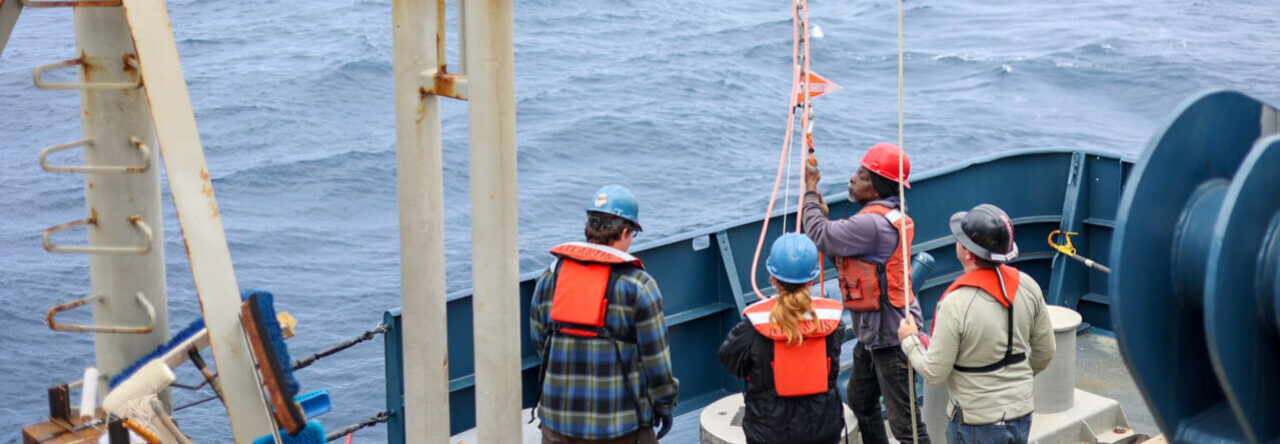
The largest project of the last few days has been reterminating the CTD. During a winch operation, its massive cable got kinked, so the last 20 feet were cut off. Brandon taught Cora and I how to strip and solder wires, something I’ve wanted to learn for a while. We practiced on some junk cable, and then took it to the real thing! I couldn’t believe they trusted the intern to touch the cable, but they let me solder one of the connections. It was a long process: stripping the wires, removing the cable from the CTD, soldering, wrapping in tape, reconnecting, reattaching the “thimbles” that hook the cable to the CTD, and more, but we finished just in time for lunch. It was an awesome experience to learn such a useful skill like soldering, then turn around and actually apply it. As I write this, the Coast Guard deck team just weight-tested the cable, and it sounds like it held up. I’m nervous but excited for its first deployment.


I’m not sure what’s next on our agenda. I think the Coast Guard is going to continue their activities in the Chukchi for a while longer. The science party is definitely getting a little stir crazy, but I’m sure we’ll all miss the calm once we’re recovering and deploying moorings and doing CTD casts ‘round the clock. For now, I’m going to continue my current project- trying to build a bathymetry chart in QGIS that we can use on OpenCPN, our map/tracking software. The process is painstaking and frustrating at every turn, and thus far I’ve had no success. Hopefully my next blog post has a better update.
Cheers, Wil
Wildlife count:
1 walrus (kind of)
3 polar bears
1 lost looking shorebird that almost flew into Cora