We have now been at BIOS for about half a week, and are preparing to leave for our next HYDRO/BATS cruise. (For those of you who are not familiar with the ocean-data time series: Hydro station S and BATS, check out my other blogs for more information!)
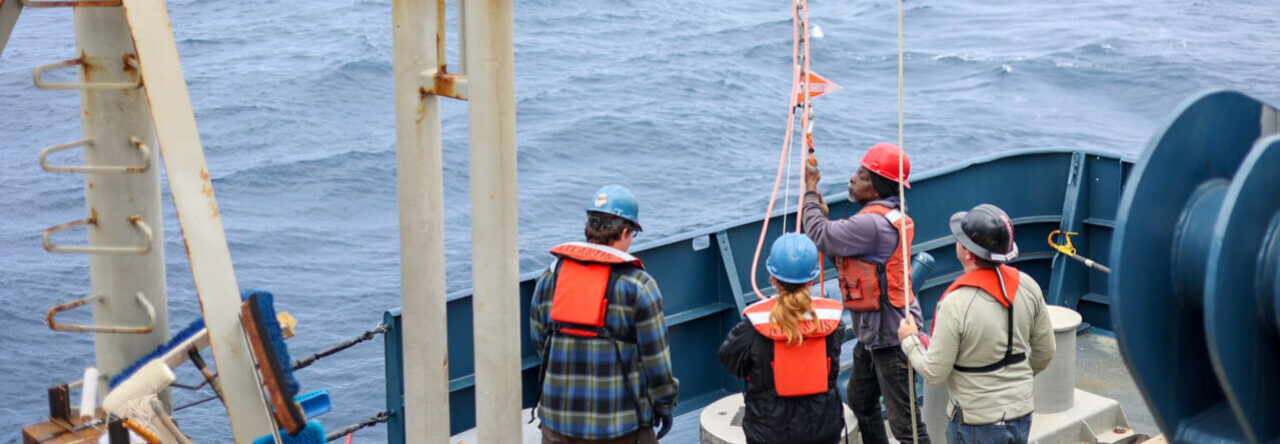
It is officially hurricane season and our recent weather has proven that statement true. We are currently waiting out Hurricane Jose in Bermuda. Tomorrow afternoon we plan to transit to Hydrostation S and BATS for a five-day cruise. During the duration of our cruise, which will involve the same deck operations as prior cruises, we will be picking up a glider for Ruth Curry- director of the glider program MAGIC.
The Mid-Atlantic Glider Initiative and Collaboration (MAGIC) was launched at BIOS in 2014 to enhance BIOS’s long-standing ocean measurement programs in Bermuda, using autonomous underwater vehicles. The goal of MAGIC is to gain new measurements from underwater gliders to assess the contribution of small-scale processes that sustain the ocean’s biological productivity. Each sensor is equipped with a variety of sensors such as a conductivity, temperature, depth and several optical sensors that measure oxygen and fluorescence. One of Ruth’s gliders, Jack, is outfitted with an Acoustic Doppler Current Profiler (ADCP) which provides detailed profiles of ocean currents. To check out more information, see the site here: http://magic.bios.edu/about/
I will be accompanied on this upcoming cruise with a technician from the tech exchange program. I will be holding my own shift during this cruise, but it will be interesting to learn from a new and experienced technician.
Upon his arrival Friday, he helped me sanitize our RO 100L tanks. Prior to his arrival, we were having issues with our Milli-q system. Our elix, an RO water maker, has been working excellently.

However, our Milli-Q system, which is attached to our Elix RO maker and RO tanks, was not performing at the quality it should.

The system works together to sanitize our water on the ship. Water is fed through our water system, sent through two prefilters to remove heavy metals, through several filters and cartridges on the Elix, into our tanks and then is pumped into our Milli-q system which gives the water a final sanitization. In order for the water to classify as purified “Milli-q” water, it must read 18.2 mega ohms on our machine. Our milli-q was running low, an indicator that the water quality is not high. After speaking to a Millipore technician Friday, I changed out our two pre-filters, replaced our Milli-q q-guard and quantum ex-filters and performed a tank sanitization. Our tank has been accruing gunk for some time, so the process was much needed.


In order to sanitize the tanks, Jason and I drained clean milli-q water into several carboys, removed the tanks from their water feeds and cleaned them outside with a diluted bleach solution. Afraid the bleach would possibly contaminate science samples, we opted to clean the inside of the tank with 5% HCl solution. Once the tanks were cleaned, we hooked them back up and began making new RO water.
So far so good, let’s hope the weather holds up!