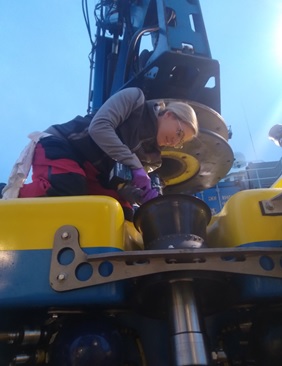
The second week of work has been quite the challenge.
Due to weather conditions, JASON was unable to safely deploy on Saturday (5/28). This hiatus gave extra time to train in the Control Van. That is where the magic happens! There are twelve screens that allow us to see and operate all of the camera angles on the ROV, JASON’s hydraulic pressures and sensors, wench diagnostics, navigation settings, sonar displays, and so much more! To monitor and operate JASON while diving, it takes three people.
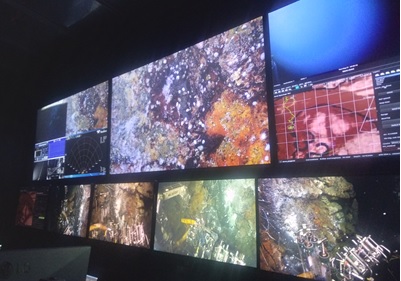
The pilot sits in the center, where they have the best views of all the screens. The Navigator sits on the left and is responsible not just for the navigation of JASON, but also the R/V Thompson. They also document the target points and locations as well. Lastly, the Engineer Tech sits in the right chair (this is where I will be). I will be responsible for maintaining, operating, and overseeing all of JASON’s hydraulic equipment such as:
- Thruster Comp Pressures
- Main Comp Pressures
- Manipulator sensors
- Camera settings and positioning
- Ground Fault alarms
- Basket (front retractable porch), slurp (suction system for retrieving samples), side sample bio-boxes, niskin sampler triggers, etc.
- I also am able to help operate the manipulator arms as needed by the pilot
- Completing hourly checks of all temperature and pressure levels, alarm systems, and reacting to every alarm that may go off.
- Tether management
I would be lying if I said I was not nervous, but the WHOI team training me are so helpful and insightful and I have no doubts they will support me the whole time.
The rest of today was spent rebuilding the sampler MAJORS from last week. These devices, when triggered, retract, and suck up whatever water or sediment they are inserted into. I ended up replacing the inner seals because they were worn and had a build up of gritty residue on them.
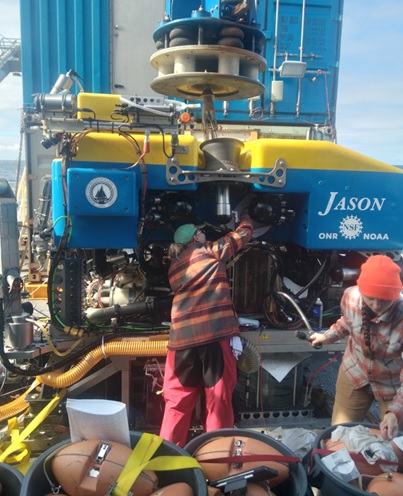
I also lead the Pre-dive check for the vehicle, which consists of over forty-five checks ranging from:
- Upper Vehicle & LARS checks
- J-Boxes & Comps
- Powering Up the vehicle/devices
- Laser & Light testing
- Thruster checks
- Hydraulics
- Manipulators
- Misc. checks like vehicle safety vests, securing inner cables/wires, etc.
Sunday (5/29)
First JASON dive is a go!
– Completed Pre-Dive checks.
– Secured and arranged sampling tools inside JASON’s front porch/basket.
– Added front weighted plates and rear weighted bricks that can be removed during the dive.
JASON was successfully launched at 11 am.
For my 4-8pm shift, I sat in the Engineering Tech seat in the Control Van and was witness to the amazing capabilities of JASON. This vehicle is capable of unbelievable things, but it is the crew that makes it possible. The dive was successful with its decent and sample collection at over 3200 meters, but towards the end of our shift, it was noted that JASON’s Thruster Comp levels plummeted from 9 to 0.5, and the decision was made to recover the vehicle.
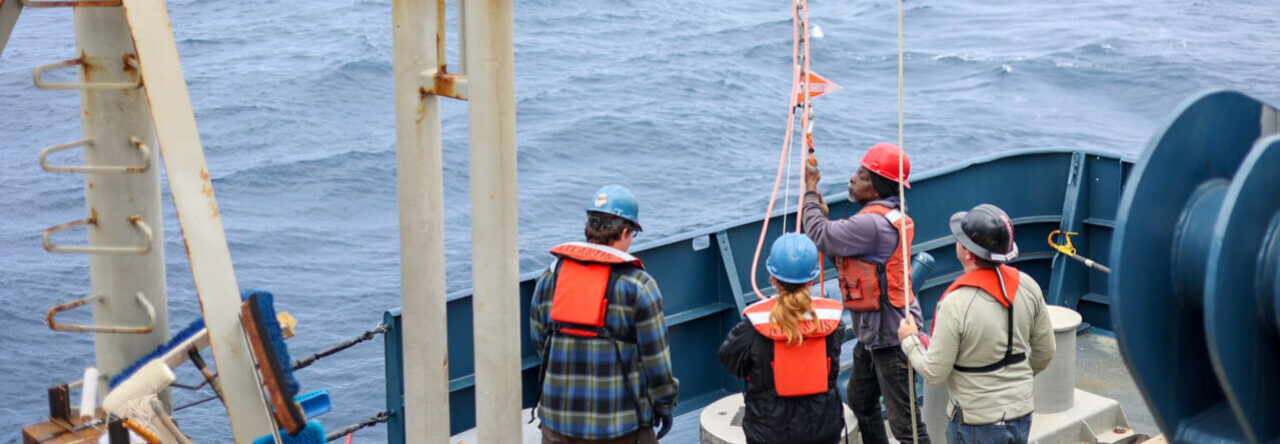
It takes almost two hours for JASON to get to the surface, but only 40 minutes to get him safely back and secured on the vessel. The team removes all 38 tether floats (which are quite large and heavy). One person ropes off the cable to bring it closer to the side of the vessel, another holds the float ropes to secure it and one last person unlatches the lock. With the crane operator timing the retracting carefully, it only takes minutes to clear the cable and finish the recovery.
It would be too long to list off everything that happens with each of these tasks, but I can tell you that everyone has several responsibilities, and each one is vital to mission success.
Monday (5/30)
4-8am shift:
- JASON investigation revealed possible water seepage into one of the thruster lines. Cleared and bled thruster lines.
- Pre-Dive checks at 6am
- JASON launch at 8am
- Unfortunately after securing all of the tether floats onto JASON’s cable, a thruster alarm triggered and JASON was brought back onto the vessel.
- The day was spent replacing the vertical thrusters and trouble shooting cable issues.
- Though my shift is scheduled 4-8, when JASON is down, everyone is working. We spent the whole day triple checking all of the adjustments and hope tomorrow’s dive is successful.
Tuesday (5/31)
- 12 – 1am – JASON was deployed.
- Both 4-8 shifts were completed in the Engineering Tech position.
- Sample collection was successful and JASON operated without issues.
- Some of the sampling tools did not perform as expected, so it was noted and will be addressed upon recovery/ post-dive.
- 8pm – JASON was recovered and secured on deck.
Wednesday (6/1) – Friday (6/3)
- JASON was launched each day and successfully completed sample collection objectives.
- The normal dive time was approximately 20 hours each dive.
- Trouble shooting and repairs were completed during post and pre-dive times.
- The brow pan/tilt camera suffered ground fault issues and was replaced.
- The thruster control pods for the vertical thrusters were disassembled, cleaned, repaired, and reattached.
- All lines were continuously bled for air and the junction boxes \checked for water leakage.
This week’s lessons:
- Oil pads are lifesavers! (We call them diapers) While replacing thruster lines, camera lines, whatever lines…they are all filled with either royal purple (an oil) or mineral oil. Even with clamps, sometimes the amount of oil lost can be substantial. So plan ahead, layout a “diaper” to collect whatever oil may spill. Clean everything!
- I was able to diagnose a thruster connector leak by making sure to clean the area after replacing the vertical thruster.
- Be meticulous. Ask questions. Double and triple check everything. Have someone else check your work. Good practice!