And I am back to better internet. I had tried to wrote this blog post while we were out on the second leg of this cruise but the internet was spotty. A few rain storms came through and heavy cloud coverage impacting the satellites.
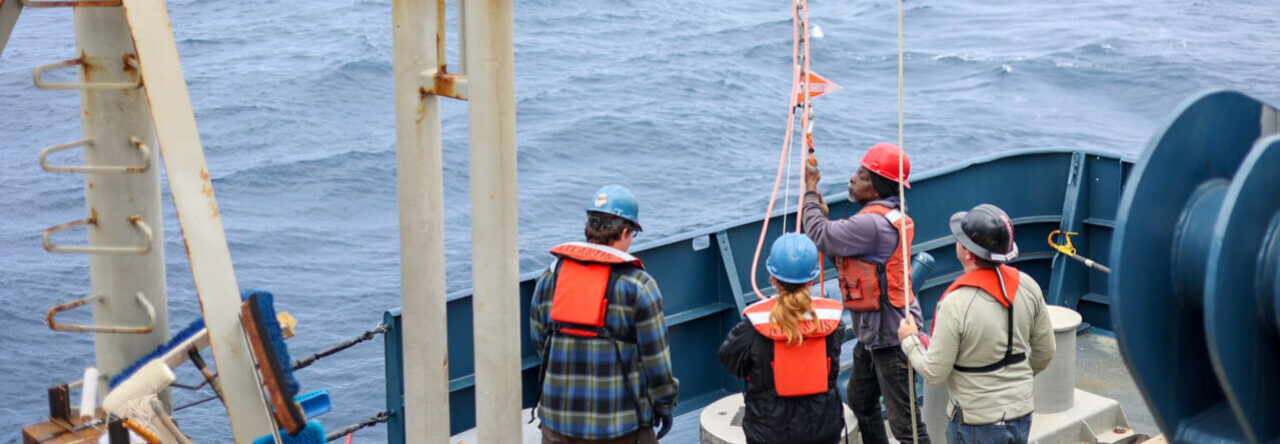
On this second leg of this past cruise we had Clio aboard. Clio is an autonomous underwater vehicle (AUV), that was shipped to the Bermuda Institute of Ocean Sciences (BIOS) earlier this year from Woods Hole Oceanographic Institute (WHOI). This is the third time Clio has come aboard the Atlantic Explorer. It is being deployed at the BATS station, 45 miles (75 kilometers) off of Bermuda.

Maya and CLIO
Clio is operated by the scientist on board and can give up to a maximum depth of 3.7 miles (6 kilometers), working up to 12 -14 hours at a time. The AUV is required to travel vertical during its time in the water for long periods of time rather than horizontal and travel at a constant depth, which is more common on AUVs.
The purpose for Clio is to help gather samples for with biological and chemical analysis throughout the ocean water column. Once Clio is lowered into the water it will stop at certain depths, programmed by the scientists, collecting particles via pumps that suck the water through the filters. If all goes well during these dives, Clio could be used to collect data while other science deployments occur. Currently it is not possible to do to many deployments when a wire based deployment is in progress.
I have less than a week left here, it has all gone by too fast. I have been gaining so much information and learning the various aspects that marine technicians are responsible for on a research vessel. I have one more cruise before I head back home.