Hello everyone! Between mobilization and simply learning how the crew and equipment work I didn’t have a chance to post my week 1 blog last week but here I go with week 1 and 2 for this post!
SEISMIC SURVEY MISSION
Why:
The scientists onboard believe there are methane pockets that are trapped in ice that are known as methane hydrates, which is a potential reason for subsea landslides in the deep sea. To help prove this hypothesis we have to go through the survey data and mark the locations where methane hydrates have been located so we can return to these coordinates and drop gravity cores down into the sediment. The gravity core will then collect layers of sediment in a tube and bring it back onboard the vessel where scientists can cut different sections off and freeze them to be studied in a lab back onshore.
How:
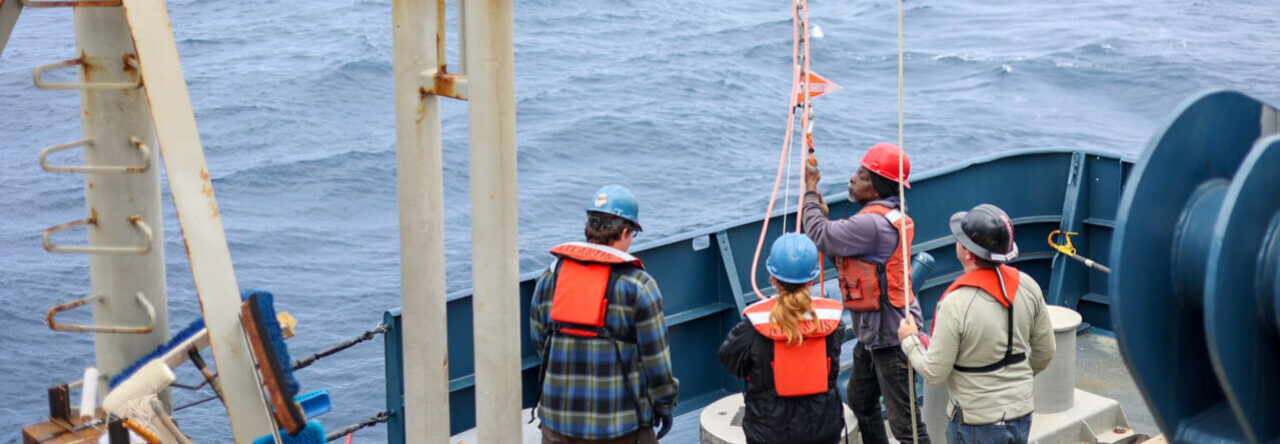
Off the stern of the vessel the technicians and gunners work together to deploy 6km of SSAS streamer cable that record sound waves that are bounced off the bottom of the seafloor. Some sound waves are able to penetrate up to 10km under the seafloor surface. Similar to sub bottom profiler data and we are able to see that data as well. After all the streamer cable is deployed the gunners and technicians will deploy the air guns which are all attached to long sausage buoys that are towed between the cables and vessel. The air guns use compressed air to create a loud blast of noise similar to a gun firing which creates the sound waves that collect data.
Week 1
May 6th
I arrived at the Virgina, Norfolk airport and caught a 20 min uber to the NOAA pier where the Langseth was tied up at. The uber driver dropped me off at the gate and the NOAA security guard checked my ID and let me in. As I walked to the ship I passed the NOAA office and one of their vessels. They had a big catamaran dock ahead of us which was being prepared for one of their missions. Cool stuff! As soon as I got on, Cody (cheif technican) introduced himself to me and showed me where my room was. I had to find my way down 3 decks to the main lab (the cook had to help me out because I had walked through the galley 3 times and he figured I was lost). I also had a chance to meet the other technicians and gunners onboard. Todd (a technician) helped me get all my PPE which I posted in my introduction blog post.
May 7th
I woke up at 6 am and helped lift floor tiles so I could reconfigure some wires for the main lab which has over 40 monitors! Afterwards, Cody and I attached a RVIM (Rubber Vibration Isolation Model) to the end of one of the streamer cables so the tail buoy would not create tension on the cable while in the water.
May 8th
Me and Cody went up on the bridge tower so we could set up the PSO’s stations on port and starboard sides where they can keep a lookout through their high grade binoculars for whales, dolphins, turtles, etc.
May 9th
This day was my first day on my 12 hour shift schedule (12pm – 12am). We also set sail between 13:00-14:00. Norfolk was interesting to see as we departed from the dock. I saw a fleet of US naval ships docked up and plenty of commercial ports and vessels coming in and out the bay.
May 10th
I woke up and put my PPE on to help out with deployment of 6km streamer cables on the deck. While deploying I assisted with changing out modules (for more efficient data transfer) and attaching digibirds (model 5000) so we could tow the cables at an appropriate altitude.
May 12
I helped out one of the gunners drill rust off the hydraulic systems and re-grease it with some heavy duty industrial grease. After I was observing data in the main lab when all of a sudden one of the air guns started to auto fire. We retrieved that gun string and realize the air gun was auto firing due to a corrupt seal. After replacing the air gun and some air hoses we deployed them back into the water and started collecting accurate data again.
May 13th
Cody assigned me 3 daily tasks to do at the start and end of my shift.
1. Checking the server for recent incoming raw data
2. Emptying the dehumidifiers in the mainframe room
3. Check the wet lab for running water so we can have updated salinity measurements.
I proceeded to help the gunners replace air lines to some more air guns before redeploying. Cody then showed me how to fill out daily scientific reports for the National Science Foundation (they are responsible for funding this whole mission). The rest of the evening I was recalibrating all the digibirds that were marked red for not usable. I tested the digibirds for accurate heading, depth, pressure, and wing movement. I then removed the bad bird modules and replaced them with working ones.


Week 2
May 14th
Continued recalibrating digibirds and observing data in the main lab.
May 15th
Me and another technician named Alan who I learned is an alumni of the CFCC Marine Technology Program went through the bird collars to fix the latches on the bad collars. We also had to soak some of them in freshwater due to salt erosion locking some of them up.
May 16th
I spent most of the day studying the different softwares used in the main lab to track different aspects of our survey.
Orca software: is used for navigation of boat, streamer cable, digibirds, survey lines, and general positioning.
Digicourse: Displays location of digibirds in the water column so we can keep the streamer cable at the correct depth.
Gunlink: shows electrical signals being transferred to airguns simultaneously. It also displays sound output from the hydrophones and airgun health by color.
Seal: shows sound being received as a whole streamer cable using sound bars.
Seal QC: Graphs sound return by Time (s) and length of streamer cable.

