This week was quite interesting, where I got a chance to see many different operations and learn a lot from KG, the senior tech onboard. The theme of this week was encountering a steady stream of small problems, as opposed to several larger issues onboard the previous leg.
Last Saturday, a very nice day, the scientists continued to tow the habcam near Long Island, close enough at one point that we could make out houses on the beach, so most of the crew headed up to the bridge holding their phones in the air trying to get service. We started the multibeam up again, but had issues with the computer freezing, so we opened up the unit and reset a chip which seemed to solve the problem. After a crash course from KG, I was operating the multibeam sonar on my own, adjusting settings as the bottom changed and sending profiles of the bottom to the scientists. I also installed a new camera on the stack pointing towards the dredging area, where I learned how to terminate the cable and secure connection points with splicing tape.
Sunday came with more multibeam and more freezing issues, so we took some screenshots of the issues and KG sent them to an expert on shore. I was assigned the task of writing up a procedure pertaining how to start up and operate the multibeam to help out future techs and interns on the boat. When I did my daily check of the SMS system, I noticed that the temperature and humidity were way off. We went aloft and opened up the sensor, which had water inside, so we replaced it with a spare that we had onboard. KG stressed the importance of always having spare parts while at sea. Monday started with me being awakened by the crash of pots and pans in the galley; another rough day at sea. We were on the high seas, 50 miles off Nantucket, getting prepped to start the first multibeam survey of the canyons for suitable juvenile lobster habitat. It was very difficult to watch a computer with all of that rolling, so I terminated more ethernet cables and worked with KG to learn the model numbers and names of CTD sensors.
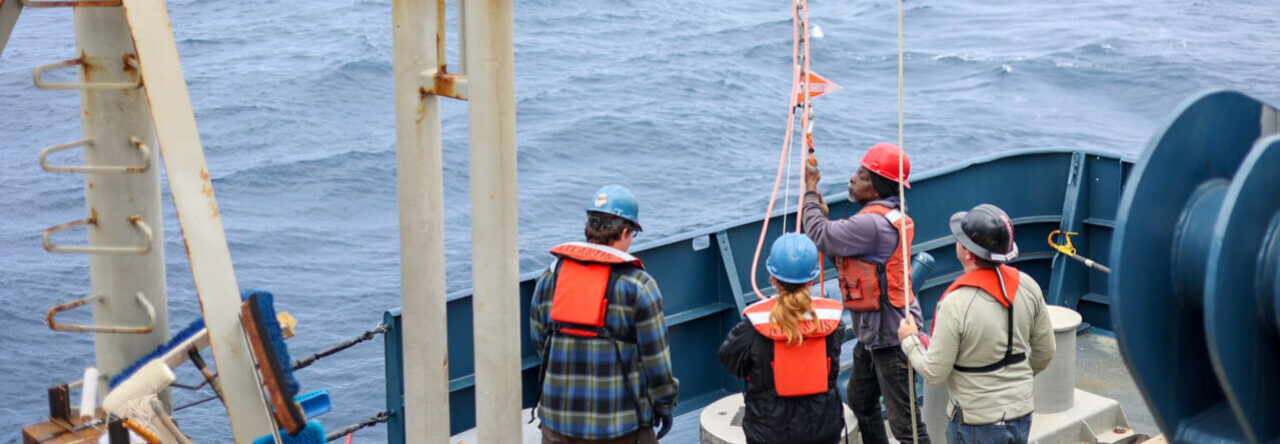
The multibeam was having issues finding the bottom due to the contant pitching of the ship, and on Tuesday we eventually pulled out the habcam, which had a ripped open termination and a point in the fiber optic cable where some of the strands had come unlaid. We cut the cable past that point so the scientists could work on a new termination, a long process that could take more than a day. So instead we headed to the first dredging site, where the science wanted to run a CTD cast to obtain water quality data at depth. KG showed me the process and walked me through the entire thing, from setting the device up, dropping it in, recovering water samples, and recovering it with the winch. Once this was complete, we began dredging, going through the motions of launching and recovering the large, rusty dredge, then jumping on the table and shoveling our catch to the scientists who sorted out the organisms they wanted. Up here, our catch was much different than the southern leg, with much less sand, more mud, and WAY more scallops, as well as flounder and mean looking goosefish. Between dredges, KG, myself, and Jonathan, one of the engineers, shucked scallops for the cook. It was worth it, because the next few days we enjoyed great meals like bacon wrapped scallops and scallop ceviche.
Wednesday was foggy but much flatter, and we came out on deck to find a winch we need for dredging leaking hydraulic fluid. All we could do was wrap it until we got to port and hope it doesn’t get worse! We did a few more CTD casts between dredges, and KG let me operate the computer controlling the CTD. He also showed me how he processes the data, and let me explore the program that cleans up the data and produces nice looking graphs. Dredging became more tedious as we mostly recovered rocks, some quite large, that we had to pick up or roll off the table. During one of the haulbacks, there was a break in communication and I left a line tied down that ended up snapping off a cleat. It was not a critical piece, though, but it’s always important to know what is happening on deck! On the last dredge of my watch, I talked to Sean, the relief captain, up in the wheelhouse, who showed me how he maneuvers the boat during a tow. It was a long day, but I learned from a lot of different people!
Thursday, another foggy day with a little more roll, began with a few dredges, then it was time to steam to the grab sample site. Once there, we lowered the keel and turned on the ADCP to monitor currents at the stations. KG, Jonathan, and I worked to get the metal grab sampler in the water and winch it down. Due to the roll of the boat and a wire that was not marked with any sort of depths, it was hard to tell when we had hit bottom. After many hours, we only had one sample, and had to move on to another multibeam survey and more dredging. Luckily, during the second survey, the multibeam worked great under my control and science was very happy. Another problem soon struck, when the winch computer was no longer reading tension as we were launching a dredge, and later the CTD winch left the device hanging halfway down to the bottom for nearly an hour. KG and I went down to the engine room to reset the computer, but it wasn’t quite done causing problems.
Today the habcam was back in the water, and it was a nice, sunny, calm day. We were doing habcam tows off Cape Cod and working our way back south to Nantucket. I was monitoring the multibeam with no major issues, until there was commotion in the lab due to a winch tension spike, everyone thinking we had struck bottom hard with the habcam. To pass the time, KG had me work on a spreadsheet that gave information about max depths of various sensors. However, we pulled it up to reveal no damage, and it was likely another fault in the winch computer. We recalibrated the computer and dropped the habcam back in, but KG stressed to Sean and the engineers that this is an issue that needs to be looked out by a professional at electrical equipment. Later, KG gave me a brief introduction to the different types of serial and VGA connections and how computers “talk” to each other. By Sunday afternoon we will be tied up in Wood’s Hole, MA where I will post more pictures. Until then!
Huxley