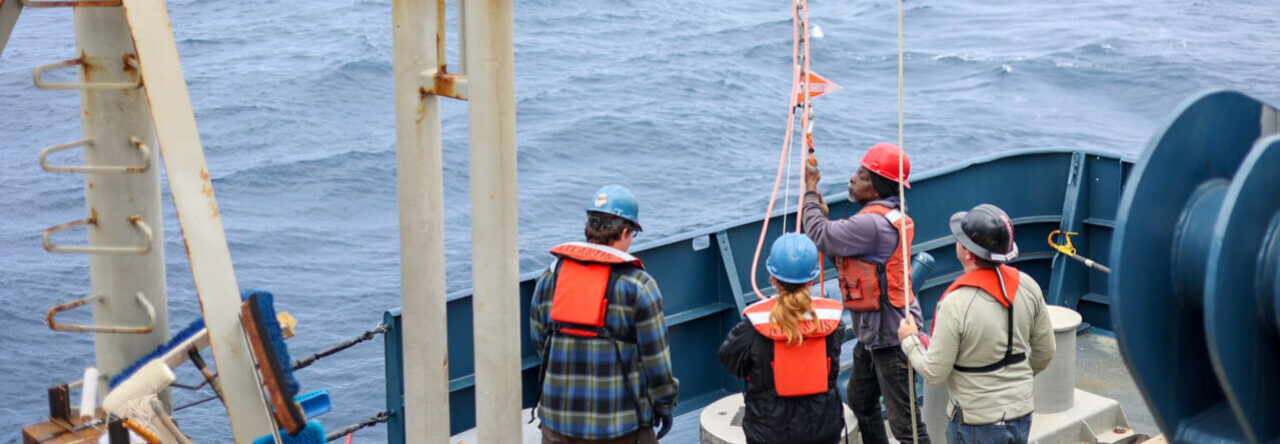
So we’re still awaiting the arrival of the engines on to the RSMAS campus. We have started the process of getting the engine spaces clear enough to move large engine parts through the hatch. This includes taking out the main engine exhaust headers which were awkwardly one solid piece of inch thick metal. They were heavy and it took all 7 of us to lift and manuever the exhaust piece with various chain fall, strap, and line configurations. It was very heavy, tiring, but also very rewarding to get this piece out of the engine room. A little foreshadowing into what we will have to do for the engine removal and install.


With Denis, our Marine Tech, we went over the new POSMV system and how it will be installed, configured, and how it stores information on the network. This system is super important as it enables the Walton Smith to triangulate it’s position to the thousandth place using two main antennae and a tertiary antennae that use as many satellites that they can see and communicate with. The main part of the POSMV system is an Inertial Measurement Unit (IMU) which uses accelerometers, gyroscopes, and magnetometers to set a reference point on the ship accounting for yaw, pitch, and roll. This reference point is set as (0,0,0) on the x,y,z plane and when connected to the antennae automatically identifies the distance from the reference point in order to integrate the satellite data received to get an accurate representation of our postioning data. This is also important as it allows Denis to set up different reference points for the scientists in cases where coring operations or ROV operations are needed. The IMU is so important that it has to be logged that we have one, let known to the USCG, and locked away if going into international waters as this is the same kind of system that can be employed in aircraft, missiles, submarines, and satellites. Alesha and I have been tasked with figuring out how to mount the antennae and route the cables through the bulkheads, through-hull, and overheads then we will learn how to configure it onto the network and integrate it with other systems onboard. Here is a picture featuring Alesha and Denis as he explains the POSMV to us:

Another project we are working on is updating the current wifi systems onboard (there are two). This entails pulling down the day shape mast attaching a new antennae to it and figuring out a way to weatherproof one of the connections before running wires down to the Marine Tech lab where it can be hooked up to the network. The other wifi modem is being replaced with a newer model and so we learned how to configure it, add it to the network, and went through some of the administrator controls that give the marine tech options to set up VLAN, limit users, and look at bandwidth. We also received the necessary materials to finish our project setting up cameras along the side of the ship.
While taking down the day shape mast and figuring out how we were going to rig up the wifi antennae to the top, we collaborated with Jon to use the opportunity to learn the basics of welding aluminum. Welding is an art form. It is very fun but hard as there are so many factors needed to pay attention to. Add too much heat and you will burn through the metal doing the opposite of what you’re trying to do. Add too little heat and the weld will bead up and not smoothly conjoin both pieces that you are welding. Go too fast and the weld doesn’t have time to fill in and you’re left with bubbly weld pools down the line. Go too slow and the weld pool gets too big, isn’t smoothed out, and becomes uneven. Get too close and you can melt the filler wire to the tip of the welder. Get too far away and the weld is too thin and cold. The settings of the welder’s voltage, how much shielding gas, and spool rate are also super important to a good weld. It is pretty interesting and definitely want to get better at it, which will take time and practice. Here is a picture of me learning to weld:
