Today was the day. I continued my daily routine trying not to think about it, today was the day. Changing the sea water filters below on the engineering deck, done and dusted.Today is the day. We get a call over our radios, okay it’s happening after lunch.
Conducted a CTD for the science party. Buoy engineers were rushing past us getting the buoy ready to be lifted and untying it and bringing in tables to the Baltic room. It’s starting to look more like a war room. Everyone keeps checking the weather, it’s in the negatives today and the wind isn’t blowing too hard. Good.
Trying to keep my mind off of the lift. I headed to the bridge for a full shift with the chief mate, where we encountered huge ice ridges and snow. So we did what the ship was designed to do in this instance, the ‘back and ram’! This consists of creating space behind us with our thrusters and clearing the ice. We back up as much as we can, then give her all she’s got and ram through whatever is in front of us. We needed to get through all of this ice if we were to deploy the buoy. The time was edging closer.


Following this, I left the bridge to attend the second and final buoy meeting. This deployment is the primary purpose for our expedition and the R/V Sikuliaql, WHOI, and UW had their best teams on this boat for a reason, and this was why. This lift, considered one of the most difficult operations the ship undertakes, requires not only two cranes and crane operators working simultaneously, but also needs at least 8-10 taglines preventing the buoy from swinging and that’s just the set up. The complex process involves 3 evolutions in total. (1) lifting the buoy from a horizontal to a vertical position, (2) rotating it 180 degrees in the air, and then (3) carefully positioning it over the side without any collisions—a truly complex operation.
After the meeting we all enjoyed a hearty lunch knowing the teams would definitely need it. With the chilling -4 degrees Celsius outside, we bundled up in our warmest clothing before heading to the Baltic Room. This room housed essential equipment like CTDs and AUVs, and served as the ‘command center’ for our ambitious lift.
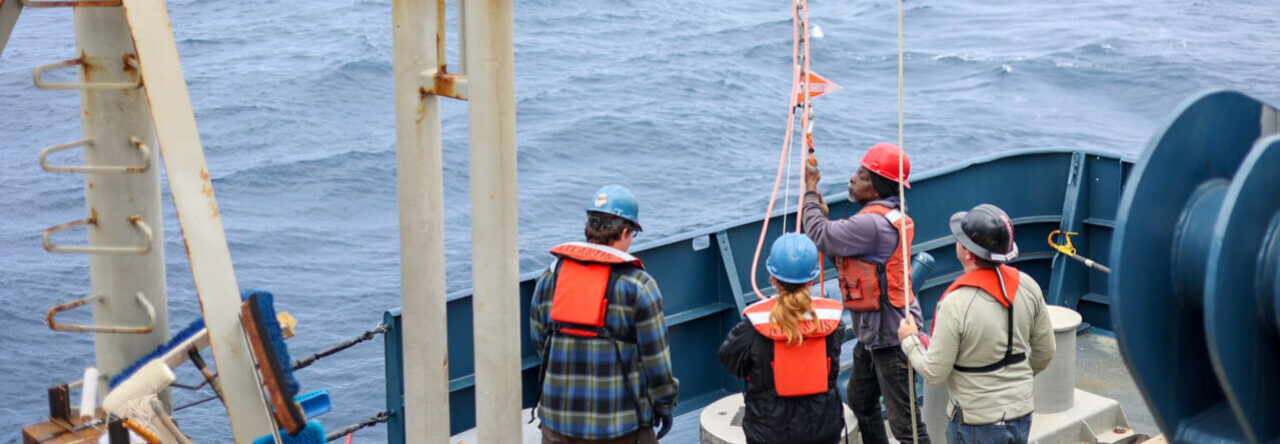
Divided into three teams, the first team consisted of crane operators, our bosun, and day bosun, supervised by the captain who would be joining us down on deck. Their responsibility was to maneuver the cranes safely, ensuring a precise and secure lift. The second team, composed of tag liners, included the buoy engineers, one of the chief scientists, and the most experienced crew members. Their role was crucial in handling the buoy to prevent any damage to its instrumentation, and most importantly keep that 6 ton behemoth from swinging. The third team, the runners and floaters, remained in the Baltic Room, ready to assist and ensure the safety of those working outside.
Before the operation began, everyone suited up and gathered in this makeshift war room complete with cameras, tables, schematics, computers, radios, and scattered clothing and food. Expressing her confidence and excitement, the bosun assured us that we were well-prepared for the task at hand. The room erupted in applause, and we conducted final checks to ensure everyone was well-protected from the frigid arctic conditions.


The atmosphere was tense as those not directly involved in the three teams (me and a few other scientists) ascended to the third deck for a high vantage point. Everything unfolded in threes—three teams, three decks, and three floors above the action.
The setup felt like an eternity, with each moment filled with anticipation and nerves. This operation was the culmination of the entire cruise, and there was no room for error. The lift, seemingly lasting for hours, required meticulous attention to detail. The first evolution involved lifting the buoy from a horizontal to a vertical position, a seemingly straightforward task but made challenging by the protruding bottom instruments beneath the buoy. When everyone was ready, it went dead silent and all we heard was the wind and the sound of the cameras starting to record. The cranes started to move and make noise and all the lines started to tighten, and tighten, and creak, and the crane team started to back up as the buoy started to rumble, and shake and make noise. Our bosun called out orders for everyone to hold onto their ropes with everything they have…then it started to lift.

The first evolution had begun. The tension heightened when a close call prompted the chief scientist to call an all-stop. Repositioning was crucial, and with her guidance, the lift continued without incident.
The buoy ascended into the air, and the teams successfully completed the first evolution.


The second evolution involved rotating the buoy mid-air, a complex task that required tag liners to skillfully transfer their lines from one cleat to another, looking from my vantage point very close to a choreographed dance. The operation proceeded smoothly, showcasing the expertise of the crew.


The buoy reached the desired position, marking the end of the second evolution.
The final stage, Evolution 3, involved carefully positioning the buoy over the side without collisions and releasing it into the water. Tag liners played a crucial role in this phase, swiftly removing their lines as the buoy descended into the water. The final moments were entrusted to the main engineer, who shouted “RELEASE!” as the buoy was set free, completing the mission. Below is the moment of the release.

It felt like hours, but due to the expertise of our bosun and everyone involved, it took only 30 minutes for all 3 evolutions. I was astounded.


With the night ending on a high note, our successful operation was celebrated with cheers, high fives, and hugs.
As we sailed away, the sky treated us to a breathtaking display of the aurora borealis, a fitting end to our challenging journey.


And so, with our final mission accomplished, we eagerly looked forward to Week 7: Going Home.
Thanks as always for reading, I’ll be home soon.
Mari