Smooth seas and sunshine has been the theme of our cruise thus far. I’d like to think I’ve adjusted to life at sea after a week, but we’ve been sailing in relatively sheltered waters until now so only time will tell.
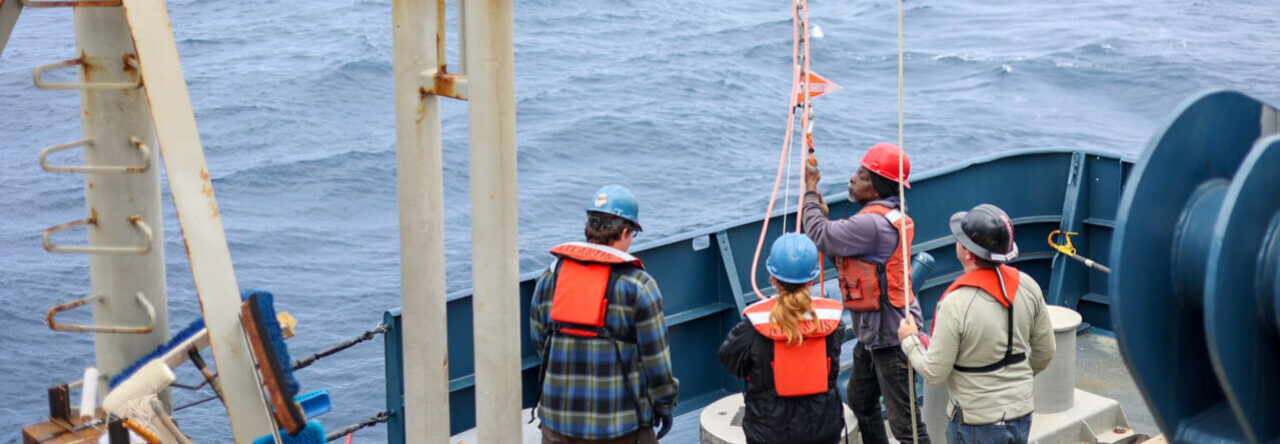
It’s been a busy week of CTD maintenance and repairs. We started with redoing the cable termination, which provided me with my first real soldering experience. I must say, soldering is more like an art than anything I’ve done so far and the experience of the MTs onboard became very evident when comparing their soldering jobs to mine. Next, we removed and cleaned/inspected each of our 24 SBE bottles mounted on the carousel. Each bottle was wiped down and any cracked O-rings or rusted circlips were replaced. After the bottles were finished, we moved onto the carousel itself. Unlike steel or titanium CTD frames, ours is an aluminum alloy that is light enough to house several instruments and still be under our cable’s max safe working load of 1.74 tonnes. However, the problem is that it needs a thermoplastic coat (to ensure trace metal analyses can be done) which eventually wears off and starts to peel. Taking the bottles off our frame revealed a few spots needing repair, so we carried the frame into the staging bay and started grinding away (pictured above) at the worn coating and corrosion. The next step will be to heat the exposed metal to 150C and apply a new layer of powder coating, then it should be good to go! The issue here is that some spots are worn out completely around the frame (as seen in the picture) and the powder coating needs to be applied in an upright position, so we’ll have to either do the repair in very small sections (not ideal..), or try slowly rolling the frame down the hangar while hitting all sides of the repair with the heat gun and powder. Either way, it will be a fun challenge!
Every part of this cruise has been a learning experience so far, and I hope it stays this way as we push forward to the Marshall Islands. We’re set to arrive in Majuro next week, where we will stay for 4 days and prepare for the three-week science leg along the central equatorial Pacific.