Hey blog readers!
I am so excited to share my adventures from this week with you! Let’s start with a routine update of the work I’ve been able to accomplish this week, and then I’ll tell you about my super-exciting mini oceanography cruise.
After my presentation last week, I’ve pivoted gears from simply researching data science solutions to really digging into generating a proof of concept. I say all of this, but of course, I spent the majority of this week setting up, installing, and configuring the necessary software for that proof of concept. It turns out that deep-sea robots are incredibly complex—and that’s after all the work has already been done to make them! Just “plugging in” to the system, so to speak, is an endeavor all by itself.
So, this week I spent a lot of time jumping down various rabbit holes in order to correctly set up ROS (Robotic Operating System) on a virtual machine, and I finally have it up and running. I was even able to run this really cool simulation of Sentry.

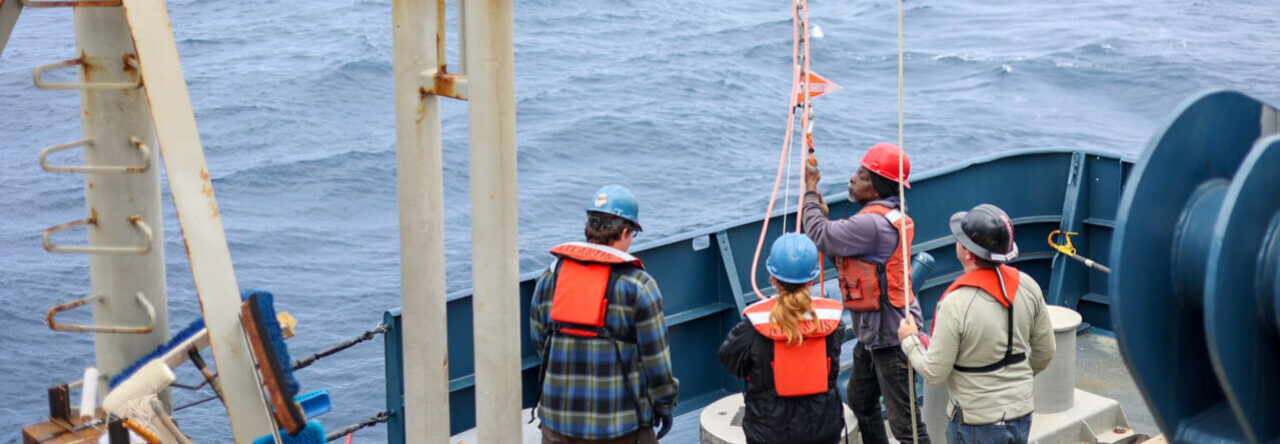
Separately, this week I had the opportunity to go on a short, few-hours-long intro-to-field-oceanography cruise! We boarded the ship—a small but decently sized fishing vessel owned by a community member who participates in a large amount of citizen science here at WHOI—and cruised out of the harbor.

We deployed a camera tow and were able to visualize and inspect eel grass forests. It was a bit choppy in the channel, so we weren’t able to see as much as we had hoped with the camera, unfortunately. But the best part was yet to come—we deployed a number of catchment vessels to pull up some critters to research! We dredged a small section of the bottom, used a floating plankton catcher, and deployed a lobster pot.

Here are some more pictures from that short but sweet adventure:


Hope you enjoyed the pictures—I hope they made up for last week’s lack!
Write to you later,
Steph