
Final week with WHOI / JASON team (Friday 6/24 – Friday 7/1)
How the time has flown by!
This was a week of perseverance. JASON struggled with a reoccurring ground fault in the starboard horizontal thruster. Regardless, the pilots were able to continue the mission and complete all tasks on time. The only real difference was when JASON was transiting, it had to fly laterally to make decent time. Adapting is most definitely an essential skill in this position.
Question of the week: What is the longest JASON has remained on the seafloor?
As of now, the longest recorded dive JASON has completed was 7 days. With it’s tether supplying the needed power, it has the capability of staying down even longer, if everything operates smoothly.
Friday (6/24)
Second day of a continuous 4-day dive and things have gone according to plan.
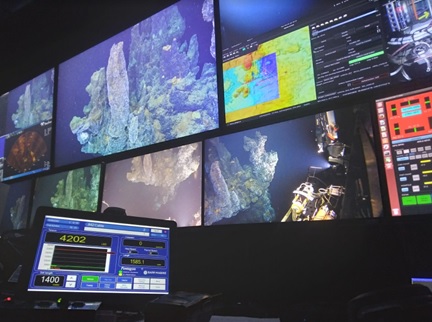
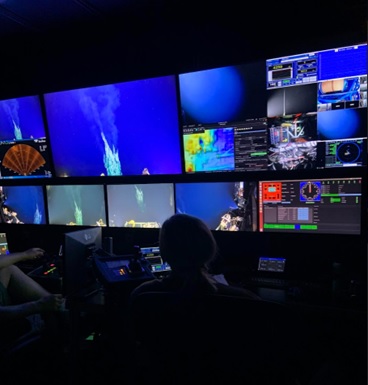
- Both of today’s 4-8 shifts were spent copiloting in the engineering chair, overseeing JASON’s operating systems. Each hour I go through a check list ensuring pressures and temperatures are being maintained. Some of these include:
- Hydraulic Compensator, Main compensator, and the Thruster Compensator Pressures
- Jetway Voltage and Amp Levels
- Level-wind motor, cable drum, and break temperatures
- Winch motor-control room temps and system free from ground faults
- I also was able to log 1.5hrs of JASON piloting
Saturday (6/25)
- 4-8am: co-piloting
- During this shift JASON’s stbd horizontal thruster had to be disabled after grounding
- 10:30 am: JASON was recovered on deck and the thruster was removed, serviced and the inner seal was replaced.
- 2pm: JASON was deployed
- 4-8pm: co-piloting, and was able to log another hour of piloting
Sunday – Monday (6/26 – 6/27)
Both these days were spent co-piloting in the engineering position.
- The same stbd horizontal thruster had to be disabled due to grounding issues.
- The overall goal these days were to transit to specific locations that contain “benchmarks” where we deploy a pressure sensor for 20 minutes to collect data. The sensor is then recovered and then transition to the next area.
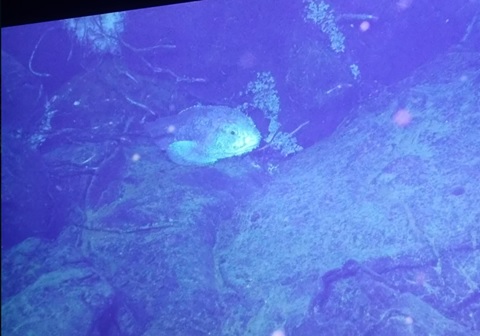
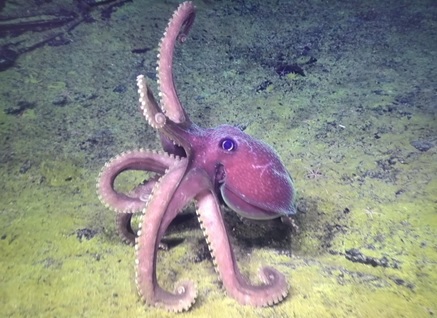
- During the collection time, we were able to see a number of different creatures at depths between 1400-1600 meters.
Tuesday (6/28)
This morning JASON was recovered at 4am.
- We completely replaced the grounding thruster with a new one, and then continued to bleed the system for air bubbles throughout the day.
- Due to weather conditions, we were unable to launch again until conditions improved.
- Pre-dive checks were completed throughout the day
Wednesday (6/29)
- 6:30am Pre-dive/launch checks and procedures were completed
- 8am: JASON launched
- 4-8pm: co-piloting
Thursday (6/30)
- 4-8am: co-piloting.
- While relieving the previous shift, we were informed that the same thruster again had grounding issues and was disabled.
- The decision was made to bring JASON back up and inspect the thruster connectors.
- 4-6pm: co-piloting and winch operations/supervision while JASON was being recovered.
- 7pm: JASON back on deck
- Thruster connectors were replaced and resealed.
Friday (7/1)
- 2:30am Predive checks completed
- 4am: JASON launched
- 5-8am: co-piloting
- While overseeing JASON’s systems, I noticed the AC ground fault sensor jumping from 40M ohms to 1.1M ohms, and reported it to the pilot.
- I investigated each sensor and thruster system and determined the same thruster was again having issues and the decision to disable it was made.
- JASON was recovered for the last time at 1pm.
Although the thruster issue kept reoccurring, all of the mission objectives were completed on time. Tomorrow during the ship’s transit back to Newport, the team will be troubleshooting and identifying what caused this reoccurrence. I have a sneaky suspicion it is the motor-control pod connector that the thruster connector attaches to. Either way, this amazing team will work together to resolve the issue and prep the vehicle for the next cruise.
It has been a privilege to work alongside such amazing individuals and am looking forward to what possibilities may come from this experience. I am grateful for every day I was able to spend out here and plan to continue my goal of pursuing a career in this field.
If you would have asked me last year ago, what my dream job would be…the answer was: working on the JASON team for WHOI. And then after applying for internship opportunities through MATE, I was lucky enough to be chosen for this internship!
It is incredible what things are possible if you continue to put the work in and remain open-minded!
This second cruise I was able to accumulate:
- 14 days at sea
- Mobilization Days: 2
- Demobilization Days: 2
- Co-Piloting JASON (engineering chair): 68hrs
- Piloting JASON: 5hrs, plus 30 minutes operating the manipulators to collect lava rocks
-
Tip of the week:
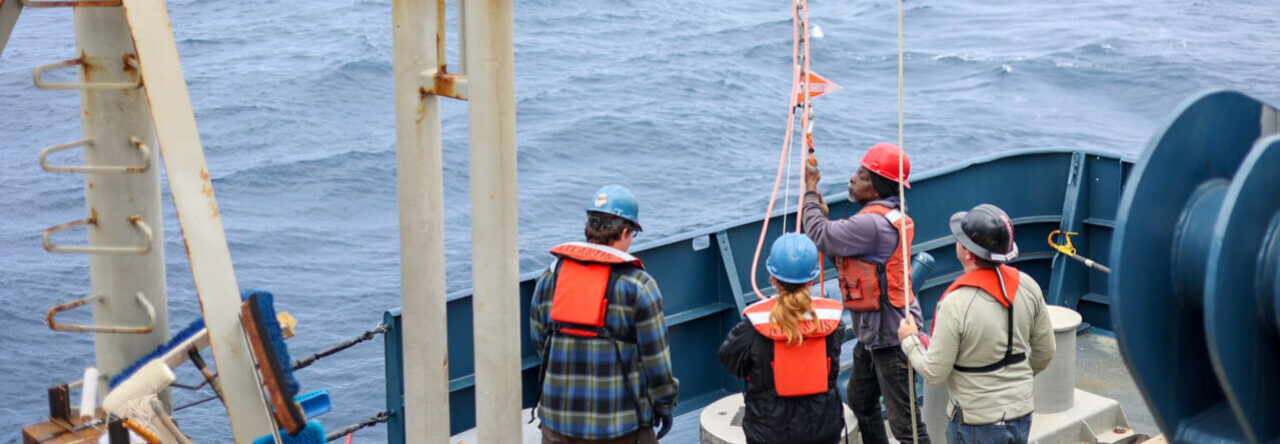
Know your knots! When you are at sea, you have to secure pretty much everything to ensure it will remain in place during transit. And sometimes you will need to help prepare scientific equipment that will need to be able to break away while at the seafloor. Knowing some basic knots will definitely help like the clove hitch, bowline, half-hitch, square knot, and also the double-sheet bend knot (where you join 2 lines).
Tip of the week:
Know your knots! When you are at sea, you have to secure pretty much everything to ensure it will remain in place during transit. And sometimes you will need to help prepare scientific equipment that will need to be able to break away while at the seafloor. Knowing some basic knots will definitely help like the clove hitch, bowline, half-hitch, square knot, and also the double-sheet bend knot (where you join 2 lines).