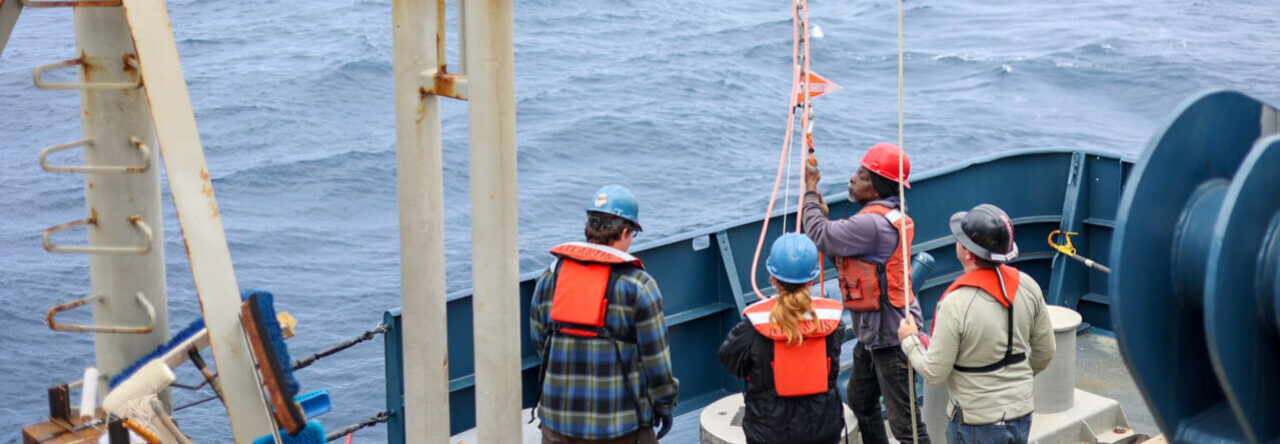
On Monday morning (4/11), during the first leg of the OOI Pioneer 18 cruise, I watched the third and final buoy/mooring deployment. Then, one of the gliders was located and recovered before we did a CTD in the late afternoon. At night, the OOI team performed a dive with ROV Falcon. It was awesome to see my first ROV dive. The goal of the dive was to locate a mooring anchor and instrument package that had been caught by a fisherman and dragged away from the anchor’s intended location. I was able to watch and participate first-hand as the ROV was launched off the back deck through the A-frame. I helped by operating the A-frame and its winch. Emily stood by to supervise and give me tips of how to manipulate the two levers to adjust the A-frame and winch as commands were called out by the operations team on deck. While it was a simple task, it was exciting for me to get hands-on experience during the launch and recovery of the ROV. During the dive and as it descended, the cameras on the ROV picked up fish swimming and groups of star fish on the seafloor. It was interesting to see live biological action from the water column! About 45 minutes into the operation, Jared, the ROV pilot, located the anchor and the mooring line. The anchor and instrument package had dug into the seafloor while being dragged, which essentially buried it. In addition, it was still caught in the fishing gear that had originally caused the problem. It was determined that we could not safely recover the anchor. The mooring line was inspected higher up in the water column. At this location there is a valuable ADCP instrument. It seemed that it could be possible to detach the ADCP via a release that could be triggered by the ROV. However, this operation could not be completed until day light hours. If we tried to do the work during nighttime, the ADCP would be released to the surface and we would not be able to locate where it resurfaced as it does not have lights to signal to us where it was. Overall, the dive was quick and successful as a reconnaissance dive. The chief scientist said that it was low on priority at this point in the cruise, so the dive to release the ADCP will occur at a later date when there is time available. It was a unique experience and I loved watching the screens from the ROV’s cameras. It was also awesome to watch the lights on the ROV disappear into the dark ocean abyss on the way down and gradually appear when it resurfaced.

Deck Operations Leader Chris talks via radio with ROV pilot Jared to complete pre-dive checks of the Remotely Operated Vehicle (ROV) Falcon
On Tuesday, I watched the recovery of the first buoy that is being taken back to WHOI for maintenance. I also began working on a Raspberry Pi project. There was a blank screen in the computer lab, so I was tasked with making it into a screen showing the underway status of the ship. I updated the Pi’s operating system and hooked it up via ethernet. The seas were calm enough that I did not use any seasickness meds.

Recently serviced OOI Surface Buoy being deployed using the A-frame. Each buoy and its attached mooring is normally deployed for 6 months
On Wednesday, to our delight, the conditions were calm again. I changed out the monitor in the computer lab that was not working. I then finished hooking up the newly configured Raspberry Pi to continuously show the underway status screen. In the afternoon, we did a CTD. At this point, my CTD training from Emily and Croy had been completed. I was now leading the CTD casts along with Jess from the science party. For each cast, I tie a safety tether line around the rosette frame and secure the CTD on its platform upon its return on deck. I also communicate by radio with the bridge, main lab, and winch during the cast to make sure everyone is on the same page as each step is initiated and carried out. That evening while cleaning, Croy and Emily happened to find a collection of Raspberry Pis and Wifi dongles that were not in use.

A beautiful sunset during calm seas
Thursday’s science plan was straightforward but exciting for me. From 8:00 AM to 6:00 PM, ten CTD casts were performed on a straight line, 5 nautical miles apart. Working as a team with Jess, I helped lead the casts from on deck. Once we feel we have arrived on station, we check with the bridge to confirm that we have stopped and ask for permission to undo the straps that secure it to its platform on deck while we are underway. Once the CTD is unstrapped, we let the winch operator know that it is ready to deploy. The person in charge of operating and monitoring the science package of the CTD in the lab then chimes in that the lab is ready for deployment. Once the CTD is cast, the lab communicates to the winch operator to a pay out the amount of wire so that the CTD recaches the bottom of the water column but does not hit the seafloor. The lab also tells the winch operator when to stop so that the Niskin bottles can be triggered to close for water collection at desired depths. Once the cast is complete and the CTD is recovered, we help resecure it to its platform on deck. Then we let the bridge know the cast is complete and it’s safe to move on to the next station. In between casts, we flush the sensors with fresh water and use fresh water to rinse off the CTD package to protect it from the corrosive properties of seawater.
On Friday, I checked out all the Raspberry Pi’s that had been recently found. I made note of if they were still working and what was downloaded on them. I used the WiFi dongles that were found to eliminate ethernet cords connected to three of the underway status screens around the ship, including the one I had made on Wednesday. In the afternoon, we did one CTD cast. It felt a little funny only doing one CTD cast compared to the ten casts from the day before.
On Saturday, I woke up early to help with another CTD cast. The REMUS AUV that had been deployed the previous night, completed its mission overnight and was recovered at 6:30 AM. The CTD cast followed it at 7:00 AM. After the cast, I sat down and discussed more of the ship’s acoustic instruments with Emily. This was a great follow up conversation to the one I had with Croy about a week ago, where I learned more about the nuances between each instrument and their ideal uses. This time, Emily gave me a more in-depth demonstration of what the data from each of the instruments looks like and how to adjust settings while using each instrument in order to get the most out of each survey. It was a perfect time to discuss these instruments- the previous day, we had located an anchor using the EK-80, which is essentially a high-performance fish finder. It seems the anchor had not properly been pulled to the surface when the acoustic released had been triggered.

EK-80 data showing the located anchor in the bottom of the water column as the small brightly colored object on the blue background
This called for a second ROV dive to connect a line to the anchor that could be reeled in by the ship to recover the anchor. Before the dive, I helped lower the ship’s USBL pole so that it could register on the Sonardyne software along with the USBL tracking beacons on the ROV and its line connecting it to the ship. This setup provides the pilot a reference of where the ROV is in relation to the ship. This second ROV dive of the cruise was successful, as pilot, Jared, skillfully hooked the anchor with a rope line and clasp. This anchor again had remnants of fishing line which may have caused the release not to work properly. After a lunch break, the operations team repeated the process – during lunch we had moved to another anchor site. This anchor was from past operations and had been on the seafloor for approximately 4 years. I was able to help operate the A-frame again during this second ROV operation of the day to recover the 4-year-old anchor. This time, I had more responsibility because the deck was consecutively recovering both the ROV and the anchor it had just clipped on to. My previous experience recovering the ROV on Monday night helped. Luckily, the job was made easy by the extremely skilled and patient mooring operations team and the Bosun of the ship. I appreciate them allowing me to help with this recovery. When the anchor and one of the water column floats came back on deck, they were covered with biological activity. Significantly more biofouling had occurred on this anchor compared to the others which had only been deployed for 6 months. Most of the science party gathered around, taking pictures of what we had just pulled from the seafloor ecosystem.

 Operating the A-frame controls to help recover an anchor that was hooked using the ROV (photo credits Emily)

Biofouling after 4-years in the ocean
After the exciting anchor recoveries, we began conducting a survey with the EK-80 and the 150 kHz ADCP as we headed for WHOI. With leg 1 coming to a close, we continued heading for WHOI overnight and arrived back at the WHOI dock at 11:30AM. The recovered OOI buoys and mooring instrumentation and gear was offloaded Sunday afternoon. Yesterday, was the nicest weather I have experienced so far on land in Woods Hole. Emily and Croy wanted me to have some time to rest and relax, so I walked to a nearby beach to eat lunch. The sunshine and cool breeze felt amazing, and I enjoyed the walk to and from the beach. In the afternoon, I stopped by the WHOI gift shop to get souvenirs for my family. After a calm restful day in port, I am ready to get back underway. The ship has been reloaded with fresh, smaller-sized buoys and equipment that we will deploy during this second leg. I look forward to sharing the upcoming details!
Until next week!
Tyler