This week, it was finally time to put all our preparation to the test: we had a CTD deployment! Despite Tyler’s and my confidence in our setup, it was still a relief to see all the sensors working properly at 3700 meters and to watch everything come back in one piece. To give the system a little extra TLC after a successful deployment, I overengineered a new syringe (used to flush the CTD’s plumbing and keep the salinity sensors wet to prevent salt crystallization, which might skew later readings) since the old ones kept falling apart.


We were also able to observe more mooring deployments and recoveries in varying conditions. Moorings are essentially long lines of instruments placed at specific depths, anchored to the seafloor, and held upright by big buoys. If we’re lucky during a recovery, we’ll find a nice patch of open water where the mooring is expected to pop up. But more often, the ship has to spend a few hours breaking ice in circles to clear the area, which leads to some pretty silly-looking cruise tracks.


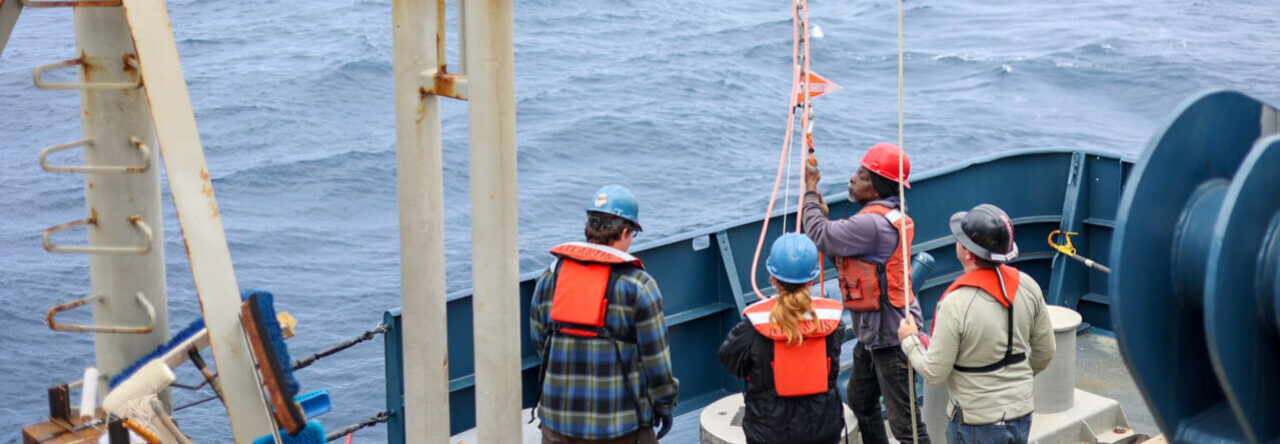
In an ideal world, scientists send a signal to an acoustic release at the bottom of the mooring, which tells us its location and triggers it to disconnect from the anchor so the whole array can float to the surface. The ship then spots the colorful buoys, drives up to them, and the crew uses grappling hooks to pull them closer and hook them to the winch line. The mooring is then dragged to the stern, where it’s hauled up and secured piece by piece using taglines to bear the weight below each instrument. In practice, the lines can tangle, buoys get stuck in ice, and many other complications arise. There’s more to learn every time!
We’ve also been deploying a couple of expendable bathythermographs (XBTs) and Argo floats. XBTs are corded probes launched off the ship that work almost like a single-use CTD. Argo floats are devices that take continuous temperature and salinity profiles for a global data network. Because the network relies on the accessibility of putting these floats out, they’re pretty simple to deploy. In fact, some cargo ships just throw them overboard in the cardboard boxes! We handled them a little more gingerly, though.


One of the most exciting deployments this week was…people! Which is to say, we had an impromptu ice station. Unfortunately, only the Coast Guard ice rescue team was allowed out to conduct training, but it was fun to watch anyway. While it was a serious exercise, seeing the team splash around in a pool on the ice looked like quite possibly the most fun imaginable. I was asked to take photos of the process for the NOAA Corps liaison on board, which felt like a fun crossover moment from my work back home.


Back inside, Tyler and I started our next big project: taking an inventory of all the scientific cables STARC has onboard, which we affectionately refer to as “the cable factory.” That’s meant a lot of multimeter time for me, along with building a spreadsheet. And, if you know me, you know that the spreadsheet is beyond tricked out. The idea is to make it easier for the next person to fix or redo the CTD, with useful info like instrument-specific pinouts. To keep it accessible, I printed out QR codes that link to the spreadsheet and laminated them with a heat gun, since I couldn’t find the laminator. If it’s stupid but it works…


Coming from a science background, one of the coolest parts of being a marine tech is getting to test dozens of hypotheses on a cruise instead of just a few, like the science party. For example, we have two water walls onboard, each with two oxygen sensors. On one wall, one sensor consistently reads about 5 units higher than the others, no matter which sensor is installed in that spot. I hypothesized that the spinning flow meter between the two sensors was forcing bubbles through the line and causing the higher oxygen readout. Tyler gave me the okay to test my theory, and after several trials and alternative hypotheses (the Y valve is causing a pressure drop? the short tubing is causing too high local flow?), we’ve ruled them all out so far. Onto the next one! Maybe a float test…
Tyler has also been teaching me some cool basic tech skills, like tying nautical knots (I’ve got the bowline down) and soldering, which is super cool, though I haven’t quite mastered it yet. I’ve learned more “computer stuff” too, like serial and UDP communication, and SSH, amongst all the instruments and VMs onboard. Tyler tasked me with creating diagrams for related computer and electrical systems, so I’ve been enjoying applying my graphics skills to a new technical subject.


Now that we’ve settled into the ship and its routine, I’ve begun to take more notice of the morale events happening. From Sunday sundaes and pizza parties to karaoke and crafternoons, there’s plenty of fun breaks to be found when you need them. Now that we’ve hit our highest latitude of the trip, I’m also happy to report: I’ve found the North Pole! Contrary to popular belief, it lives in storage in the hull of the Healy. Who knows what else we’ll find! Until next week.


Polar bear count: 0*
*Everyone, PLEASE manifest bears.

Side note: Thank you to everyone who reached out to check in on our safety following the massive earthquake off the coast of Russia and subsequent tsunami warnings. We are quite north and all safe! Tsunamis are generally not too big in deep water but grow to larger heights when they enter shallower water, so even if it did reach us, it would still be a small blip out in the open ocean. Thinking about those affected, and hope you are all safe!