Category: R/V Oceanus

Last OBS cruise

On Tuesday August 5th we arrived at Newport OR from a two week cruise having recovered 33 and deployed 28 Ocean Bottom Seismometers (OBSs) along the Blanco Transform Fault Zone and within the Gorda plate region in the Northeast Pacific. Life revolved around those exciting seconds as I was trying to hook the primary tagline on the instrument while it was bouncing around and drifting away with the swell. I did quite well considering the conditions, missing two times out of 15 attempts.

On Saturday August 9th we departed for the second, shorter leg for more OBS work, deploying and retrieving another 20 instruments. This time I had the midnight to noon watch helping the Scripps technicians on deck and monitoring the science instruments, data logging and network. After breakfast I would work on my small project soldering and potting cables for a Conductivity Temperature Density (CTD) instrument  but if I could not fall asleep I would read Linux for Dummies- it works extraordinarily well. 

Deploying OBSs

Hi Seas Net: a frustrating mystery

By far the most frustrating thing to troubleshoot onboard the Oceanus has been the satellite Internet. Unfortunately, it’s what we need to fix on a regular basis and what people care about the most. Simply put, when the Internet is working people are happy and think highly of the marine tech’s capabilities. When it’s not, well you get the idea.

Early Saturday morning after deploying another Ocean Bottom Seismometer I returned to my station and realized that the Internet was down. I rushed to the main lab to have a look at the L-band satellite modem but all indicator lights were looking good with reasonable numbers for azimuth, elevation, and Automatic Gain Control (AGC). Puzzled by the fact that things looked ok I went up again to inspect our network router, but that didn’t seem to have any problems either.

At this point my limited knowledge prevented me from doing much more. I really didn’t want to begin pushing unknown buttons potentially causing greater damage. Instead I started going through the 500 page modem manual trying to find what could make the Internet go down but have all green indicator lights, waiting for Johna, the marine tech, to come on watch. 

What is frustrating with this complex system is that it could start working by just rebooting, never knowing what was wrong. Other times we go through a long series of diagnostic tests treating probable errors. In the end we are never 100% sure that what made it work is a direct result of a specific sequence of actions we took. 

Once Johna arrived we spent two hours trying to narrow down the source of error. It could be our network router, the satellite modem, the antenna control unit (DAC), the gyroscope input, or even a loose cable. She had a feeling that something might be wrong with the power of the antenna, so we asked the captain if we could use the iridium telephone to call technical support. Steve, from customer service, confirmed that we where outside the footprint of our satellite and we had to increase the power. So we logged into the page interface and changed the power level from -26Dbm (Decibel-milliwatts) to -24Dbm and just like that the Internet started working.

Lesson learned: when we are more than 200 nm off the coast and the internet goes down for no apparent reason increase the power level and see if that helps. 


First week onboard R/V Oceanus

The first 24 hours onboard R/V Oceanus where rough. The vessel’s normal ±30 degree rolls eliminated my interest in any kind of food and slowed down my thinking process. I spend extended time on deck staring at the horizon or in my bed trying to rest. Since then I have been feeling much better as the sea has calmed.

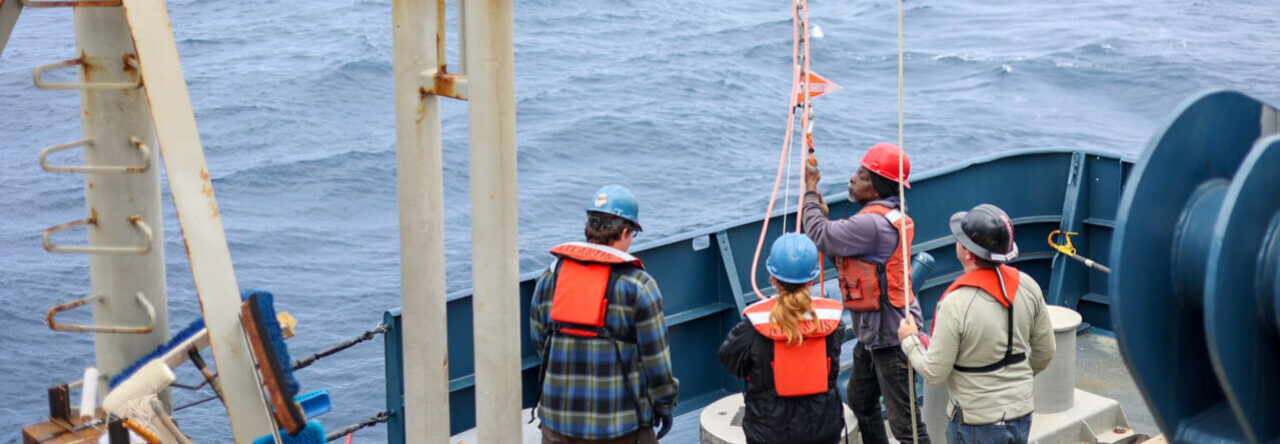
The day of our departure I helped load and secure 24 ocean bottom seismometers (OBS), as part of the Cascadia Initiative offshore component. Technicians from WHOI have been deploying them at specific locations in a counterclockwise pattern approximately 170 nautical miles offshore of the Oregon coast.

I have been on deck for all deployments so far, having the unofficial duty to take down and setup the section of rail the instrument has to clear to go overboard. It’s fascinating being involved in this process; always being aware of staying out of people’s way but still being around to learn and help. It’s also amazing to see all the specialized smaller teams coordinating with and among each other. The four WHOI marine technicians on deck that know all about the OBSs have to communicate with the scientists inside the lab that determine the deployment position, the Oceanus marine technician operating the crane, the crewmember overseeing the operation and of course the bridge where all actions are radioed in for approval.

In addition to that, I have taken up a small project to solder and pot cables that will connect the old Conductivity/ Temperature/ Density (CTD) instrument to the new type of cables. It takes extra patience with this precision work especially on a rolling vessel.

When I am not busy I read manuals on troubleshooting and operating the resident science equipment, how to use the various software, and learn how the satellite communication network works.

Just finished preparing, ready to begin

It’s almost midnight Monday the 7th, and I just finished packing my backpack, charging my electronics and gathering any important documents that I might need the next couple of months. I’ve been going through the checklist of things I need to complete before the internship starts and this blog post is the only one unchecked. In a few hours I’ll be waking up to catch my flight to Oregon to begin my internship onboard R/V Oceanus.

Just two days ago I arrived to the continental US from the island of Hawai’i where I was living in the small town of Hawi on the northern tip of island, a beautiful place with sporadic cell phone coverage and limited internet access. Every Monday the public library would be open after 1700, so after work I would go and check my email for any news from my MATE or OSU mentors, sing up for the COOP course, and start reading operations manuals, safety standards and guidelines for marine technicians.

I am so excited to start this internship tomorrow. I know there is going to be lots of hard work and plenty to learn these coming months but I really think it’s worth it-I feel very fortunate this opportunity was offered to me.

IT WORKS!!

My time on the Oceanus came to an end.  It was a fascinating cruise, I was sorry to see it end.  The load out and interim between cruises for these vessels is very hectic and there is a lot of work to be done.  Repairs have to be made, the lab areas need to be emptied of the science party’s equipment and prepared for the next group.  Then the next group arrives and several days are required to load and secure their equipment.  During this time I was able to wire and plumb my automated CTD Cable Sprayer System.  I installed a junction box with the Arduino and relay in it, with access to the Power over Ethernet connection.  I plumbed the sprayer into the ships fresh water system and, after a little tweaking of the software…BOOM! It worked like a champ.  We were able to turn the spray washer on and off via its purpose built website on the Local Area Net.  The next phase of the project is to get the sprayer to turn on and off based on an interface with the ship’s winch data system.  I will work on that coding while on the Healy, but the system is wired and plumbed and the only changes need to be made to the software.


My time ashore has been informative.  I have done some welding, some machining, some forklift training, and have continued to work on my programing.  The latter I have done with a Raspberry Pi that Dave and Eric lent me to work with.  My plan is to program the Raspberry Pi to act as a dummy winch DESH-5 system then program the Arduino to listen to the appropriate serial data and click on when the data indicates that the winch is spooling in and off when it is paying out.


I have definitely done some grunt work too, which is fine with me.  I have cleaned and organized the main bay area, fabricated an antenna bracket for a cell phone booster in the shop, and put up a shelving unit in one of the Marine Technician offices.  I am happy to do what I can to be useful to these folks.  They have shown me a lot of attention and I am pleased to do whatever work needs to be done.


On a personal note, it has been nice to be able to FaceTime with my wife and daughter regularly, since returning from the cruise.  My wife and I have noted that if I was doing a normal hitch as an ROV Technician, I would be home by now, and we are doing fine.  She has had her hands full with Lilly, but they keep busy.  I have missed them terribly, but its bearable.  So this has been educational from the stand point to preparing us both for the rigors of extended separation, and showing us that four weeks is not so bad…..However 🙂 Poor Alice has 38 more days before I will be home and I think she will be climbing the walls by then.  And I will be sooooo ready to see my wife and baby girl again.

Ocean Bottom Electromagnetic Receivers

Back at the dock now,  The connectivity would hot have made blogging practical, over the last couple of weeks, so I am writing this after the fact.  We left port in a gale and the first two days were pretty darn rough.  Everybody did just fine though, once they got their sea legs – me included.  The mission was to emplace and retrieve Ocean Bottom Electromagnetic Receivers used by Scripps Researcher Kerry Keys and his coworkers to map the resistivity of the Cascadia Plate and to use that data to interpret how water moves in the descending crust.  It was a pleasure to watch his team in action.  They were better than the military – the same precision, but with more continuity and fewer “oh drat” moments, so often caused in the military by high turnover.  These guys had this down to…well, a science:)  

I injected myself into the noon to midnight watch and helped them on deck with the placements and recoveries.  It was an education.  The first few nights we had some real “Deadliest Catch” moments, with 10-foot seas breaking over the fan tail!  Everything was done safely though and the ship’s crew was very patient and professional.

The weather moderated after that and we got a break.  It was fascinating to see the development of the routine of the watches, the division of labor, the interactions between the ship’s crew and the science party (all very productive and professional).  The rhythm of life aboard ship was interesting: the importance of meals, the value of a good cook, the watch-sleep-watch cycle, the pattern of resting, eating and working that form the entirety of your day at sea.  This was compounded by a near complete lack of connectivity so, barring slow emails, there was very little contact with home.

It was funny to see the news, “Hey, I have two bars.” race through the ship when we passed near land and got cellular contact.  Everyone made time to call home, check Facebook and emails, and text loved ones.  I was probably the worst, since I was hungry to hear from my family.

In the interim, between times on deck, I was working on a project for my mentor.  He had me construct a microcontroller based spray wash system for the CTD cable, with a webpage interface.  I am no programmer, but I know a darn sight more now than I did two weeks ago.  Staring into a computer trying to figure out how to break a string into a separate array at the first carriage return in rough weather is a recipe for an urpy stomach.  I had to take routine breaks to get fresh air.  But I was able to get the thing working, and I learned a great deal in the process.

In the last three weeks I have used many of the skills I have learned already; soldering, electrical circuit construction, basic programming, cable management, deck operations, to name a few.  But it is clear to me that I have a lot to learn about networking computers and advanced programming.  Fortunately, I have several more weeks to work with these folks and sharpen those skills.
 

JASON!

I forgot when I did my last blog post, but when we were working on the Oceanus, the NOAA ship the Tommy Thompson was tied up next to us.  Lo and behold, on her fantail was the most famous ROV of all…JASON!  My mentors know a bunch of people on the Thompson so we got to visit.  I got to meet JASON’s crew and chat for a while.  The supervisor gave me some good information about being an ROV Technician.  For a budding ROV guy, it was pretty cool!

On Board the R/V Oceanus

Only four days in to my internship and I have already completed two task that are the stock and trade for ROV Technicians (my future career): cable lubrication and cable termination.  My mentor has me working on a great project to build a microcontroller operated spray wash system for the CTD cable as well.  Tomorrow we depart for a 12 day mission to deply and recover geophysical devices.  If I learn as much in the next 12 days as I have in the last four, my head will explode!


Page 2 of 2

Powered by WordPress & Theme by Anders Norén