Category: University of Washington, School of Oceanography Page 2 of 7

Week 8 with JASON/WHOI

August 21st-August 27th

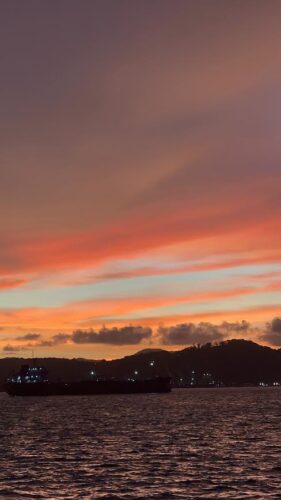
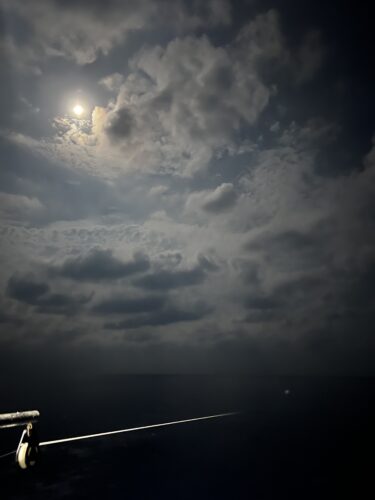
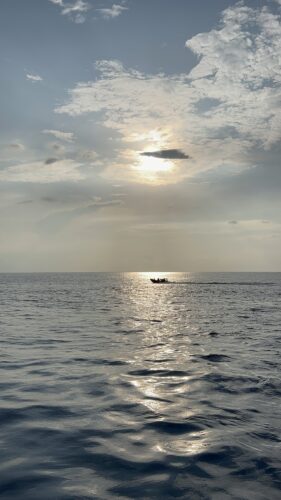
Two months in and it just keeps getting better! This last week we finished up the first leg of the Kelley Cruise, and even though we had a few weather days, we finished strong with 3 successful dives on Tuesday, August 22nd and were back at port by 6pm. Since these cruises were follow-ups of each other, we were given the day off on Wednesday, August 23rd. It was much needed, and many of us spent the day running into town to get supplies and then ended the evening with a fire on the beach, enjoying the ocean sunset.

This port stop was short lived, and by Thursday, August 24th, we were heading out again by 6am. This time, we transited for 18 hours over to the Mt. Axial locations to continue replacing science equipment. Along the way, we prepped JASON and completed predive checks so it was dive-ready as soon as we got on location. Friday and Saturday 12am-12pm shifts were composed of multiple dives, replacing cameras and junction boxes at various depths ranging from 2000-2200 meters. One of the sites we visited is called the Ashes location and was absolutely stunning! Seeing these hydrothermal vent locations and stacks is definitely a favorite of mine.

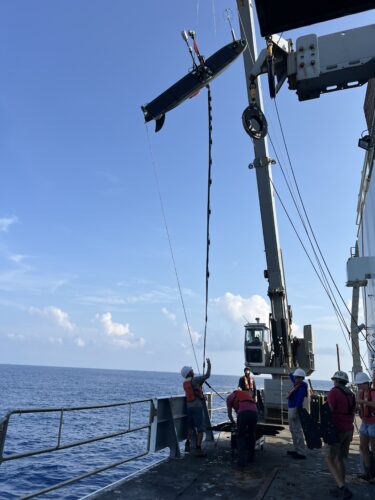
Nearing the end of our shift on Saturday, our crew received a distress call from a nearby MBARI team, who lost their AUV in the thermocline area at approximately 60 meters. It was incredible to see not just our JASON team, but the science members and Thompson’s crew all pitch in to help out. I assisted in concocting a quick, clip-on float that we rigged to JASON’s basket that would be connected one of the AUV’s handles, which would give the vehicle enough positive buoyancy to bring it to the surface. In under one hour, we launched JASON with the float and utilized the AUV’s tracking address (provided by MBARI’s team) with our own Sonardyne system to track the AUV. Within 15 minutes, we had visual of the AUV, grabbed onto it with one of JASON’s manips, while the other manip removed the float from the basket and attached it to the AUV’s handle. The Thompson repositioned itself so it would be clear of both JASON and the AUV upon surfacing, and we were able to release the float, which promptly surfaced the AUV within seconds. I was so very excited and proud to be a part of something like this!

Once the AUV was recovered, we began a long transit back to shallower locations (700-800 meters) and spent Sunday, August 27th visually surveying the seafloor and then swapping out junction boxes, cables, and connectors. With only a couple days left of this leg of the cruise, we are hoping to complete all science objectives tomorrow and use the added morning on Tuesday for exploration of uncharted areas.

***Look closely! You can see JASON about to surface (left), the recovered AUV at the surface (above and to the right of JASON), and the vessel in the background (on the right) waiting to swoop in and collect the AUV***

**Here is a shot of the clip-on float we attached to the basket that carried the AUV to the surface (left)

Tip of the week: “Shift and eating adjustments are a must! Plan ahead.”

Changing shifts can be quite the task, especially going from 4hr-split shifts to 12-hr shifts. I am usually in bed early and an early riser, but this shift has me flipping my natural rhythm. I now work 12am-12pm, work out, shower, eat lunch (well, to me it is “late night dinner”) and then try to sleep from 2:30pm-10:30pm. I have struggled with falling asleep, especially since I am used to split shifts and only sleeping 4-6 hours. As I start to adjust, we then head into port, where we flip back to day shift for only a day or two, and then switch right back to our 12-hr shifts. I continuously plan my days out to be sure I am resting enough, but also eating too! Since I work at unregular serving times, I tend to stash meals from one day to eat that following morning from 12am-8am. So when I wake up before my midnight shift start, I have a sort of “breakfast” and “lunch” option. Otherwise, you can get stuck in the cycle of grazing through the sugary snack treats available in the mess throughout the night. I have been nicknamed “the squirrel” since I squirrel away meals for my next midnight shift. In the end, I feel better with the healthier options and have more energy without the sugar crash later on. Just a little something to think about if you consider working in this field!

7th week at sea with JASON/WHOI

My oh my, how the time is flying by! Another week in the books from Monday August 14th to Monday, August 21st of the first leg in the Kelley Cruise series. This leg focused on utilizing JASON to carry down equipment ranging from BEPs (benthic environment profilers), to junction boxes (power supply boxes essentially), and undervators which are extremely large and heavy under-water elevators (thus the name undervator) which we used to transport camera and light systems to the seafloor.

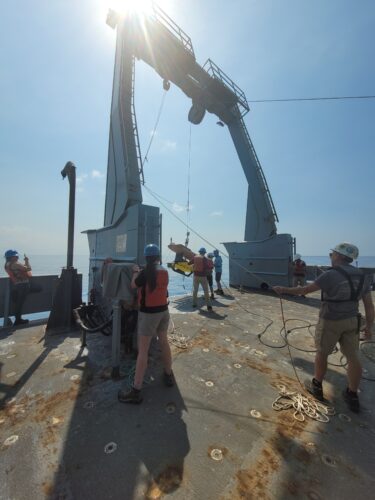
We started out of port on Monday and immediately switched to our 12-hour shifts. I was assigned to the 12am-12pm shift, which took a couple days to adjust to. This is set up so teams can work 24/7, with each team consisting of 5 people: 2 pilots, 1 engineering position, 1 navigator, and 1 data/support person. My role continues to be in the engineering position. This expedition entailed multiple dives each shift usually. We would latch JASON onto the science equipment on deck, crane it over, and gently fly it to the seafloor where the rov would detach, assemble, plug in, and turn on these pieces to start collecting data. Once completed, JASON would then load up the older equipment and bring it up, where it was unloaded on deck. This swapping of equipment was done quickly but carefully. The larger loads can be dangerous to launch with JASON, especially when applying the tether floats in large swells. The load sway can create slack in the tether cable and then snap back with thousands of pounds of force, so communication with the football handlers (myself included) and the crane operator were very important.

Our multi-dive shifts continued throughout the week until the weather worsened with high winds, waves, and large swells. Unfortunately, this led to a weather hold which lasted Saturday and Sunday. By Monday morning the weather calmed, and we were able to get back to diving! We started out at an 80-meter site, which is a new one for me! These shallow dives can be very challenging, but we were able to launch a dive test first at 9am and successfully completed it. By 11:15am we recovered JASON and finished post dive checks so that the next shift would be dive-ready!

We only have 1 more day left before returning to port, but the new experiences I have gained in the last week alone is incredible! I look forward to what tomorrow brings!

Tip of the week: “Team building is a must.”

In a career like this one, you become close with the members of your team not just because you are on a ship for weeks on end, but because you work together for a goal: to maintain and operate JASON to complete all science objectives. All aspects of doing this requires a level of trust and respect, knowing that we each have a vital position in making this happen. There was no better representation of this than a few days ago, when the weather worsened, and my team had to recover JASON carrying a heavy BEP in the dark. Myself and another team member were removing the tether floats, timing each one just right to avoid the dangers of the slack-snap but without seeing the wave actions. Thankfully, our crane operator had a light out to monitor the water and would call out to us when the small few seconds of a window would open for us to safely get in and remove a float. Yes, this process took some time, but we were able to finish it without injury, and safely load both JASON and the BEP back onto the deck. Without this trust and communication, the likelihood of a serious injury happening would be extremely high. I consider myself privileged to be working alongside these amazing individuals.


6th week with JASON/WHOI

6th week with JASON – WHOI

Monday, August 7th – Sunday, August 13th

The new week marked the end of the Orcutt Cruise as we began transit back to port. Unfortunately we hit a few “bumps” in the cruise and are heading home with a faulty winch/level-wind system and an elusive ground fault in the temperature probe that we have been unable to track down. The demob kicked off with emptying the vehicle’s oils to remove science cables from the j-boxes, repeated test casts to try and identify the level-wind issue, and clearing out the rov’s front basket to prepare for the next mission.

Once at port, the team detached JASON’s sled and swapped it out for a heavier, slightly shorter sled made for the heavy lifting Kelley Cruise. The last cruise is actually broken up into 4 legs, each lasting between 1-2 weeks and will go until the end of my at-sea internship, approximately September 20th. The days this week were spent mobilizing for this new, highly-technical cruise. I have been informed that when we leave port, the first dive will be within a couple hours and only 80 meters deep. We will be launching JASON up to 5 times a day to transport equipment to the seafloor, bring up old set-ups, and make adjustments/altercations as requested by the science/engineering party. The shifts will also be changing to 12 hour on/off shifts. Each shift will consist of 5 people; 3 in the control van and 2 on deck for launch/recoveries. This is a welcome change from the split shifts primarily because during your 12 hours off, you get the full 12 hours. Even if there are issues with the vehicle, the shift that is on is the only one that responds.

The weekend was spent reterminating the tether cable and completing a pull test. After that was successful, I was able to spend an afternoon prepping and splicing the optical fibers, fed it into JASON’s mainframe, connected and tested them to ensure acceptable light levels. It was my first solo optical fiber term and I was able to do it next to the vehicle, during high wind gusts, and constant crane operations overhead. It tested my focus but I really enjoyed doing it!

By Sunday, we finished all repairs and maintenance and were ready to leave port. Unfortunately, due to high winds offshore, the departure was pushed to tomorrow. I am looking forward to the new style of dives and fast-paced, technical aspects of this cruise.

Tip of the week: “Treat yourself”

It can be hard being away from home/family for long periods of time, but one perk of coming back to port is that you can receive packages that either were sent to you or that you ordered. Since coming out, I have ordered some colder-weather gear and it was almost Christmas-like when we loaded everyone’s mail onto the ship. Some people get mail from their loved ones, and others get the packages and shipments they purchased while at sea. It is also a nice treat to order some snacks or healthy options (whatever you prefer) to have while you are working. There are some snacks/food in the mess hall, but there is something special about having your own little snack station at your desk area. The comfort of your favorite treat is a little reprieve you can get while so far away from home.

For me, I like to have a bag of jerky, honey roasted pistachios, peanut butter m&m’s, electrolyte packets to flavor my water, and protein powder to have. It is a little mix of healthy and snacky that suits me just right!

Week 2: Over too Soon

During week two we hit our stride with diving and in turn, I feel like I got into a routine. During the cruise, I worked the 8-12 shift, working 4s was a new concept to me. This took some initial adjustment as I was unable to get a full eight hours of sleep in one go. I eventually settled into a routine of sleeping 6 hours at night and taking a two-hour nap during the day. We continued to have fantastic weather and we even saw the northern lights! I don’t think we could’ve asked for better conditions. 
 
Despite our trouble launching at the start of the trip, we eventually had back-to-back successful dives and even found ourselves ahead of schedule at one point. When this happens the Jason team allows time for pilot training, during which I was allowed to pilot and operate the arms! Being able to control Jason was easily the highlight of my trip, it was such a cool experience. The breakdown of diving operations is fascinating to me. On each watch, three operators act as pilot, engineer, and navigator. The pilot is responsible for the operation of the vehicle and dictates to the rest of the team how to assist the vehicle. The navigator’s primary responsibility is to coordinate with the bridge on moving the ship, and the engineer helps run the cameras, winch, and auxiliary Jason functions (like the hydraulics and power).
 
Further into the cruise, we ended up having more difficulties. The level wind system to coil cable was acting up and the team spent much of their free time trying to fix this issue (including the transit back to shore). Once on shore we had a post-cruise party and continued maintenance Jason. I departed on the 9th.  As quickly as it started my time aboard the Thompson has ended, I feel so lucky to have had this opportunity. It has truly been life-changing

My brief stint as pilot:

Me assisting in post dive check of Jason:

4th and 5th week with JASON/WHOI

Weeks 4 & 5 with JASON

Holy wow! The last two weeks have been very eventful!

The 4th week we wrapped up the HUBER cruise with 2 more successful dives where we completed water sampling objectives and began our transit back and arrived in port on Wednesday, July 26th. The team got right into demobilization mode and we spent the next 3 days replacing the winch level-wind motor, removing the SUPR sampler from JASON’s aft underbelly, drained the j-boxes and removed all of the science cables/wiring. The most exciting part of this demob for me was that I got to complete a retermination of JASON’s optical fiber on Thursday July 27th. I started at 8am and was overseen by the lead ET (electrical technician). I was able to follow the manual and complete the entire process, including wiring the finished fibers into JASON’s port-aft j-box and testing to ensure minimum signal loss.

On Friday, July 28th, the leaving team members and science crew departed, and it gave those of us staying the chance to relax while also moving our rooms to prepare for a much larger science party to come aboard the following day.

Saturday, July 29th was the official start of the Orcutt Cruise. New JASON and science team members arrived and by 8am, and mobilization began. The port manipulator has to be broken down and repaired since it has started leaking during the last couple dives. The next 3 days our team wired in new science cables, arranged and secured new equipment and mounts on the basket, built and assembled 18 push cores for sediment sampling, filled the vehicle with oil, bled all lines, comps, and thrusters, and made sure the electrical harness was solid. The Thompson departed port on Monday, July 31st and JASON’s predive checks were completed.

5th week:

We launched our first dive on Tuesday, August 1st and continued to recover and launch almost daily until our last recovery on Sunday, August 6th. This last week of dives were successful, but the team faces numerous challenges ranging from port manip leaks, port swing-arm actuator leaks, air motor replacement, temperature probe ground faults, and winch issues. Each one, the JASON team tackled together, and the turn around time for repairs was amazing. This team really loves what they do and are dedicated to vehicle maintenance to ensure science objectives are met. It can be quite daunting when things seem to go wrong, but this crew faces what is in front of them, one thing at a time, and still take the time to teach others about this amazing system.

In the mix of trouble shooting, diving, and water sampling from corks, I was given the opportunity to fly JASON while transiting to new locations. It was so exciting, I felt like I leapt into the main chair! I was able to practice my lateral transiting, landing on fine sediment surfaces without kicking up dust, and centering the vehicle for science cam visuals. It was a blast and I even got to stop and check out a skate, weird sea cucumber-like tailed marine life, and a sort of bubble-like growth at depths of 2600 meters. I still gasp when I see new marine life and absolutely love every minute of being out here. 

The Orcutt cruise dives came to and end Sunday, August 6th when the winch level-wind started making an intense, vibration sound. This lead to cutting the last dive short, but we were able to complete all of the testing and science equipment retrieval before recovering the rov. As we head back to port, we will begin demobilization and continue testing the winch system to identify exactly what this reoccurring issue is.

Tip of the week: Find some balance.

Having a career out at sea has its own set of challenges. Being away from home and loved ones can be a hard thing to adjust to, but also finding some sort of balance for yourself. Some people enjoy watching movies, reading books, or exercising. It is important to find a little “you” time while out here. I try and stick to a schedule, even though it can change considering what is happening at that very moment. Luckily, we have a small gym room, and I really enjoy working out. It is a little time for myself to stay active, work off stress or overthinking, and I always feel better after. Whatever helps ground you, I suggest making time each day for it. Especially if you are staying out for months at a time.

Week 1: Arrival and starting Jason Ops

Once I arrived at the R/V Thompson Saturday morning, we began preparing Jason for the cruise. I assisted where necessary but my personal highlight was mounting and troubleshooting the science party’s powered devices. In order to connect the various sensors and actuators to Jason, we drained mineral oil out of the junction box housings then set to work connecting cables. Late into Sunday and Monday morning, we discovered that the MPS and ODI couldn’t communicate. We set to task isolating the fault (wether the issue was subsea or topside) and eventually narrowed down the issue (for both systems) to the adaptor that interfaces the serial connection through the control van (topside) to science’s laptops. Once we realized the issue we were able to build the correct adaptor and fix the issue! It felt great to contribute.


The ship embarked Monday and reached destination Tuesday. Other problems have arisen but as of now we are operating normally. As weird as it sounds, I am thankful I have witnessed issues because it has allowed me to be hands on with Jason. Whether it was building the adaptor, performing pre dive, or sitting in the engineer’s seat for ops, seeing the team troubleshoot issues is a pleasure.


I was nervous going into this experience, primarily because I’ve never spent extended time at sea. Once we started moving I did feel slightly queazy however that feeling has since faded. I was shocked to find the food aboard delicious and the berths are comfy. All in all, this has been throughly enjoyable and I look forward to updating you all as the cruise progresses.


Picture of me wiring Jason’s port side junction box:


Emergency Suit Drill:


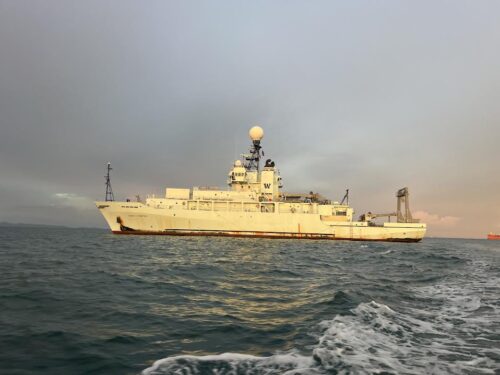
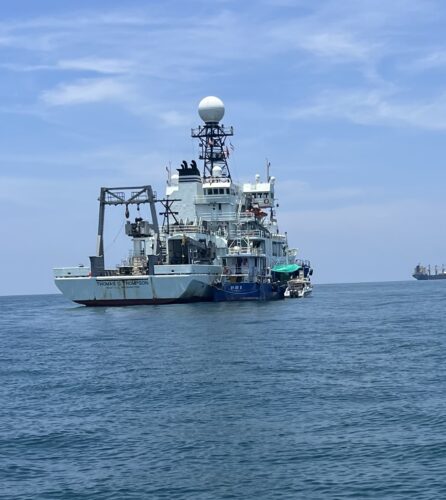
The R/V Thompson:


3rd Week with JASON

Week 3 with JASON

Monday (7/17)

Last morning at port! Today was spent discussing alterations such as adding a wrist camera to the port manipulator, so science is able to have views from both wrists when sampling hydrothermal vent sites as well as basket changes to house all of the sampling equipment and storage needs.

We then continued mobilization for the HUBER cruise with:

Securing and testing the SUPR water sampler.

Adjusting NISKIN water samplers.

Attaching the port manip wrist camera.

Predive checks.

We began our transit around 3pm. This should only be a day transit and are hopeful to dive tomorrow afternoon.

Tuesday (7/18)

For this cruise, I will remain on the 8 to 12 shift starting when we dive.

This morning we finished mobilization with:

Securing JASON’s electrical harness.

Completing a final predive check.

The first dive launched at 12:30pm and recovered at 9pm. We were able to pilot JASON down to approximately 1600 meters to position water sampling equipment near hydrothermal vents around Mount Axial.

Wednesday (7/19)

This cruise will entail daily dives if everything goes well.

This morning we launched JASON at 3am and I was able to work my 8am-12pm shift in the engineering/copilot seat. This position is where I will mainly work during my at-sea time, and it has responsibilities such as:

Overseeing vehicle functions, pressures, ground faults, gauges, etc.

Completing hourly checks on pressures, temps, winch system, and jetway voltage/amp output.

Operating/adjusting JASON’s cameras to help support pilot’s job.

Cable management.

At 8pm we recovered JASON and completed post dive checks.

Thursday (7/20)

4am launch! By this time, we are like a well-oiled machine. Each JASON team member takes part in the launch and recovery of the rov. Somedays I get to hold all the tether football floats while someone else clips them onto the cable, other days I am the one latching the floats. There are so many steps to launching and recovering, but we have trained again and again what to do, who will do what, and it has become muscle memory for most of us.

8am-12pm shift: Copiloted while collecting water samples from hydrothermal vents.

Recovered JASON by 6pm and completed post dive checks.

Friday (7/21)

Midnight launch did not go as planned this morning. When JASON was lowered into the water, a wave jolted the rov upward, which resulted in cable on the drum to loosen. This can be a huge issue, but with the quick thinking and communication of team members on the crane and in the control van, the situation was resolved, and adjustments made so we could successfully launch at 3am.

8am-12pm shift: Copiloted.

Recovered JASON at 4pm and completed post dive checks.

Saturday (7/22)

Another successful midnight launch.

8am-12pm shift: Copiloted. While overseeing the vehicle, I noticed a leak in the wrist of the port manipulator. I informed the pilot, and that arm was stowed to stop the leak.

4pm: Recovered rov and swapped out leaky manip with a spare. Unfortunately, while I completed vehicle checks later in the evening, I noticed this spare arm was also leaking. I made sure to clean the area of possible residual oil from the change over, but upon observation, identified more oil seepage and notified my team lead. The arm was serviced, and a second comp system added to help support the arm in case the leak continued.

*At this time I was nicknamed “the problem finder” because I have a knack for finding air bubbles in tubing and hoses, water or air in j-boxes, and oil leaks…even really small ones. I just can’t wait until I can also be a fixer of all of these problems, I am able to identify.

Sunday (7/23)

Another midnight launch……and I copiloted for my 8am-12pm shift.

The vehicle was recovered and on deck at 4pm with hoped of a “quick” turn-around.

Launched JASON at 8pm and stood on “winch watch” until it was at a depth of 1500 meters.

From 9:15pm-12am I copiloted. 

Tip of the Week: “Review and repeat”

I have adopted the habit of checking the vehicle’s comps, hoses, securings, connectors, bleed valves, etc. every time I am even near JASON. If we are standing nearby, I find myself surveying the parts nearest me, and even checking the ground for oil drops that could potentially be coming from a leak. This thoroughness and awareness of the vehicle allows one to pick up on issues that may present small in the beginning. Instead of just wiping away oil and forgetting about it, I wait and observe. Sometimes a leak is so small it takes several minutes for the oil to accumulate and form a droplet running down the arm. I try to practice this diligence every time I am in view of JASON, even if I am off shift. This potential leak could end a dive early, so it is important to identify it and resolve the problem. And as always, if you have questions or concerns, just ask your team lead.

Intern Introduction

Hello!

My name is Adam Ensminger, I am a senior in Computer Engineering at West Virginia University. This past academic year has been an interesting one for me. Last fall I studied at Korea University in Seoul, South Korea. Then in the spring I took time off to work as an arcade repairman, while there I was selected by the MATE program. Upon hearing the news I decided to leave my job and backpack Europe until the start of my internship.

I have been selected to sail on R/V Thompson with WHOI’s Jason team for the Orcutt cruise. While I am new to both the field of marine technology and life aboard a ship, I plan to go into this cruise with an open mind and I intend to learn as much as I can. I am incredibly excited to embark on such a fantastic opportunity and I look forward to sharing my experience with all of you.

2nd week with WHOI

Week 2 with JASON

Monday (7/10)

This was a day of transiting spent servicing parts and completing predive checks to ensure JASON is ready to dive at midnight.

The next set of dives are considered “bounce” dives, where the rov will carry down new science equipment to swap out with older ones on the ocean floor.

Tuesday (7/11)

12am – Successfully launched JASON to complete the first “bounce” dive. The depth is more shallow, only 650-700 meters. Science equipment was switched out efficiently and we recovered by 2:30am.

6am – Prepared JASON for another “bounce” dive, but while launching faced some mechanical issues and aborted dive. The team worked together to identify and resolve the issue at hand, and we were able to resume diving.

1:30pm – Completed a second “bounce” dive to exchange equipment at the same depth and has JASON back on deck by 3:30pm.

Post-dive checks were completed, and new science equipment was secured for the next dive.

Wednesday (7/12)

Last dive for this expedition!

2pm – Launched JASON and switched out the last of the equipment on the ocean floor at a depth of 700 meters. The dive went smoothly and there was extra time to collect visual images of the area so science members could complete a mosaic of the study area. During the collection, everyone was able to enjoy a vast assortment of marine life like octopus, fish, crabs, sponges, and corals.

6pm – Recovered ROV, completed post dives and began transiting back to port.

Thursday (7/13)

On the transit today we started our demobilization with:

Removed science cable wiring from the front port-side j-box. 

Stripped down the front basket to prepare for the next cruise.

Drained the vehicle’s fluids and serviced the ROV.

The ship docked at 2pm and the team was able to have the rest of the afternoon off to relax. We ended up disk-golfing and having dinner at a local restaurant. This shorter cruise had gone quite well, and the science and rov team were satisfied with the amount of work completed. 

Friday (7/14)

Today was spent servicing the rov. We reconnected hydraulic lines and equipment, filled the junction boxes with oil, secured all lines and hoses with zip-ties, cleaned and situated all pieces on the vehicle so it was neat, organized, and easily manipulated, if needed.

The science team departed this morning and the new one arrives tomorrow.

Saturday (7/15)

New day, new cruise!

Today began our official mobilization of the HUBER cruise. Some of the science team joined us on the R/V Thompson, while others’ schedules have them arriving tomorrow.

A few WHOI personnel flew out to help with this mob and I was able to reconnect with some who I worked with last summer.

This cruise will be heavy on the sampling side, so we began assembling and mounting:

The single bottle slurp system

A SUPR sampler for water samples

3 NISKIN water samplers

-I got to spend a few hours under JASON’s “belly” running and securing trigger lines. Although some of the mob duties require fitting into smaller places, I really like being able to “get inside” the rov and implement new tools for sampling.

Sunday (7/16)

Continuation of mobilization:

Rechecking mounts and lines from yesterday

Tested NISKIN trigger lines

Create a layout for the basket which will hold multiple sample bio-boxes, milk crates, 3 major water samplers, temperature probes, the slerp hose/handle, and other science equipment as needed.

Trained for operation and troubleshooting of the SUPR sampler. 

Tip of the Week: “Safety first”

No matter what the situation is while at sea, always remember the most important thing: Safety First! This career focuses on maintaining and operating rov systems for science purposes, but one’s safety outweighs any equipment or operation at any time.

This is extremely important, especially when deploying or launching the rov. As the crane lifts JASON, we do help stabilize the vehicle with a person at each corner. For every lift/lower event, always remember to watch where you position your feet and hands. Equipment can be fixed and replaced, your health and well-being cannot.

Be safe out there!


Let the adventure begin! Week 1 with WHOI

Week 1 in the books!!!! (7/2-7/9)

Sunday (7/2)

Here we go!!!!!! I’m leaving……on a jet plane………and heading from Traverse City, MI to Portland, OR. The official start of MATE’s long-term internship 2023!

Luckily these flights were merely delayed a few hours, so I made it to Portland by 3pm.

This first evening will be spent catching up with the JASON team members who I worked with last summer. We reminisced about the previous science cruises, successes, and struggles while discussing this summer’s objectives.

Monday (7/3)

After breakfast, we divided into groups and loaded up to head from Portland to Newport. The few hours spent transiting allowed a few of the newer individuals to get to know each other before reaching our next hotel. We stayed the night at a location right on the coast and celebrated our arrival with dinner at the hotel restaurant while watching the sunset over the ocean. I really enjoy watching the JASON team members come together like an extended ROV family, sharing stories of their previous endeavors, future goals, and many laughs throughout the night. It really sets the tone for the upcoming cruises.

Tuesday (7/4)

Happy 4th of July!!!!

Up and at ‘em early! We arrived on the Thompson early enough to unload our belongings into our berths and begin work at 8am sharp!

Mobilization is the name of the game! This morning was intentionally started early so the crew could prepare the back deck so the tool and rigging (equipment/storage) vans could be loaded and secured in place. We were able to load the control vans on top of the tool and rigging vans before having to break.

There is a local race every July 4th, and runners come through along the dock, which pumps the breaks on our mobilization efforts.

Once the vans were secured and runners exited the dock area, we set up the stairway to the control vans, unloaded all the storage vans, set up the ROV lab, and brought JASON onto the deck of the ship.

It is impressive to see how quickly an empty back deck can transform into a major ROV workspace. The communication and teamwork make the process faster than one would expect.

Towards the end of the day, we began vehicle checks and focused on the pan and tilt(p&t) cameras. We removed, cleaned, filled the comps, and remounted the pilot and science cams.

Wednesday (7/5)

While in port, the schedule tends to be from 8am to 5pm, but once we depart and dives begin, the shifts change to the 4-on and 8-off split. For this cruise, I will be on the 8-12 shifts, so 8am-12pm and 8pm-12am.

For today, the team divides to conquer mobilization tasks. The team I am working with focus on vehicle checks and maintenance.

In continuing the work from yesterday, we verify the brow p&t is good to go, but had to comp the aft p&t.

Mounted 2 deck cameras, secured their cables, and tested their systems.

Retermination of the Optical Fiber****

I was really excited to be involved in this! My marine electronics fiber fusion splicing practice was essential here! Once we finished connecting the new fibers to JASON’s aft, port-side junction box (j-box), we tested and verified light levels. And success!!!! This was a bit tedious and the retermination process is too much to try and describe here, but it is a favorite of mine. Last summer I was only able to observe, but this year with having completed classes specifically relating to this, I was able to assist with completing this. 

Thursday (7/6)

Continuation of mobilization:

Wired science cables into the front port-side j-box and verify voltages. 

Tested fiber cables and cleaned connectors, then rested. 

Brought up Jetway voltage (105 volts).

Completed Predive checks for ROV.

Friday (7/7)

Last morning in port! The team’s goal is to wrap up loose ends and prepare for departure. The first dive is scheduled for tomorrow, is all goes smoothly.

Tasks completed today included:

CTD configuration and mounting.

P&T camera adjustments

Fill junction boxes

Bleed all of the air out of everything! -J-boxes, comps, manips, cams, etc……on the hunt to remove any and all air bubbles from lines.

Preparing for departure included securing everything that could move once the ship is underway.

Completed Predive checks.

The Thompson departed at approximately 4:45pm and we are officially at sea!

Saturday (7/8)

Back at it again with adjusting the Pilot p&t motion adjustments. We had to ensure that it only rotates a certain distance left-right, and up-down. This morning was spent verifying topside and predive checks.

I identified a small amount of water in the port-side aft j-box, so we drained it, removed the water, and refilled the j-box with oil.

We then completed another set of predive checks, which were successful.

4pm: JASON’s first launch

I was able to participate in the first launch, and it went very well.

This first dive should be around 800 meters deep and is scheduled to last anywhere between 6-24 hours.

8pm-12am: First split shift

Co-piloted from 8-10:30pm, overseeing the vehicle’s systems and completing hourly voltage, pressure, and temperature checks.

By 10:30pm we completed dives tasks and added objectives before recovering vehicle.

10:30pm: Recovered ROV, completed visual inspection, and washed it.

Sunday (7/9)

This morning we completed Post-dive and Predive checks, tidied up the tool van, and now have some free time on our hands.

We will be transiting to our next location, and our second (and possibly last) dive will be in a couple days.

My first week back with JASON has been wonderful. There was no “readjustment” period, it seems we all stepped right back to where we were last summer. The group is fantastic! Each willing and enthusiastic to share their knowledge with others.


Last summer I shared a weekly tip, so I will do my best to carry on this tradition.

Tip of the Week: “See something, say something.”

-In this line of work, the idea of double-checking and triple-checking your work as well as other’s work is essential. Sometimes a fresh pair of eyes, no matter how experienced they are, is just what is needed. If you are newer in this field, always ask questions. The only bad question is the one not spoken. Or even just an observation. A small amount of water in a j-box could prove to be detrimental to mission success, so pointing it out to your team lead is vital.

Everyone contributes to these cruises, and everyone has a voice. This team makes you feel included, heard, and important.

So let’s do this!


Page 2 of 7

Powered by WordPress & Theme by Anders Norén