Category: Columbia University, Lamont-Doherty Earth Observatory Page 9 of 10

RV Langseth: First week out at sea

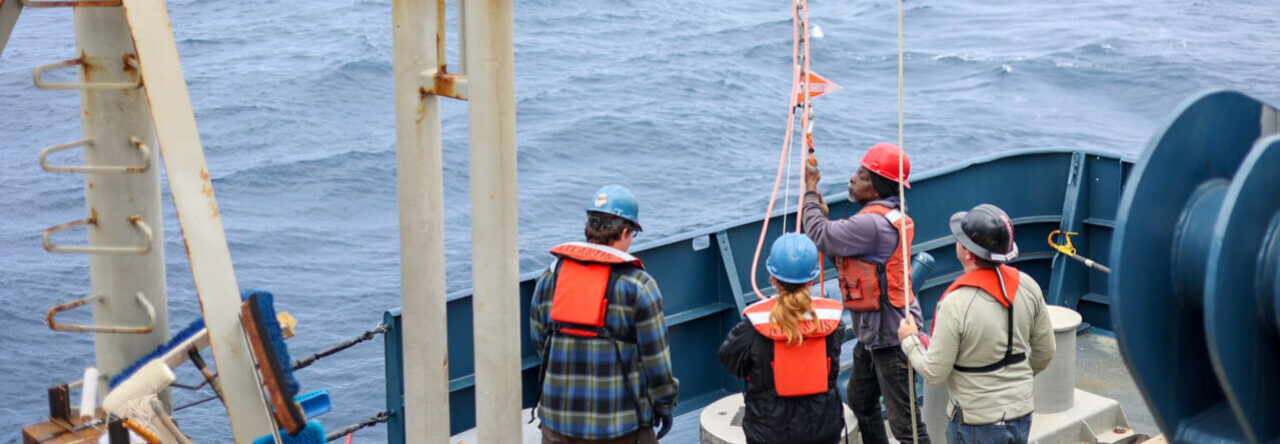
This past week has been very busy. We spent all weekend getting ready to head out on Monday. I spent most of my weekend rebuilding the air guns. We were able to leave port about 9 am on Monday morning. While transiting to the survey site we deployed the cross cable, doors, and head floats. The doors are 4m tall floats that have fins designed to spread the cross cable to cover the intended area. While deploying and recovering the doors my job was to help disconnect the lift ropes and then run the 50 Ton winches that let the doors out and in. We were able to fully deploy the p-cable and streamer on Tuesday but we had to fix a few issues. Last night I got my first try as a data acquisition technician. This means that I was in charge of making sure the guns were firing at a proper rate and also logging any shots that were missed or not recorded.

            One of the best things about living on a boat is the food. Every night we have had a different meal. We have had everything from fish, steak and scallops, to chicken, potatoes, and pie. I will try and post next Wednesday but it depends on how well the mission is going.

RV Langseth: First few days on the boat

            I decided to delay my second blog post because of the lack of news. I arrived in New York yesterday and made it to the boat just in time for dinner. The guys I’m working with have been showing me how things are done around here and explaining a little bit more in depth of what we will be doing.  I had some down time to explore the ship and start to figure out where everything is. This morning another tech and I checked out the birds that will go onto the streamer to make sure the program had the correct serial numbers to be able to communicate back and forth. After the morning everything slowed down a little bit while we were waiting for other people to arrive. I also helped to replace a UPS(Uninterruptible Power Supply) to keep the electronics running in the event that we lose power. Tomorrow will be busy because we will be spooling the P-cable that we will be towing.

            I found out that we will not be leaving port until Monday, which will give me time to get anything I may need while out at sea. The cruise plan is to complete a survey of an area approximately 20 miles off of the Barnegat Inlet in New Jersey to about 150 miles offshore. I was also informed that I will be working the day shift which is from 12 noon to Midnight while we are sailing. In the next few days as we prepare to leave I will be trying to get onto this schedule and I will make another post later on in the week as I get more involved and learn more about what we will be doing.


-Tyler

RV Langseth: Getting ready to go

Hello everyone,

My name is Tyler Hackett and I have been choosen to be the MATE intern aboard the RV Langseth. I am currently a senior in Ocean Engineering at Florida Institute of Technology. My main focus within the field of Ocean Engineering is Marine Technology which includes Remotely Operated Vehicles, Instrumentation, and sub-sea technologies. My senior design project that was completed last year invloved a mechanical and electrical overhaul of ROSCo (Remotely operated sea crawler).

I am very excited to have this opportunity to spend time at sea doing research that I have a passion for. I have already started packing for my departure next tuesday. While on board the Langseth we will be testing and using several different types of marine instruments. Some of the instruments that will be used include ADCP (Acoustic doppler current profiler), 3D Siesmic scanners, 2D seismic scanners, gravimeters, and magnetometers. Throughout my internship I will be going more into depth on how each of these instruments work and the data that can be obtained from them.


It’s the Final Countdown!

     It’s the final countdown, unfortunately we only have 4 days left of this expedition & we are heading back to port. I can honestly say that I’m going to miss all of the wonderful people who I’ve met along the way. This experience has been life changing & I can not wait to share my journey with all of my friends & loved ones back home. I’m so grateful that i had the opportunity to be apart of such an enjoyable eye-opening cruise. There hasn’t been a single person aboard this ship who has ever been negative about anything. Everyone is so optimistic & friendly which makes for a great cruise with a fantastic crew. 

     I could say that I have taken full advantage of living on land. I was accustomed to jumping in my car driving where I wanted too, eating what ever I wanted when I wanted, having no problems shaving my legs, showering, walking 300 feet in a straight line & even sleeping! Living aboard a boat from a month you realize how good you have it because the simplest tasks turn into such difficult ones. Eventually you get used to everything and you learn to love it. You start to make daily routines which become simple over time. For some people life aboard the high seas isn’t for them. I could say that I would love to do this again just maybe aboard a boat that works with ROV’s next time.

     My mentor was extremely helpful throughout the entire trip as well as the other scientists. They taught me the functions of the magnetometer, the Knudsen, the multibeam, the gravitometer , & so many other machines that we have used to collect data. Launching XBT’s was always one of my favorite activities, other than going on the deck in ridiculously high seas.

     Hopefully this is the first of many trips for me. I would love to dive into other trips; this expedition ignited a fire that I don’t think I will be able to smolder. I would love to go out & explore more areas of the world as a scientist collecting data or aboard a ship that works with ROV’s. Reading other peoples blogs also makes me thirsty for another opportunity to dive into the world of oceanography. What’s possibly better than having fun doing something you love? Nothing !

      I can’t express how thankful I am for such a life changing opportunity. Hopefully this isn’t the last time I blog as a MATE Intern. Also I will post photos once I get back to New York since my computer won’t cooperate with me right now.  

Signing off

Ashley Paradiso 


Icelandic Culinary Delights

Before I delve into this blog entry, there are a couple things I’d like to address:

First, in the last entry I detailed our gravimeter aboard the boat and identified it as a Lacoste & Romberg G237 unit, which is in fact the portable unit I will be using when we land back in Iceland.  That unit is taken to various control points around the world where the exact gravity has been surveyed in using some other very sophisticated equipment.  The Science Techs and myself will be taking the G237 to two control points in Reykjavik:  At the University of Iceland; and, outside the Hallgrímskirkja (giant Irish Lutheran Church in the center of town).  The data we get from those points can be compared to the calibration of the Lockheed Martin B210 unit that is secured in the Main Lab aboard the ship.  All the data we collected during the cruise can then be confirmed as accurate and true; though, calibration is done before the cruise as well, and the B210 is monitored throughout our cruise.

Second, there is a website devoted to this cruise, which also includes some blog entries by other members of the team:   

R/V Langseth – Reykjanes Ridge Cruise

I highly recommend that you check it out for some different perspectives.

Iceland is well-known, as most cold-climate Northern European countries are, for its penchant to age fish for long periods of time prior to consumption.  It seems there are a couple methods of doing this that date back to times well before the Vikings settled this island.  So, it can be surmised that they brought these methods with them; though, it is common knowledge that the Inuits of Greenland have enjoyed a fermented dish of birds called Kiviak for countless generations.

The preparation for Kiviak begins when seal meets club.  After much ado about seal clubbing, a small party of Inuit men (likely said clubbers of seals) scale sheer cliffs,  armed with loosely woven nets on 20ft flexible poles and recently acquired seal-skin sacks.  It is nesting season in the Arctic and these cliffs are choice real estate for Arctic Auks.  One-by-one as the birds leave their roosts, they are snared in the nets and brought back to Earth, where the Inuit men promptly break both wings and stuff the living birds into the sack.  This technique is repeated until about 500 flopping auks have been wrangled.  The sack is then sewn shut, buried under rocks so as to keep at bay the hungry mouths of Polar Bears and Arctic Foxes, and left until Winter where they are brought out for only the finest of occasions (weddings, birthdays, and – I imagine – the occasional bachelorette party).  

But, I digress…

In Iceland, one method for aging fish is to hang the catch on hooks, in an open shelter with a roof but no walls.  This method made sense during the first days of settlement, since the largest predator on the island were foxes; and, hanging the meat high enough significantly reduced the number of thefts and fox-sized bites missing from the wettest, smelliest portions of the fish.  At times however, ice floes brought with them the very same Polar Bears from Greenland, who were now quite ill-tempered having wasted a good portion of the prior year trying to get a mouthful of rotting auk.  Also, the limited number of catches made in a season made it less amenable to advertise your food stores for all neighbors to see, since disagreements over property were typically settled with the meeting of axes.

So, burying fish became all the rage.  As a result (it’s assumed that) dinner parties were cancelled, invitations “lost in the mail”, and the off-shoot stationary shops of the seal-skin industry went by the wayside.  This method was quite simple:  find sandy hill; dig shallow hole in hill; toss fish in hole; bury with sand and gravel; top off with stones – so as to press out the juices; dig up in several weeks; Bon Appetite!

Whether by accident or insight, this method produced an altogether wonderful (or terrible) discovery, depending on your predilection for all things putrid.  Greenland Shark, or Hákarl as it’s known locally, is common in the waters off Iceland; but, the meat is naturally toxic due to the high concentrations of urea and trimethylamine oxide.  The elevated level of these chemicals make shark blood mostly isotonic to their environment, allowing them to maintain osmotic balance with seawater.  While it’s true that most shark meat contains the same chemicals (see Bullshark, and River Shark), the Hákarl is particularly dangerous.

*Strangely enough, the most common shark steaks you will find served in restaurants in other parts of the world belong to the families Alopiidae and Lamnidae (Thresher, Mako, Salmon, and Great White Shark) which are partially warm-blooded due to aerobic red-muscles connected to the core of the shark that generates heat through counter-current exchange.  Evolution – wee!

The typical preparation involves beheading the shark, then burying in similar fashion, only with much larger stones on top, for 6-12 weeks.  When Hákarl is aged in the burial process it is called Kæstur Hákarl.  The meat is then chopped into large chunks and hung up to dry for several months.  Of note, during the fermentation process the urea is broken down by happy little bacteria who produce ammonia as their waste.  This provides a not so palatable balance between ammonia and rotting fish – though I’m told it’s quite a treat.

It is also worth noting that whale is sometimes aged in this process; though, I’ve only found melted whale fat, and fresh-caught seared whale steaks.

Now, I must address the many suggestions put upon me by several of you regarding the indelible Puffin.  Yes, Puffins are cute.  Yes, Puffins are numerous.  But, no they are not here right now.  They aren’t nearly as big as on TV.  And, it’s going to be pretty darn hard to find a Puffin Burger (Lundi) out of season.  Though, I’ve heard tell of a place…I’ll have to get back to you on that one.

Possibly more than you wanted to know about what we do

Contrary to popular discussion overhead in the galley, there is a point to all this drifting and isolation.  We are here to affirm assumptions from lands far away.  To stand firmly on ground never before tread upon – so to speak.  To discover the secrets of a land not yet explored.   At least so I’m inclined to believe.

My job is fairly straightforward.  I stand watch over the scientific equipment collecting various types of data, by monitoring the computers designed to record the data in real time and help troubleshoot and launch the equipment required to retrieve said data.  I suppose a brief walk-thru is in order to fully understand what we are collecting and how it can be considered accurate and true.

We are here to map, analyze, and determine the differences in how the earth’s plates are interacting south of Iceland along the Mid-Atlantic Ridge, in an area known as the Reykjanes Ridge.  To quote the Project Summary for per Hey, Ramirez, Hoskuldsson:  

“The project is month-long marine geophysical expedition to collect the multibeam, magnetic & gravity data that would provide a definitive test between the fundamentally different thermal & tectonic hypotheses for exactly how the Iceland plume caused the reorganization of the Mid-Atlantic Ridge south of Iceland.”

In layman’s terms:  When thermal and tectonic forces are acted upon this ridge, how do they interact over time and situation, and is there a pattern to this interaction by which we might change the perspective of the scientific community for how Iceland has formed and will continue to form in the future.

In the short term, this can have significant impact on Iceland’s economy.  You see, there is an invisible barrier around every country bordering a body of water touched by another country.  It is called the Exclusive Economic Zone (EEZ), and limits all commercial offshore activity within the zone to the country of ownership.  This is pretty darn important when you consider that Iceland is in the middle of the North Atlantic, about the size of Indiana, and only about 40% of it is reasonably inhabitable.  It’s so important that the country’s governing body for all things related to geology, geophysics, and plate tectonics sent a representative (his name is Sigvaldi) on the Langseth to develop a case for Iceland to expand its EEZ to include the Reykjanes Ridge all the way southwest to our survey location and beyond.  This would be a huge development as Norway, Scotland, and Denmark all are looking to exploit these waters for their potential as sites with huge deposits of oil and heavy metals, fishing, shipping routes between Europe and Greenland/Canada/US, strategic military advantages, and (to a lesser degree) whaling.

The first type of data we collect is magenetic, and we do this by deploying a tethered Geometrics G-882 Cesium Marine Magnetomoter.  “Maggie”, as she is affectionately called, resembles a stinger missile with a bonnet on her noggin.  She is launched from the Main Deck, Starboard Aft of the Stern, by at least two technicians:  One to apply the Van Sumeren technique of “gently” heaving her overboard; the other to man the hydraulic winch, which spools out the designated 200m of powered cable.  Due to our optimal surveying speed over ground of 10.5kts, she rides quite high in the water as she measures the magnetics being emitted into the water column.  This is done by recording the changes in pressure that occur in a Cesium vapor vaccuum-sealed cylinder within Maggie.  Typically she is reading the magnetics from the earth’s crust some 1000-3000m (3000-9000ft) below where she rides in the water column.

The Earth is magnetically polarized, like a battery, with a positive and a negative point existing typically near the North and South poles.  Over time, the magnetic field surrounding the Earth can swap polarity, and has done so since its inception with little fanfare.  Newly created or recently exposed crust will take on the polarity characteristics relative to its proximity with the poles.  Over time, these values can diminsh.  This constantly updated/recorded reading from Maggie can tell us two things when values elevate:  That there is thermal activity due to volcanism occuring that is creating new crust, such as in the deep trench located in the middle of the ridge where there are hundreds of volcanoes seen in a single pass of the vessel (we call this location the Axis, as pertains to the meeting of the Eurasian and American plates); or, when the values abnormally shift over locations outside of the Axis, where we can sufficiently determinwthat there has been tectonic reorganization occuring, which leads to much older layers of the Earth’s crust being exposed next to relatively new ones.

Maggie is a delight to work with when she is attached to the boat, but is tempermental with heavy seas and high winds and attempts to retrieve her must be done in the worst and most dangerous of conditions.  I say attempts because after retrieving all 200m of cable early last week when we stopped getting magnetic data, there was no Maggie.  $20,000 in the drink.  Luckily we had a spare onboard, but should this happen again we would be unable to record this very important data.  So, when storms sweep through, we pull her out of the water.

Side note on storms, of which we have weathered three major systems.  Last week there was flash flooding, baseball sized hail, and 60+mph winds back home in Traverse City.  On average, storm systems take between 3-6 days to reach us, and those that pass through the Great Lakes are almost guaranteed to head right for us after leaving North America.  It’s not so much the precipitation that we worry about, but the high winds.  That same storm system hit us strongly a day and a half ago, resulting in sustained 50kn winds and waves as large as 9m (30ft!) until early this morning.  Because of the length of time of said winds, we are projected to have 4-6m waves for the next four days – uggggh.  That means everything you care about needs to be strapped down, walking down hallways is a workout, and sitting in a chair during watch can be hazardous to your health.  That also means sleeplessness and seasickness rear their ugly, conjoined heads.  It’s best to sleep wherever you can whenever the moment takes you; be it barricaded (taco’d) in your bunk, in the Movie Room, or even in the Main Lab (though, sleeping during your shift is highly frowned upon).

The second type of data we collect is gravity.  It is far less elegant and far more complicated than magnetic.  In the Main Lab there is a Lacoste & Romberg G237 Gravimeter, basically an encased gyro with various sensors measuring roll, pitch, heave, as well as several other values, and most importantly the strength of gravity in a given location of time and space.  The data is constantly being updated/recorded and helps us determine one of two things:  Either the thickness of the Earth’s crust; or, the density of the materials that make up the layers of the crust.  Combined with a extremely low frequency sonar system (called a Sub-Bottom Profiler) and core sampling, can provide an incredibly accurate picture of the geology and geomorphology.  Unfortunately, the latter requires that we stop moving and, due to time constraints from bad weather, has been scrapped for this cruise; and, the former (Our Knudsen 3.5kHz Sonar) had to be turned off when the bottom became drastically uneven, providing poor quality data, and also operates at a frequency that can cause problems with our EM122 Multibeam Sonar used for Bathymetric data.

Which brings me to our third type of data, the one I was trained in at Northwestern Michigan College, and consequently the reason why I was selected to be a part of this cruise:  Bathymetric data.  This is collected using our Kongsberg EM122 Multibeam Sonar operating around 12kHz.  The sonar has an encased piezoelectric crystal that vibrates hundreds of thousands of times per second when electricity is applied to it, sending out that energy in the form of measureable acoustic pulses.  These pulses reflect off targets in the water column and return to the sonar where they are “heard”, and provide us with an accurate measure of depth in a given point on Earth.  As with the prior two systems, knowing our geographic location on Earth is essential to collecting accurate data; and, they are all integrated with our multiple GPS/Satellite-based positioning systems located at unobstructed points on the top of the vessel.

The more depth measurements we can collect with each ping of the multibeam the more defined picture we can see of the shape of Earth’s crust.  This is by far the most interesting data to stand watch over, as it is projected on the monitors in a three-dimensional (and very busy) display.  Not only are we keeping an eye on the 3-D Terrain Modeler, but also the 2-D Geographical (Seafloor Map), the black and white 2-D Seabed Imagery, the convuluted Water Column display (which provides us with backscatter data – used to see thermal activity in real time), and various readouts of motion and Sound Velocity which help determine the quality of data being collected.  Sound Velocity (or the speed of sound in water in this context) is extremely important as its measure allows for us to calibrate the sound pulses on the fly so that they return to us in a straight line rather than with a bend (which would give the illusion that the distance to the bottom is longer/shorter and in a different location than it really is).

We take measurements of Sound Velocity on this cruise by launching XBT’s manufactured by Lockheed Martin Sippican.  It is a bullet-shaped lead weight attached to two thin copper wires within a plastic mortar tube that is released from the Streamer Deck.  Those wires are linked to a powered cable that connects to the lab, where measurements of Temperature, Salinity, Pressure, and Depth are recorded.  Typically, we use the T-5 model which is rated to 2500m.  It falls quite rapidly and within five minutes has reached the end of its wires, whereupon the wires are severed and the probe lost to the deep.  Two important things to remember when launching an XBT:  First, don’t let the wires touch any metal or it will short out (everything is metal on a boat); and second, don’t fall overboard!

Thank you for bearing with me in this blog as I delved into the depths – so to speak – of what I do while working aboard the R/V Langseth.  Future entries will cover the leisurely options I have to pass the time.
Fun, Games, & a little bit of Science

So you want to know what really goes on aboard the R/V Langseth?

     Some times we have random dance parties, other times we are quietly reading books. A majority of us blast music & have sing-a-long sessions while others play video games or blog on various websites. The game “Who Am I?” is played amongst the girls during their midnight shift to pass the time. While people are on watch others are sleeping (or attempting to), watching movies in the movie room, snacking in the galley, pumping some iron in the gym, playing ping pong in the dry lab, reading a book in the library, or joining others on watch because they’re bored and want some company. I know I know, this seems like all fun & games. I’m sure you’re all wondering what we are actually doing out here considering it seems like we are aimlessly traveling hundreds of miles offshore. No we are not here just to have fun & meet new people. It’s all about the SCIENCE!

     I am currently participating as a Intern aboard the R/V Marcus G. Langseth while the Science Party led by Fernando Martienez & Armann Hoskuldsson propose a month-long geophysical expedition. This expedition will include collecting the multibeam, magnetics,& gravity data that will provide us with a definitive test between the fundamentally different thermal & tectonic hypotheses for how exactly the Iceland plume caused the reorganization of the Mid-Atlantic Ridge of South Iceland. The results will help ensure that the thermal Reykjanes Ridge models are providing accurate information about Earth’s behavior. If their models are wrong they will now be able to provide everyone with a corrected model. 

   Sounds fun right? How do we go about doing that you ask? WELL, there are tons of different electronic & electromechanical equipment on board as well as sonars which we use to record data that is vital to our trip. The expedition requires sonars such as: the Kongsberg EM122 12kHz multibeam echosounder & the Knudsen 3260 3.5kHz Sub-Bottom profiler.We are also required to collect data from the Bell Aerospace Gravimeter & from the T-5 Expendable Bathythermograph (XBT) Probes. The XBT’s are launched on a daily basis throughout the journey. We also collect data from the LDEO PCO2, LaCoste & Romberg portable Gravity sensor, & the SBE-45 TSG for temperature saliniograph data purposes.The information is collected automatically by the computers but is also logged by humans to ensure that humans remain a factor in scientific research. Thirty minute data collection of wind speed/direction, air temp/humidity, & barometric pressure using the RM-Young Weather Station will also be a duty. Last but certainly not least, we are also involved in the deployment & recovery of research equipment such as “Maggie” the magentometer.

    Speaking of Maggie, there was a casualty last week due to the rough weather we had encountered. Maggie is no longer with us anymore, she was lost while making a turn which had caused the cable to break & set her free. She is now swimming with the fishes, RIP beloved Maggie. Luckily her twin sister Maggie II was on board & deployed within an hour of the casualty of our beloved Magnetometer Maggie. Maggie II has been in the water ever since & has been recording some stellar data.

    Every now and then we run into some rough weather which causes a lapse in our data. When this happens, you find frantic scientists who start to panic as soon as we have the slightest amount of missing data. Unfortuantely it happens & there isn’t much we can do about it. Mother Nature has a way with the seas, sometimes she really likes to challenge us with 10 meter seas. American equivalent of about 33 feet! These seas result in falling off chairs backwards, the Chief Scientist Fernando sliding from his table all the way into our Co-Chief Scientest Armann’s office, playing slip & slide in your bedroom while your roommate is yelling “I’ll save you,” & the navigating through the fun house hallways AKA walking through the corridors to travel around the ship. 

      Well now you’re all up to date on what really occurs aboard the R/V Langseth. Hopefully we have some other interesting things happen within our final strecth of the trip so that I can keep blogging. 

-Ashley Paradiso 

From the Boston Tea Party to Tacos

       It was like the Boston Tea Party all over again in our common room the other night, minus the casualties of course. The seas were begining to calm down & every one was becoming accustomed to the occassional roll of the vessel. Around 3:30am things started to get out of hand, waves went from a flat 1-2 meters to around 4-5 meters within a few hours. Crazy how things could turn from peaceful to unbearable within a small frame of time. Walking down the narrow hallways trying to make your way to your bedroom without slamming into walls was an almost impossible task. Regardless of which way you went, you were bound to walk into something. After a long night of watch, my roommate Alicia & I finally settled into our beds only to be woken up by a loud crashing sound outside of our door. As soon as we heard it, we knew that the the cup full of tea, which was left on the table, splattered all over the floor. We grabbed two rolls of paper towels & started to clean up the tea giggling the entire time. Despite the fact that cleaning up tea wasn’t an ideal job at 5am, we couldn’t help but laugh because we were sliding all over the room. Balance is something you take for granted when you live on land your entire life. After flying around the room & banging into the coffee table & couches we finally handled the situation. I still laugh every time I think about it because it was just too funny not to laugh.

      As everyone knows, Tacos are a simply delicious Mexican food, but they also help you  sleep at night. I’m sure you’re all like what? how does a taco help you sleep at night? Sticking almost anything under your mattress whether it’s a pair of sneakers, a rain coat, an extra pillow, or even a backpack works wonders. The things you put under the mattress tilt the bed and angle it so that your body can’t move back and forth. That ladies & gents is what we call a taco on the high seas. Without this method it’s almost impossible to sleep when the boat’s rolling back and forth. At first I was a bit skeptical because I didn’t think it would make such a huge impact, but once I tried it I was sleeping like a baby.

       The highlight of my week so far has been the tour of the engine room!  As much as I love science, I would much rather work on engines & be around machinery. The sounds, smells, & feel of all of the different parts that make this vessel run intrigue me. People don’t realize that every single nut & bolt matter in making sure that everything is perfect while underway. The size of the heat exchangers & cylinder heads were shocking because I’m used to seeing small diesel engines. These engines were 10 times the size of any engine I have ever seen before. To me the experience was really cool because of how much I enjoy taking engines apart & troubleshooting them. I guess I could thank Captain Nappo, my professor, for sparking that interest. I made sure to ask plenty of questions about the fuel injection system & the propulsion system; The chief engineer was impressed about how much I knew about diesels which made me feel pretty good. I made sure to take plenty of photos, I even took one of me with a wrench thats about the same size as me ! 

       In the world of science, everything had been running smoothly until today we had a few glitches in the data which caused us to restart the SIS & HDDS a few times. A general reboot of the system was needed to get everything up to speed. Other than that we’ve found some new evidence of lava flow. I got used to watching the monitors & logging data when needed so now the shift’s just fly by. I know my sleep schedule is going to be all messed up when I get home though due to the 12-4am shifts.

Check back in a few days for more updates on the trip

Ashley Paradiso

Settling in New New York

It’s about 65 steps from my room to the Lab, when the weather is good; or, somewhere in the neighborhood of 85 when the seas are unsettled.  The ship can be quite large if you don’t know where you are going, and 65 steps can very easily turn into 500+, which consequently is how I spent most of the first two days – aimlessly wandering the hallways, walking down the same pathways from different directions, and generally having a real hard time keeping a face like I knew what I was doing as I passed by the same deckhand for the fourth time.  It’s truly a maze of watertight doors and bulkheads.  To get from one place to another, chances are there’s at least 7 different ways to go about it, but only a couple that make sense.  The good news is that it’s only temporary, and with a little patience and some proper emulation of those in the know, you can figure out the errors of your ways in quick fashion.  Truth be told, once you know where you’re going, it can really be a small (small, small, small!!!) space.  But, let me not get ahead of myself, this is my home for 4.5 weeks and I am the new roommate, nervous to intrude on common spaces and make them my own.

There is an established order to things around the ship, and the Main Lab is no different.  There’s the Science Tech lead, Bernard, son of an Irish immigrant and native of New York.  He works in the lab with Bobby the IT Tech, a Texan who lives in Jersey.  And, Rob the Temp Tech who usually works on a different research vessel, but was brought in for this cruise due to his experience with Kongsberg multibeam sonar systems.  Rob also is from New York.  I can sense a trend here.  Work on a research boat, and chances are you’ll be near NYC.  There are other options in Virginia or all along the West Coast, but I gotta admit that it’s kind of refreshing to have this New York attitude in the workplace.

My shifts have been set, and I’ve been able to settle into a rhythm quite nicely.  I work two 4 hour stints in the lab, both from 8-12.  This gives me a fair amount of time to eat, sleep, clean, do some laundry, and a couple of hours to find peace of mind – which I’m finding is quite essential to maintaining a comfortable shipboard environment.

Beyond personal space, I’m finding that the little things begin to make a huge difference.  Hot water in the showers, ample supplies of bacon for breakfast, that feeling I get when I take off my boots at the end of the day, a working thermostat in my room, and an ice cold can of Coca Cola that the cooks sneak me during dinner.  I cannot emphasize the meaning of the last item in the list enough.  A can of Coke is worth it’s weight in gold on a ship at sea.  You can horde it, drink it, trade it with other crew for any number of stashed luxury items, and with a little finesse – flaunt it.  Money means little out here, reduced to equals we share the same ambitions in life – eat, sleep, Coca Cola.

Speaking of the eating, the food has been very filling and pretty good.  It is a bit heavy, and so my appetite dwindles at times.  I’m beginning think that serving potatos and gravy with every meal is a national past time in the Philippines.  But, the ice box filled with Snickers Ice Cream bars kinda makes everything okay.  There’s Herwin, the Costa Rican chef who truly lives the ‘Pura Vida’ lifestyle.  And my main man June from the Philippines, who cooks great Thai food.

Whether it’s Chili Lime Salmon with Beans and Cilantro, or a good ole American French Bread Pizza, where the cuisine goes – so goes the general mood of the crew.  And, let me tell you these guys are good at predicting what the crew wants.  Crave Philly Cheese Steak sandwiches and chances are you will see its kin in the galley within two days.  The dark art of ESP is real and it’s being practiced openly in the presence of the pyre, and the townsfolk could not be happier.  Oil soaked torches ready to light timber become red and white cans raised in a unison, and accusations of witchcraft or black magics become songs of praise, valor, and jalapeño cheddar poppers.  And I revel in every last bite.

My First Week at Sea

         So far it’s been almost a week, eventhough I blogged two days ago I felt it was nescesary to blog again and keep everyone up to date! We have finally made it to our destination where we will actually get cool images of the sea floor & the sedimenation that’s occuring. We will be able to see if therehave been any recent lava flows occuing. We will also be able to determine the age of the ridge as we go. With all the data we will be collecting, we will be able to prove which theories are correct & incorrect. During my previous watch, We passed our 18th waypoint. By the end of my second shift at 2400 I exoect that we would at least be at our 21st. 

        The weather hasn’t really changed much, it’s been fairly rough seas with a lot of rain. You get your sea-legs within the first few days of being aboard. Well most people do & if you don’t then you’re laying in bed most of the time. Luckily I can say I haven’t gotten sick yet! Being on the water 24/7 really makes you realize how much you take the land for granted. I used to hop in my car & drive where ever I wanted to when I was home. Now when I’m bored I find myself reading a book, sleeping, watching a movie, or socializing. Don’t get me wrong I’m having a lot of fun but I do miss having the ability to get in my car & go to the local ice cream shop or meet up with my friends.

      Well off to dinner I go, will blog again fairly soon depending on if any exciting events occur within the next few days! Also pictures will be posted after the expedition is over due to difficulty in transferrring them onto the computer. It’s very difficult to load them & make them the smaller size. 

Ashley Paradiso signing out


Page 9 of 10

Powered by WordPress & Theme by Anders Norén