Author: Kevin Reinhardt

Cape Crusaders

Cruising along the islands of the Gulf, we were able to see land from time to time. The change in scenery, wildlife, and weather kept our thoughts on the upcoming arrival. We took advantage of the calm to rearrange surplus equipment and shipping gear. This was to better prepare it for rapid unloading when back at the pier.

On the tech side, we spent the time doing some diagnostics on critical equipment. There were some systems that could not be interrupted while gathering data for the science mission. After that was finished, we were able to get into some delayed repairs. Two of the last projects I worked involved mounting sensors for the next cruise and assessing a small leak down in the bow dome.

The P.A.R. (or Photosynthetically Active Radiation) sensor has two actual instruments in it. One stays on the ship, mounted up high to measure sunlight. The other is mounted to the CTD, and travels underwater to measure how much light filters down. The name refers the the spectrums of sunlight which are most important to the processes of photosynthesis. As the primary producers of the ocean food chain, it is important to study their living conditions.

The leak occurred in a very remote part of the ship that few people get to see. Down at the front of the ship, under the water line, there is a bulbous projection. This part of the hull helps to “break” the waves and improves and efficiency. On this vessel, however, the bow dome has been fitted with special windows which scientists can use to get an underwater view.

Next to the windows, there is a pipe which pulls in fresh, clean seawater. This is provided to the scientists, and is a lot easier than running outside with a bucket. The plastic pipe had cracked, slowly letting some ocean into the inside of the ship. We discovered this, sealed the valve, and found the spare parts so that we could fix it in port.

Arriving in Nantucket Sound, we were greeted with spectacular weather. Blue skies, gentle breezes, and a front row seat to all the fishing, sailing, and motor boats which shared our appreciation of the weather. We joked about it being the sort of day that fishing companies film their commercials on – not very realistic, but the lighthouses and clanging buoys are hard to ignore.

Unloading went smoothly, with opportunities to explore the facilities and vehicles for which Wood’s Hole is famous. There was the ROV Jason, doing trial runs in the harbor, and other subs in a hangar nearby. It was just the sort of stuff we all dream of, and the reason we all came here. It is just the final point in a whole month of new experiences. I have learned so much, and never imagined that I would have had this opportunity on the R/V Knorr.

As the old girl prepares to finally sail into the pages of history, she leaves in her wake new memories,  good friendships, and a fresh set of moorings across the North Atlantic. Just a small part of this legendary ship’s legacy, these buoys will go on to serve an entire new generation of explorers to come.

Looking Westward

Late on the 18th (or early on the 19th), we recovered one of the malfunctioning ocean gliders. We will return it to shore for analysis. More importantly, that operation marked the completion of our mission here in the North Atlantic. The 19th marked the first full day of transit, and we reached the Straits of Bell Isle on the 22nd. Although we were still in pretty protected waters, the weather reared up, bring our speed down to 2-3 knots. Our loved ones ashore kindly reported that our ship tracker (Where is Knorr Now?) made it look like we’d barely been moving. After the big run over, it felt that way, yoo

Around the ship, operations continue, with the primary focus being on prepping the gear for offloading in Wood’s Hole. There is that midway point in packing, where you have to stop or else you find yourself without your toothbrush, which is reflected in the status of many containers around the boat. Most of the big supplies are loaded, but laptops and other personal items are still out. Theu are being used to produce portions of the cruise report for our Chief Scientist. By collaborating, we get input from the most relevant sources, and it is something to really be proud of.

Kevin Reinhardt holding XBT probe

As we transit through the Gulf of St. Lawrence*, I take an opportunity to do some inventory work. It actually isn’t as boring as it sounds – going through the racks down in dry stores was an interesting lesson in the wide variety of support services the techs provide. Everything from printer toner to computer modules to XBT probes was down there. The XBTs were new to me, but are actually a pretty time-proven technology. The eXtendable BathyThermograph probe is essentially a lead weight, thermometer, and spool of thin wire. This small device is launched over the side, and, with a constant sink rate, gives a snapshot of the thermal water profile. Quicker than a CTD, and able to be consucted underway, these disposable devices provide researchers with up-to-the minute information.

*Fun fact: it is the most extensive estuary on the planet.

Our favorite patch of ocean

Since my last post, we have accomplished most of the prescribed work for this trip. It has been a great change of pace from the transit. The big buoy was launched by early afternoon on the tenth. While spectacular in its size (5m!), the launch was professionally uneventful. These guys really know what they’re doing!

After the big launch, we continued hydrographic surveys of the mooring sites. After the big deployment, every task seems smaller, but even the keyboards have to be cleaned, too (sorry – no action shot). We completed deployment of the first flanking mooring, and then the weather turned too sour to continue operations. Weather predictions showed all sorts of angry colors moving into the area, which translate into hurricane-force winds and general nastiness.

To avoid the worst of it, we sheltered off of the coast of Greenland for a couple of days. Although it caused a slight delay, this possibility had already been taken into consideration. The refuge also afforded us a beautiful view of the coastal mountains. We didn’t realize until later that we were thirty miles away and just seeing the tops. Imagine how big they must have been!

After the storm passed, we returned to our favorite patch of ocean to complete deployments and verification. I got to do a little personal project, too, which was rewarding.

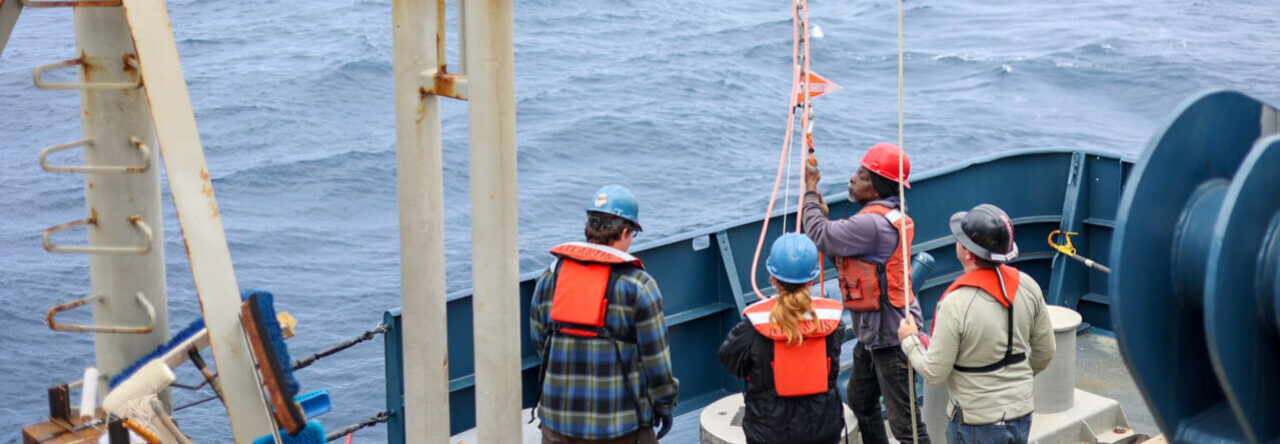
When we recover the CTD after a cast, we must first attach tag lines to its frame. When it comes out of the water, it is about ten feet away from the side of the ship, and so we have to use long poles which hold special snap hooks. These let us get a handle on things without the CTD swinging close enough to the ship to bump. One of the nice features is that there is an insert in the end of the pole which is designed to keep the snap hook from rotating. Unfortunately, these were loose.

Luckily, this ship has a well-stocked machine shop and very friendly engineers. With a little guidance from the deck side (personally, I had just gone to grab a bigger hammer), I located some screws to replace the missing originals. The poles are all set and hopefully won’t frustrate anyone else with swinging snap hooks.

In all her glory

The Atlantic, that is. While we have yet to see the worst (forecasts predict the 13th), I am certainly impressed by this ocean. Having been mostly a Pacific sailor, I was looking forward to the opportunity to meet new people, learn new things, and explore new waters. As we head towards the southern tip of Greenland, the science party is busy preparing their moorings and packages. Some personnel check software, some calibrate, and others concern themselves with the physical hardware and deployment procedures.

In preparation for deployment, we first made a survey of the seafloor in the deployment region. This will be used to select a good site for this year, as well as the alternate site for next year. This particular mooring is expected to be maintained for 25 years, with crews swapping the mooring every year.

After the survey, we tested the acoustic releases by strapping them to our CTD cage, and lowering it to their equivalent depth. After a little bit of trial end error with the deck box, the releases were successfully triggered, and the CTD was returned to the surface.

Another important task accomplished during the release testing was the validation of our CTD settings. While the release test casts weren’t really looking for ocean data, they still allowed us to check things out. It was a good thing we did, too, because we immediately noticed an issue.

At about 50-60m into the downcast, the oxygen sensor started giving off-the-scale noise, with no discernable trend. Although we could not change enything until the cast was completed, we did speculate that either the cable (not so bad) or the housing (bigger deal) had failed. This hypotheseis was given strength when, upon recovering the unit, we noticed that the two housing pieces were rotating freely. Normally, these would be snugly sealed. It did not look good…

Fortunately, the casing was dry, and just a little bit of fouling was found around the connector pins. While we still swapped it out for our spare, it looked like it would be able to be used again. It will get serviced more thoroughly when we get back to WH. After replacing it, the spare worked fine, and the rest of the casts and the deployment went well. We even had some local whales stop by to take a look at the new buoy in their ocean. Hopefully this mooring, and others like it, will help us get a better understanding of their home.

Let’s do this!

Hello, readers! As this is my first post, I would just like to thank all those who make these internships possible. I am very excited to be a part of this process, and can’t wait until I begin traveling to meet the R/V Knorr. Over the past few weeks, I have been busy preparing for the time at sea – packing, visiting with friends and family, and making sure that everything will be taken care of while I’m gone. Right now, everything is quiet as I await my long day of travel tomorrow, but I know that things will be exciting once again when I meet the people I get to work with aboard the Knorr. It seems like the end of a long process, one that began back in April, but I know that this is just the beginning. It is going to be a great trip! -KR

Powered by WordPress & Theme by Anders Norén