1st Cruise
During my first cruise I mainly spent my time learning as much as I could about the ship and the available science equipment. This particular cruise was focused mainly on physical oceanography, which meant a lot of CTD casts as well as constant collection of ADCP and SCS data.
For those not familiar with oceanographic sampling equipment a CTD package (which stands for Conductivity, Temperature, and Depth) is a device that allows scientists to collect vertical profiles of the salinity (measured by the water’s conductivity) and temperature of the water according to depth as the package descends from the surface. Depending on the scope of ones research there are also other instruments that can be attached to the CTD. These include a transmissometer, which measures the amount of particulates in the water, a fluorometer that measures fluorescence as an indicator of plant life, a PAR sensor that measures the global solar radiation in the spectral band active for photosynthesis, and oxygen sensors that measure dissolved oxygen in the seawater. In general research vessels deploy the CTD attached to a rosette. The rosette is made up of a framework of sampling bottles (currently 9 – 8 liter bottles on the R/V Savannah, though some rosettes can house up to 36 bottles ranging from 1.2- 30 liters in capacity) affixed around a central cylinder. With this setup researchers are able to signal the rosette to collect a water sample whenever they see properties from the CTD sensors that are of interest. For example during the first cruise the scientists were specifically looking at salinity and oxygen gradients as the collected their water samples.
The second instrument that we used during the physical oceanography cruise was the ADCP, also known as the Acoustic Doppler Current Profiler. This device uses the shift in sound frequency to measure currents beneath the ship as it is underway. Sound waves are sent from the ship and are bounced back to the ship’s receivers from particles and plankton in the water column. The waves are then translated into a profile of water movement. During our cruise we used both a 300 Khz (first leg) and a 1200 Khz (second leg) ADCP. The 300 Khz ADCP is the one that is generally kept in the well for cruises while the 1200 KHz is used mainly for shallow water research.
Shipboard Computer System, (SCS) a NOAA software, is a vital program for the research done on the R/V Savannah. This program collects, process, displays, and achieves data from the navigational and scientific sensors aboard the vessel (essentially just taking data from multiple sources and combining it in one easy to use interface). The two types of data logging supported by SCS include “continuous” data and “event” data. Continuous data is data that is vital to safe navigation and I recorded and processed on a continuous/real-time basis. Examples include information from the GPS, gyrocompass, water depth indicators, and meteorological sensors. Event data is recorded on an “as needed” basis. The SCS can also derive data such as wind speed and direction. Overall the SCS provides a vital summary of information including location, direction, water depth, vessel speed, atmospheric pressure, wind speed/direction, water temperature, and water salinity.
Software requirements:
In order to be a successful marine technician one must accumulate an understanding of the different types of programs used to control the scientific instruments on board. For the most part these programs are a staple on all research vessels (though versions may vary). Examples of common software includes:
CTD
-Seaterm= Used to connect to and start/stop data logging for the CTD.
-SeaSave= Used to see the actual plots and data produced by the CTD.
SCS
-SCSMenu_v4.6.0= Used to access and visualize multiple sensor readings in an easy to use user interface.
ADCP
-WinRiver (Acquire)=Used to start/stop data acquisition from the ADCP and see the outputted data.
Navigation
-NobleTek=Used to see current location of the vessel overlaid on NOAA charts. Also allows for the plotting of points (stations).
Overview of cruise
Overall the first cruise was very exciting. While it was mostly physical oceanography (which can be a tedious subject to tackle data collection wise), I was still able to get exposure to different instruments. These include a Van Veen sediment grab, a Microstructure profiler, a CTD, and a custom made device that essentially measured the optical properties of the surface waters. We also recovered multiple buoys and moorings during this cruise…which turned out to be a rather difficult task. In order to recover the moorings we had to grapple for the small surface buoy. When we were able to snag it we quickly pulled it to the ship, all the time watching the line to make sure it wouldn’t go under the boat and get sucked into the propellers. One of the crewmembers would pull the buoy up so there was enough slack in the line in order to tie it off to a cleat. When they managed to do that I came in and cut off the zipties and undid the biofouled shackle (talk about lots of cuts if you aren’t wearing gloves), for the buoy and the small microcat sampling device that was connected right under the buoy. Once I had completed that task I pulled the buoy out of the way and we connected the line to our A-frame winch and pulled the mooring up. Due to the materials and the way the moorings were constructed we had difficulty recovering some of them (frayed lines, etc) and had to call in a dive ops team to remark two of them. Once the dive teams added a new marker buoy and line we successfully recovered the moorings.
When it comes to difficulties during this cruise we had two main ones. The first main problem was a generator crash that occurred during the second leg of the cruise. This crash happened around 10pm during one of our triangle transects. Luckily we weren’t in too shallow of water and were able to drop our anchor before our dead ship ran into the banks of the estuary we were working in. While I missed the first two hours of the dead ship, I woke up around midnight and noticed the lack of lights….and air-conditioning. The first thing that came to my mind was “Ohh ….! I need to check on the servers”. I ran up to the pilothouse to make sure we were not just doing a pre-planned generator switch as we had done earlier in the day but was informed of the crash. With this information I went back down to my lab and safely shut down the server and backed up all the data. I really lucked out that the backup generator for the server didn’t fail (The first thing I was warned about by my mentor was the instability of our current backup generator). Finally around 2am the crew was able to get the ship up and running again and I booted the server up. While that crash was quite concerning it actually worked out for the best in my opinion. It gave me very good experience of how to shut down/start up the servers as well as helping me fix a computer issue I had been dealing with earlier in the day (The SCS had stopped working on the pilothouse computers and the SCS server blue screened and router resets etc wouldn’t fix it…thinking back on it the variation in current that we had been receiving to the computers during the day may have been causing all the errors we were getting.).
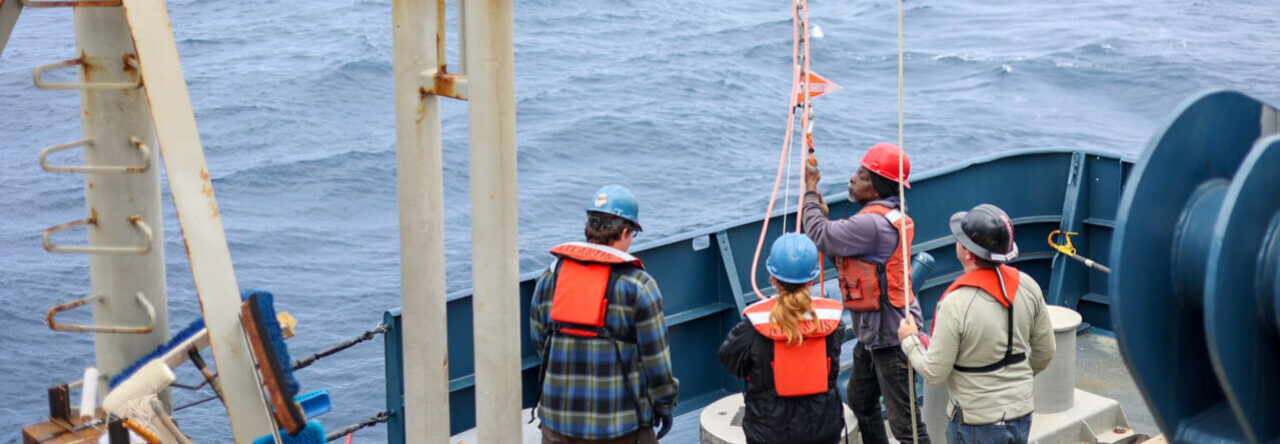
The second difficulty I had to deal with was the science party and their view on safety. This is where tact comes into play. One of the main issues I had during the cruise was having science members who would not follow directions or wear their safety gear while working on deck. For the most part I was able to get the interns to follow the rules after pulling them aside and politely asking them…but the worst offender was the chief scientist and her technician. For the life of me I could not get them to wear their hard hats or life vests while deploying the CTD. It seemed that as soon as I talked to them about one thing (life vests) they would instantly start wearing that but not the hard hat. By the end of the cruise I had gotten the C.S’s tech to start wearing his gear after refusing to allow him to do deployments (which was frustrating for me since I needed practice on the winch vs doing taglines for him). However the chief scientist would still not listen to me about wearing her hard hat until I brought the captain into the mix. I really just don’t understand why it was so hard to wear the safety gear. I even asked her why she refused to wear a hard hat, offering to get her a new one if the one she had been wearing was uncomfortable etc…
2nd Cruise
The second cruise was at a much more “relaxing” pace when compared to the first cruise. While the vibe of the first cruise could be compared the Hare from the story The tortoise and the hare, the second cruise was definitely the tortoise. However even with our slow pace we still ended up finishing all the stations 2 days early.
During this cruise I actually stood watch, which basically means 4 hrs on and 8 hrs off. For this cruise I stood watch from 4am-8pm and 4pm-8pm. For the majority I spent my time on watch piloting the ship and learning the basics of navigation, proper radio etiquette, and autopilot use. I must say I absolutely loved being on watch and getting to help pilot the ship (on top of my normal duties). I’ve even discussed with the captian about getting him to sign off on my sea time so I can take my steersman or 100 tonne exam.