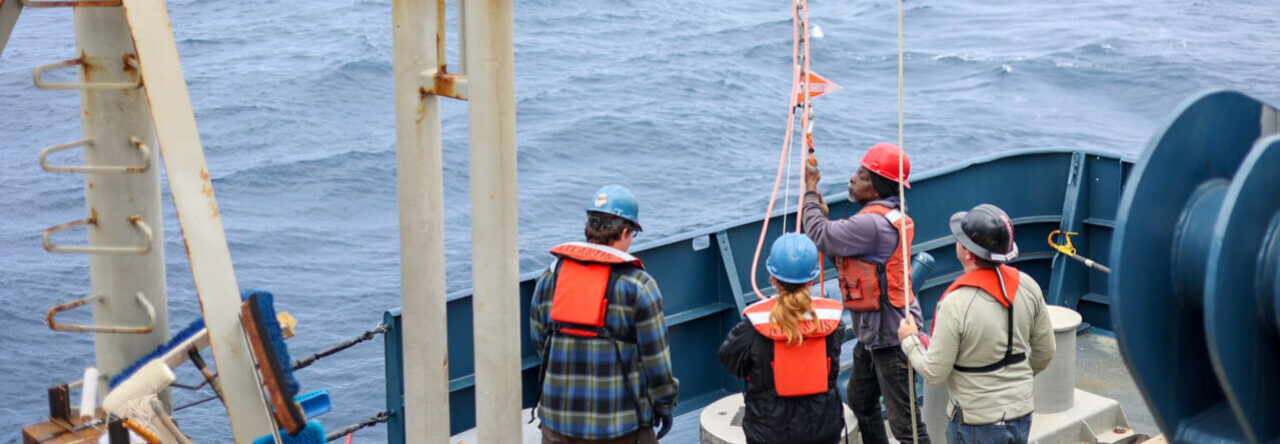
I arrived in Honolulu on June 19th after a grueling sixteen hour travel day that started at 2:30 AM in Boston, Massachusetts. My first two days aboard the Healy were spent in port, where I used that time to familiarize myself with the ship and got to know my fellow companions that would be accompanying me on the voyage. Once we left port, my mentor Andrew Woogen had us set-up and trouble-shoot both flow-through systems connected the the Science Seawater System. The main flow-through system went together rather painlessly, but the flow-through in the wet lab was not so easy. Everytime we were able to get the sensors related to the TSG box online the other sensors would seem to cut out and stop working. Once we ironed out the problem, all the sensors in the wet lab came back online and we then began to organize and label the rats nest of wires that were associated with the flow-through system.
The following day we were met with much rougher seas and my fears of becoming seasick finally vanished. I had no problems tolerating the rough conditions and actually found the situation rather exciting. The task of the day was to install and connect all the necessary sensors associated with the CTD. My duties included installing the altimeter, the PAR sensor, and mounting and installing the transmissometer. I was also shown the basics of how the software associated with the components onboard the CTD work and how all the instruments are programmed. I ran into some trouble finding all the correct wires necessary for each sensor, but with the help of my mentor together we were able to source all the appropriate cables and get the CTD completely wired up and ready for a connection test.
Since the cables for the CTD were difficult to find and some important ones were scarce, the following day I was put in charge of categorizing, organizing, and inventorying all of the CTD cables aboard the Healy. I decided to organize everything first, then when through and created a spreadsheet and checklist of everything we had, and what we needed. In my spreadsheet I noted that the cables I inventoryed were only the ones that I deemed “Plug and Play” or “Complete”, being that a majority of the cables have been cut or spliced at some point. My mentor also suggested that a particular Y-cable that would run both the fluorometer and the transmissometer off of one connection would be helpful in future deployments of the CTD. My second task that afternoon was to source that particular Y-cable using Sea Bird Electronics website as a guide. I was able to narrow my search down to two options of cable that I believed to be the correct ones for the application. Since I wanted to guarantee I had the correct cables, I decided to email Sea Bird Electronics to ensure I had the correct ones.
My mentor was pleased with the way that I organized and inventoried the CTD cables, and suggested that I email my spreadsheet/checklist to an incoming marine technician so he could get a head start on gathering the required cables for his future research mission. At that point, I hadn’t heard back from Sea Bird Electronics on whether I had the correct cables or not, so I decided to email the incoming marine tech the two cables that I thought were the correct ones, and noted that I wasn’t one hundred percent sure they were the proper cables. I also added in my email other necessary supplies that we knew we in need of.
I look forward to updating this blog later on this week or sometime early next week as we cruise toward Seward, Alaska. At some point we are supposed to start in on the Science Seawater System so in the next installment of my blog I will hopefully have some good info and experience with that equipment.
Stay Tuned–
Kyle Yusen