After making the trek from Nicaragua to Miami I finally arrived at the F.G Walton Smith, a ship that fully lived up to its expectations. Arrival was followed by a whirlwind tour of the boat and a speedy introduction to the crew. Denis, the marine technician on board and an individual who clearly loves what he does, was eager to show me all the tech on board. Within my first hour on the boat I was already learning about the different kinds of servers, connecters and circuits that keep the ship running and reliable.
By the second day on the Walton Smith it already felt like home. An early morning breakfast was followed by a new lesson, this time about the engine room and the ship’s communication methods. A tour of the engine room revealed the complexity of the ship’s inner workings. Huge rotating gears connected to metal casings that house the very guts of the ship fill the engine rooms and intimidate any aspiring engineer. Since the engines seemed to be fully functional and smoothly operating I turned to a new task. The horn on the aft deck was heavily corroded and barely functional so I was given the task of replacing it with a new one. Thus I received my first hands-on lesson on wire stripping, threading and replacing. And so, step by step, I removed the old horn, wires and all, and replaced it with a shiny new one.
Our first cruise was a short one, only two days long, and had the objective of assisting NOAA with a long-term project monitoring and collecting CTD data along a transect of the Gulf Stream off the coast of Florida. On Thursday morning, the ship was fully loaded with equipment and off the docks and into open water by 6:00 am and within a couple hours we were surrounded by nothing but beautiful, deep-blue sea. Since it took several hours to arrive at the first station, where we would be deploying the CTD, I spent the day in the bridge with the captain and second mate where I learned everything from knot tying to celestial navigation. The knots started off easy with a granny knot, but I quickly worked my way up to the significantly more complex Spanish bowline knot. We then moved on to learning about the mechanics of steering a ship, covering everything from pitch directionality to throttle and speed. Finally, we moved onto celestial navigation where I learned the difference between variation and deviation and how to spin a compass to determine the degree of deviation due to the mechanical components aboard the ship. Scrutinizing navigation maps led to celestial navigation and the applications of a sextant. With a huge assortment of eclectic information swirling in my head, I was happy to spend a few hours relaxing on the bow and watching the boat gently sway about on the ocean swells.
 After several hours navigating along the Florida coast, we finally arrived at our first station where the NOAA team planned to deploy the CTD. I watched as the CTD was slowly lowered with the hydraulic crane into 600 meters of water. Once at the bottom of the water column, the CTD was slowly pulled through the water, stopping at periodic intervals to collect water samples using a trigger mechanism connected to the fiber optic cable found within the cable used to hoist the CTD. As the massive contraption was dragged through the water column it also collected and transmitted real time conductivity, temperature, and depth readings, which the NOAA scientists eagerly monitored on a screen in the dry lab.
 Once the CTD was back on the deck, water samples were partitioned into oxygen content readings, organic compound samples, and salinity samples, all of which were carefully collected, processed, and stored away for future analysis. Since there wasn’t much to do in the way of mechanics or engineering, my role was to assist in the collection and processing of the oxygen content samples, which primarily involved carefully filling bottles with aliquots of water samples and adding two compounds that helped quantify oxygen content.
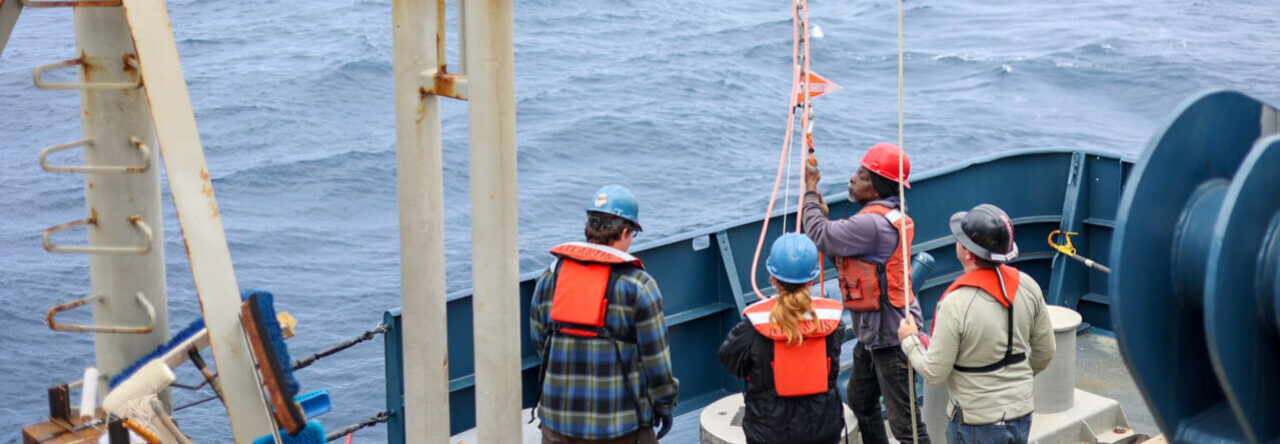
The NOAA crew was also working on deploying a series of three different drifters; floating computers that use satellite GPS systems to track current speed and directionality. In this case, they were not only testing the efficiency of three different styles of drifters, but also collecting data on the Gulf Stream to assist in calibrating measurements obtained from a submerged telephone cable that measures current flow and speed by recording fluctuations in electromagnetic currents as currents pass over the wire. The team was only too happy to let me assist in throwing the massive computers off the deck and into the Gulf Stream, where we watched them float away with surprising velocity.  We started deploying the CTD and the drifters around 6:00 in the afternoon and were not done until about 7:00 the next morning. It was a long and exhausting night, but one full of learning opportunities and unforgettable experiences.