As week two finished with the Healy wrapping up the science for cruise 1703, week three ended similarly with the extra objectives we picked up for 1704 coming to completion. Apparently the next cruise (1704) is looking at extremely rough weather and a heavy work load to boot. So the Woods Hole science party used the extra time to recover some of 1704’s shallow moorings as well as some mapping survey work too. This actually turned out to be quite fortuitous as I’ve always wanted to learn more about bathymetry and the multi-beam sonar.
The mission parameters had us navigating a grid of swaths we were to survey. Using the Knudsen echo sounder to map and delineate the sub-bottom and the EM-122 multi-beam sonar to render a topographical 3-D model of the ocean floor, we began tracing the gridlines from waypoint to waypoint. One of my supervising techs, Mike Coons had some extra time and kindly gave me a tutorial on the operation of the Knudsen. I had never seen this instrument before arriving on the Healy, and had only developed a basic understanding of it. After a couple of hours and some frenetic note taking, I now had acquired a working fundamental ability to operate and adjust the echo sounder to bottom conditions as they change. This instrument works like what is most commonly referred to as “ground-penetrating-radar (though it’s sonar). Drawing a distinct line at the seabed’s surface as well as shapes and layers of sentiment and rock beneath it, the Knudsen determines what the underlying matter is by the strength of the echo return.
Mike repeated this one-on-one lesson with the multi-beam a day later. The multi-beam is fascinating. For those unfamiliar, a multi-beam sonar works just as it sounds (not a pun, really!). Multiple single sonar pings working in concert with each other, focused at slightly different angles, render a swath that actually gets wider with depth. It then composes a 3 dimensional model of the features of the seabed. Boulders, seamounts, shelves all appear in a color-coded video model. (If you’re still confused just watch the movie, “Tron” [either the original or Legacy]). Our major hurdle was that the EM-122 was designed for great, abysmal depths, using lower frequencies so it did not always function optimally in these relatively shallow (200-300 meters) waters. However, we were able to get great results most of the time. We were even able to possibly locate a mooring that was considered missing. The science party knew its approximate location and had even communicated with it. We then found an image in this general area that gave strong indication that this was indeed the wayward, misfired mooring. This would aid the next cruise should they attempt to rescue it from the bottom.
Anyone familiar with my previous blog (or who even glanced at the title!) would have to admit that I’m beginning to sound like a broken record or at the very least that a theme of “things getting stuck” is taking shape on this voyage. I must wearily concur. For the other morning, I awoke to my alarm as always, with a troubling exception. Where was this electronic clanging coming from? It seemed my phone had slid from my bunk down into a half-inch wide gap between the steel (attached to the wall) bedframe and the ships bulkhead! Yes, dear readers. Once again I had managed to get something inexplicably stuck in a tiny portal of doom!!! Luckily, I spend my days surrounded by the most talented troubleshooters I’ve ever witnessed. The theories of rescue were many and varied and all destined to fail. However, just when I was about to dismantle the entire steel bunkbed, a very McGuyver-esque hybrid of many of the plans took shape. And using a very long screwdriver, a plastic wedge and (of course) the obligatory coat hanger – all of them mummified in duct tape- I was able to first lift it to where I could see it. Then with a desperate jerk- I popped it up into the air where it fell unceremoniously onto the waiting box spring. Phone rescued! Cue the triumphant music (Wagner or something)!
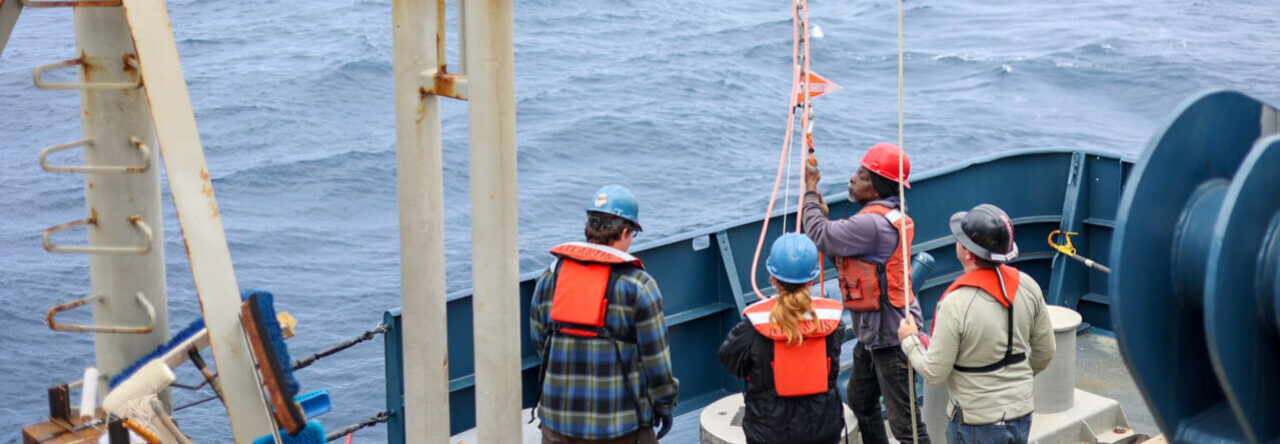
I did also mention in a previous blog that I was assigned two projects at the outset of this mission, the first of which I detailed in my last offering. The second project was related to this installments title. The Niskin project. A Niskin bottle is a container used to collect samples of water as it rides upon the rosette (or the cage containing the CTD). They come in 12 and 10 liter varieties and are open at both ends. Located at each end is a spring-loaded cap and when fired, the bottle closes, trapping the collected water inside. This apparatus is all held together and manipulated by a series spring-torqued lanyards fashioned from heavy monofilament line and even string trimmer refill line. My assignment was to optimize and standardize these lanyards for both versions of the Niskin bottles.
Royhon Agostine (hope I spelled that correctly, my friend), the MATE intern before me (cruise 1702) had worked on this as well and had left an excellent manual on the top, bottom and middle lanyards construction. He had pretty much laid out a standard for their lengths and construction, even going so far as to leave templates for the 12 liter bottles. This was an extremely important precedent in light of the fact that, standardizing anything is difficult with a vessel where different techs constantly rotate in and out. So many people with divergent backgrounds lends itself to 24 bottles rigged 24 dissimilar ways. The goal was a single recognizable, efficient, effective lanyard system. Royhon had done a great job. My task was to test and improve if possible, any portion of this bridle of line and springs. And then apply this to the 10 liter bottles as well.
After a great deal of testing, very few changes were made. The bottom lanyard received the most redesign due simply to the fear of losing the attached hook. It was hoped that tying the hook in with a strap hitch would make for a swift hook change out should a malfunction occur. However, after some trials, Mike Coons and I concluded the hook could actually work itself free and be lost. In the end we basically shortened the lanyard and formed a simple loop with no tail to trim from crimping. This made for a much quicker change-out based on simplicity alone.
So, the project continued in that fashion with minor tweaks to lengths here and there. Once I had outfitted the entire compliment (24 with 7 back-ups) of 12 L Niskin bottles we sent them down on several CTD casts with perfect results. The Niskin bottles are now standardized and optimized. I tangled with a generous amount of string trimmer line and worked and re-worked an army of Niskin bottles so now I’ve no doubt, you understand why I entitled this tome thus.
Life on the Healy remains fun-filled as well. Saturday night the crew staged a Sumo wrestling tournament in the helicopter hanger. They had those huge inflatable suits that simulated a typical mammoth Japanese grappler and no matter who donned it, they looked hysterical. Some of the crew could barely get their hands to stick out of the arm holes! Some of the most historic mismatches of all time transpired in that hanger. One particular bout that comes to mind involved an absolute tree trunk of a man vs. this tiny petite female sailor. She bounced around him like a balloon in a tornado and he stoically stood, unflinching in the middle of the ring. It was the old comic formula of the toy poodle savagely barking at a bear. He even went as far as to pratfall and concede the middle round. In the final round, she charged at him and with barely a shrug, he sent her glancing off him into the out-of-bounds. Handily one of the funniest moments of this whole trip!
It has just begun to sink in that this journey is nearing its end. As sad as that makes me, I am so grateful I had this opportunity. It has been a fantastic immersion into a world where I hope to thrive. One more week remains and I’m going to squeeze every last drop out of it.