
0800 Local Time
Goðan dag!
Today is our last day at sea on the Iceland transit, hence my Icelandic greeting. We were originally meant to be in Reykjavik yesterday afternoon, but two days of really rough seas set us back.

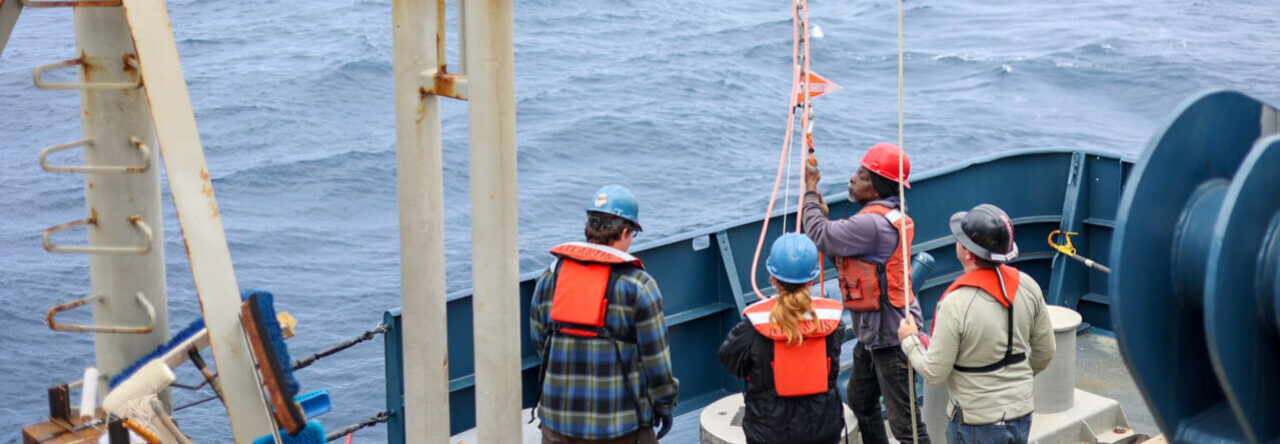
Despite the weather and sea conditions, we did still manage to deploy 3 wave buoys as well as a glider over the side. Tina was our lone scientist on board and was fun to work with to get these things deployed. The round, orange, surface float is designed so that the drifting buoy will move on the surface with the currents, helped along by an attached, underwater drogue. A variety of sensors are also enclosed in the float, and an onboard antenna transmits the sensor data and buoy position. I have no doubt that those little surface buoys picked up some interesting climate and weather data.

The glider was the last to get deployed this week and was a challenging operation as the weather had once again turned against us. The Bosun thought it would be safest to attach a tag line to one of the starboard side winches and jib the glider out as far away from the ship as possible. Even then, it still drifted dangerously close to the hull and the Chief Mate had to engage the bow thruster to move us away from it. The danger was that the sensors on the nose of the glider are incredibly sensitive and could not come in contact with the vessel at all. Even rubbing against a shirt sleeve could destroy them.

This past week also provided a lot of opportunities for troubleshooting instrumentation and working on new projects. I think Amy and I totaled a solid work day worth of time trying to troubleshoot connectivity issues with the EM710 multibeam (offshore, shallow water unit). We inspected the transceiver unit and ethernet connections, swapped TX boards, bypassed the remote switch (which also seemed to have issues), and even pulled out the remote switch to inspect the connections inside. We got some good transmissions for a time, but it is not consistent, which remains a real head scratcher! Once we were in deep enough waters, we tried booting up the EM122 multibeam, and then found out that the database for it was missing. So that was another day of problem solving and configuration on that particular unit that, thankfully, ended in success. Go, Amy!

One project that I was excited to undertake was editing and reprinting a cylindrical coupler for the electrical slip ring on the CTD winch. The first print, unfortunately, did not quite fit the bolt pattern required and so I took some additional measurements and created a new, printable file in Autodesk Inventor. Thankfully, I worked with that program at Cal Maritime, but had yet to facilitate an actual print job. The ship has a LulzBot 3D printer, and I downloaded the printer software and slicing program for it. We did a test run of 3mm each of the top and bottom of the piece to check alignment and then, just 12 hours later, the part was successfully printed and is a good fit!

Now, just 4 hours out from Reykjavik, I am a bit amazed at just how quickly this month has passed by. I am so grateful to Amy, Joe, and Cris for their guidance and the multitude of learning opportunities and hands-on projects these past few weeks on the R/V Armstrong. They work really hard and need to be savvy with so many different systems and skillsets. Their services are vital, and I hope they know that they are appreciated!
Due to our delayed schedule, I will be staying in Reykjavik tonight and flying to San Diego tomorrow to board the R/V Roger Revelle at Scripps. Stay tuned for more as I head back to the West Coast!
– Emily