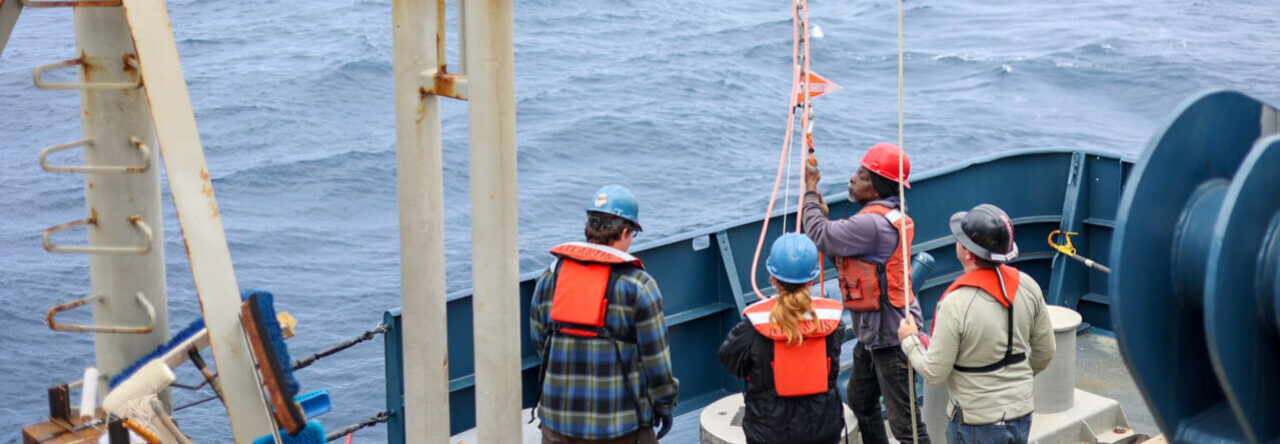
This week shaped up to be filled with a lot of new experiences! USCGC Healy departed Dutch Harbor at 1300 local time on the 15thand began the steam to Nome to pick up more gear on our way to the first mooring locations of the science cruise. The cruise is centered around Stratified Ocean Dynamics of the Arctic (SODA) and involves deploying a series of four moorings used for navigation as well as three more instrument heavy moorings equipped with upward facing multi-beams and CTDs to survey ice floe throughout the duration of the next year. There are also going to be 3 ice stations later on in the cruise where we will deploy multiple buoys and floats to survey ice floes over the next year. Our original plan was to steam to the first SODA mooring location and get going with those as soon as possible, but there were some slight delays, which eventually turned out to be longer than originally intended, that caused us to change plans. Instead we stopped off at a secondary mooring location for University of Delaware and the deployment was successful. This was my first time seeing a mooring go into the water and the process of getting everything together was really valuable to watch. The US Coast Guard does not allow much deck time, if any at all, so I will be mostly standing by to survey exactly what the boatswain and crew on deck are doing to safely deploy all these moorings over the course of the next 4 weeks and try to learn as much as I can from that perspective. 
On our way to the Badiey (UDel) mooring location, my first project was to design and build a mooring release transducer conversion j-box so that Healy would be able to account for multiple types of deck boxes for the science party to use. The deck boxes are used to range and communicate with the moorings they are placing and also to release depth sensors and even the whole mooring if need be. I did not fully understand what my conversion box was going to be responsible for until I watched it be put to use. It felt good to know that I helped a main part of the science and shipboard technology improve and be capable of improving more in the future. Below are some good images of what the finished product and wiring look like inside the j-box. While transiting north to the first mooring location we crossed the line of the Arctic Circle which, if you complete a ceremony through the coast guard, registers you as a “bluenose” for having crossed the line on a ship. I do not think we will be able to do any such ceremony on this cruise, but still a great experience to have done.


Science operations are changing in what seems like by the hour so we are just ready for anything. We have been working 12 hour shifts in the lab to make sure everything is covered science tech wise, even though most of the ops are going to be happening in the daylight. We were now going to put in one of the navigational moorings and delay the SODA moorings even further. All the moorings from here on out will be over 3700 meters deep. Part of our job as STARC and science technology aid is to run multi-beam surveys over the potential mooring sites so that they are able to better gage the actual profile of the seafloor. Our EM122 multi-beam has been having a fair amount of trouble that we actively troubleshoot and relay to the bridge what needs to be changed to get better data. Brett and I found some great ways to clean the data and then give the scientists various data output formats for them and us to use later.
A day later, my conversion box was used to release a depth sensor off one of the navigation moorings, and then we proceeded to steam halfway to the next one to deploy gliders on the way. The gliders are going to collect data from the SODA moorings and be able to send it back to the University of Washington via Iridium satellites, that way they will be able to know just how well the moorings are functioning when we arrive back in port and further on into the year.
I forgot to mention! We hit ice around 0700 on 09/19. It is really amazing to see for your first time and it reminded me of watching a fire in that you could really get lost in the ice breaking for as long as you want, only it’s below freezing temperatures and extremely windy outside, not exactly as comforting as the fire.
Overall first week has been full of great experiences and the big SODA moorings are coming up soon a long with ice clusters. I will report back soon with how everything is going with the main part of the SODA mission and how we are travelling in the ice.

– Nick