Arriving at Cape Canaveral is pretty cool. If you haven’t ever been to this part of Florida, you’ll be greeted with signage indicating that you’re entering the “space coast”. You may even run across some streets named “NASA road” and the like.
What is so interesting about my arrival is that I won’t be going to visit the space museum, or watch a launch (which is still on my bucket list), but I’ll be going to the port at Cape Canaveral to board a ship for a 5 week research cruise aboard the Marcus G. Langseth, a Columbia Universtiy research vessel.
I am filled with nervous and excited anticipation, and can’t wait to see what the living quarters look like! Having never been on a research cruise before I am particularly interested in discovering all the nooks and crannies of the ship and making it home for the next little while, whether it’s finding cozy places to read or hanging the small string of battery-powered lights I brought, or putting up photos of friends and family in my bunk.
Which is a great segway into a small introduction —
Hello all! My name is Sara Pierson.
I am a third year (going into fourth year) PhD student in the Planetary Habitability and Technology (PH&T) lab at Cornell University. I began my college career as an Aerospace Engineering undergraduate student at the Georgia Institute of Technology (Georgia Tech, GT, for short), specializing in underwater and space-faring vehicles. I then went on to complete a Masters degree at GT in Mechanical Engineering, and began my PhD there in the Ocean Science and Engineering department (then my lab moved to Cornell about a year ago, and I went with them!)
In my junior year of undergrad I began research with the PH&T lab, and the rest is history!
Intrigued, I continued working with the PH&T lab and began specializing my research on wireless data transfer through ice. This topic is now the subject of my Doctoral thesis work! The novel and interdisciplinary nature of my thesis has led me to studying several topics, namely: acoustics, seismics, and RF communication.
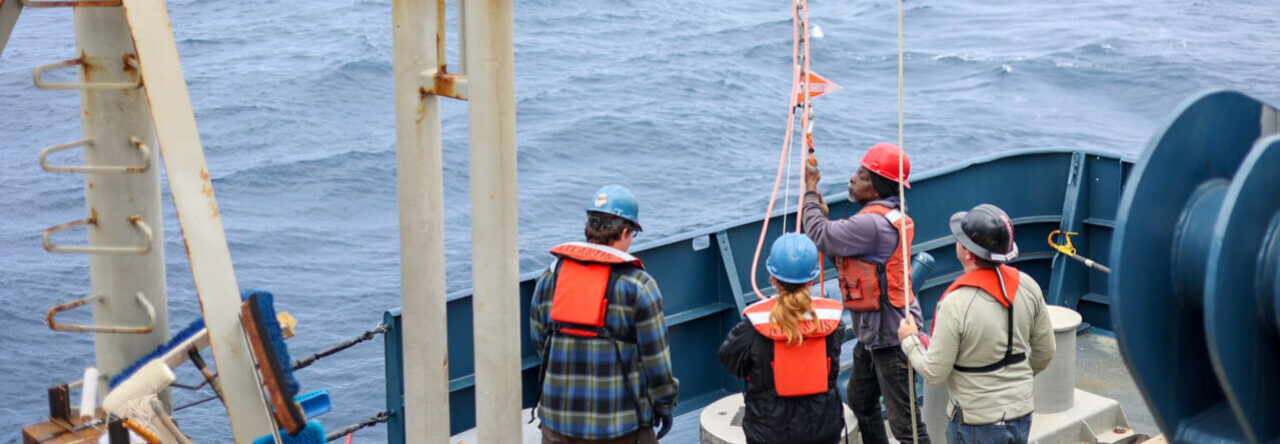
It is these topics that brought me aboard the Marcus G. Langseth as a marine tech intern. As an intern, I will have the opportunity to have hands on experience placing acoustic equipment in the water, using that equipment to take 2D surveys of the ocean floor, and then learning — first hand — how to take and process/read this data.
Not only will this be an extremely unique experience, it will be rewarding to learn more about topics that I am incredibly interested in and that will further my personal goals as a graduate student.
I look forward to updating on all the things I was interested about before I got on board: the accommodations, food, laboratory space, how people spend their time off, what the working deck and instruments look like, and much more I am sure!
Until next time! 