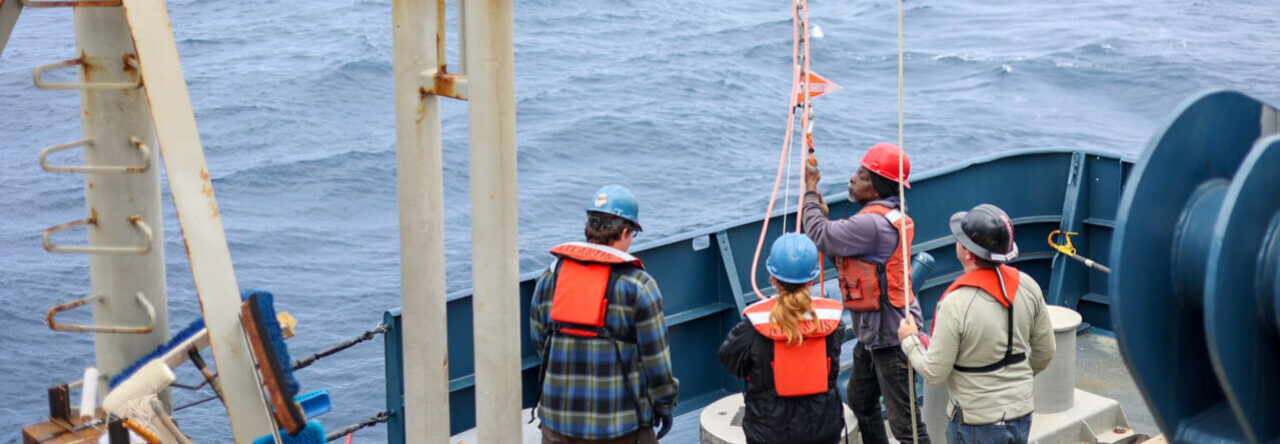
This is my third and last cruise as a MATE intern aboard the R/V Langseth. This last cruise will be very different that my previous two, which collected sediment cores and ocean bottom seismometers respectively. This cruise will use the Langseth’s highly specialized seismic equipment to collect multichannel seismic data. It is currently the only UNOLS vessel able to collect this type of data. Essentially, this means we will be towing seismic equipment that uses sound waves to create highly detailed maps of the geological features under the seafloor.
I have spent the last week working with scientists and contractors from all over the world to prepare the seismic equipment for deployment. I have been gaining an intense crash course in geology, seismology (the study of earthquakes), and basic mechanics.
Here’s the basics[refer to pic below]: The seismic equipment is made up of airguns, streamers, and Digibirds. The 36 airguns create a loud sound that then travels through different layers of the seabed before bouncing back to be heard by the 12 kilometers of streamer. The streamer has thousands of hydrophones (precise underwater microphones) along it that receive the sound signal and create a high-precision map. There are also 47 Digibirds (orange winged “birds”) that use their wings to control the depth of the streamer.

We spent the first 2 days calibrating the Digibirds (pictured in rack below) which help us keep the streamer at a precise depth (12 meters). The Digibirds have a sensor on them that determines depth based on pressure, it then moves it wings up or down to move shallower or deeper based on programmed depth. It was a two-day operation to deploy the entire 12 kilometers (7.5mi) of streamer with hydrophones, 47 Digibirds, and 36 airguns across 4 strings. Now that everything is deployed, we will monitor the equipment for changes as we tow the seimic equipment across the survey lines.
 This is a Digibird in the Bird Lab, where we calibrate its depth and test it before deployment. We prepped 55 Digibirds before deploying the 12 kilometers of streamer.

 Here is the back of the boat towing the seismic equipment. The four yellow lines go to the four airgun strings (each has 9 airguns on it; the 4 airgun strings are the sound source) and the white line is the 12km streamer (where hydrophones recieve the sound after it bouonces off the seafloor).
