My introductory post is here
I arrived in Bermuda on Monday just before a brief downpour of rain. Just after boarding the RV Atlantic Explorer, I was informed of a change of plans. Our first cruise was meant to leave later in the week, giving me a couple days in port to get ready and acclimate to the ship. However, in response to the approaching tropical storms, the departure date was moved up to Tuesday. Lydia, my mentor and one of the ship’s marine techs, immediately started giving me a tour of the place. At the same time, our visitors from NIOZ (Royal Netherlands Institute for Sea Research) brought their equipment aboard and prepared for their experimentation.
Once the cruise got going, each of our days were basically laid out the same way. We deployed a VMP 6000, a device which belongs to our visitors, then lowered our CTD (pictured later in this post) to a depth just above the bottom of the ocean, raised the CTD back up, recovered the VMP 6000, then set out to find and recover mooring lines, one line each day, that our visitors deployed over a year ago.
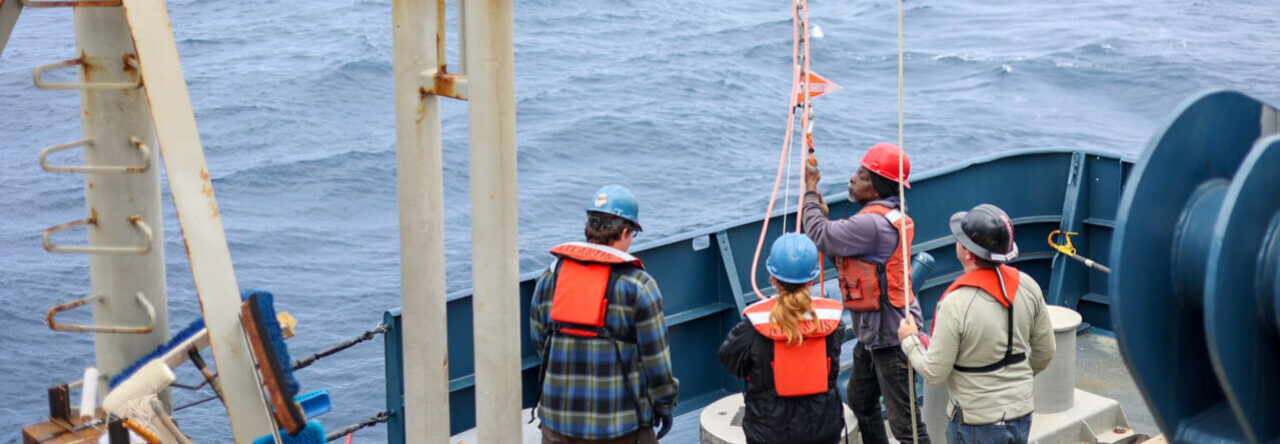
Unfortunately, however, recovering said mooring lines was never an easy task. Out of the four lines, three were missing the uppermost section, making them difficult to bring aboard. One was missing entirely, perhaps still underwater, perhaps broken and floating off to who knows where. Every day, it took hours to locate the mooring lines. I spent those times circling the bridge deck, staring into the ocean looking for small buoys that marked the upper end of the mooring, but finding nothing but water and sargassum. Once a buoy was spotted by someone aboard, we then spent hours hauling the lines onto the ship by winch, a process that generally stretched well into the evening.

One of the mooring line’s buoys
While I may seem a little unenthused by this tedious process, I want to make it clear that I’m having the time of my life. Being able to have a hands-on interaction with this research project is very fun. I enjoy hearing about the NIOZ team’s various educational backgrounds, and their past projects. As the week goes on, I am able to do more significant tasks. Lydia has been finding good places to slot me into the process of CTD deployment and mooring recovery so that I can get some experience under my belt.
Running the CTD has been my favorite part, by far. Everything from setting up the device, launching the device into the water, running up to the bridge to begin data collection, communicating with the winch operator, watching the data plot itself, and bringing the device back on board with a winch and three control lines (one which I get to handle), is an intricate and engaging process. On the last day of CTD deployment, just for fun, our visitors sent down a mesh bag with styrofoam cups that were compressed by the extreme water pressure.

Me climbing on the CTD
Outside of the work, I am adjusting to the ship just fine. The food is wonderful, everyone is welcoming, and I sleep very well, even when I’m a little seasick. The onboard stationary bike is especially delightful. In fact, my laptop is zip tied to the handlebars as I write this. We are coming into port soon, and I look forward to exploring Bermuda for a bit before hurricane Franklin hits.
Next week I’ll be starting on some personal projects, and I’ll get to tell you about it in my next post!