When I wake up we are dockside in St. Georges. The wind, too, has shifted. Typically, there is a steady breeze coming in from the Northwest, or no breeze at all. But today, at sunrise, I face East and feel wind on my cheeks. The sky is pink and warm.
Even though the cruise is complete, there is still unloading of all the scientists and their equipment, which can take a couple of days if everything goes smoothly. After demobilization, there is usually some time to fix any issues that arose while at sea, maybe get a day or two off, and then prepare for the next batch of scientists.

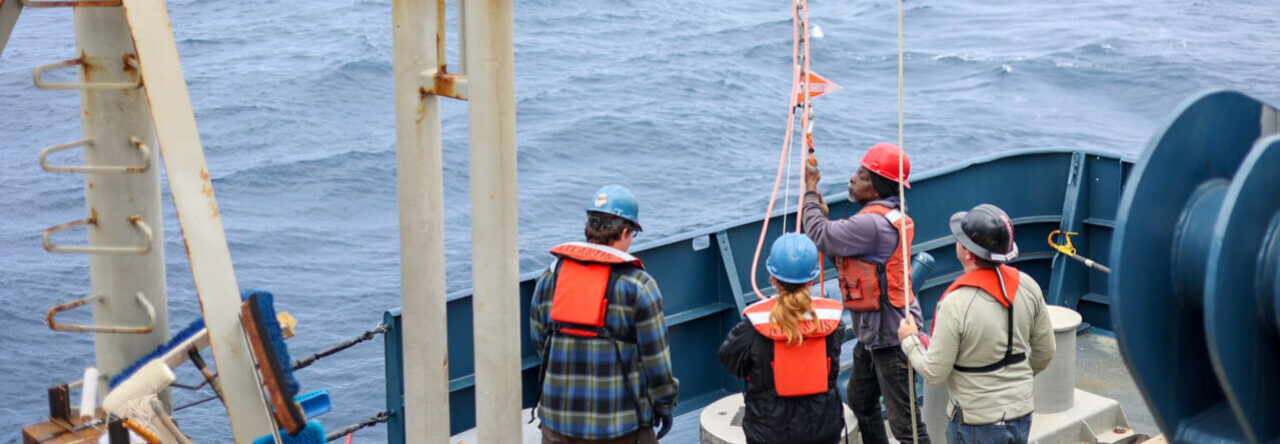
Dockside in St. Georges
This week, Jillon returns! She is another technician aboard the Explorer, and once she is back I will no longer be the only female on the crew. Women at sea are a rare breed, tasked with forging their own space in a workplace that continues to be largely dominated by men. Life at sea is not glamorous or forgiving, and includes living on a boat with a bunch of boys. For these reasons, I have found that the women who have chosen this life are resilient, independent, and pretty incredible.
Jillon arrives and lives up to the expectation. She is all smiles with a bright and sunny disposition, a surfboard strapped to the side of her moped, a sticker-covered water bottle in hand, and the symbol for ground tattooed on her forearm. I spend most of the week with her.
We begin work with the waterwall. The underway seawater system is designed to pull seawater in at the bow of the ship, where temperature and salinity of the surface water are measured. Through a series of pipes, the seawater winds its way along the port side of the ship, past the steward’s stateroom (which it occasionally floods), through hallways, and inside the forward lab. The foremost wall in the lab is covered in sensors that measure the rate of flow, fluorescence, and dissolved carbon dioxide. A network of tubes connects the sensors and directs the water through each and subsequently into the sink and overboard. This allows for water sampling to be done at any time from the convenience of the lab and for constant monitoring of the ocean’s surface water characteristics throughout the cruise.
During the Sentry cruise, one of the fluorometers began to leak seawater, so we discreetly shut down the waterwall and removed the sensor. The previous group of scientists weren’t interested in the underway data, but the upcoming BATS team definitely is. Jillon and I remount the sensor, more securely this time, and tinker with the valves and water pressure until the flow meters spin.
We make other repairs and handle issues as they pop up. Jillon also teaches me how to terminate cables and solder electronics, which I am very excited about. By the end of the week it feels as if we have accomplished a lot. Jillon is driven to be productive, and in just a short time, I have learned a great deal from her.

Jillon on the back deck
In our free time we drive to the ocean side of the island and I swim while she surfs. The sand on the south shore is fine and speckled with rose-colored bits that have made Bermuda famous for its pink beaches. The surf isn’t spectacular, the waves are short and steep and crash all at once, but that doesn’t stop anyone from trying. Anyways, it is healthy to just escape the boat every once in a while.
I have completely lost track of time, and I suddenly realize I am just a couple weeks away from my departure. All of me wishes I could stay longer. This upcoming cruise will be my last, at least during this internship. Now, there is talk that the next cruise may be postponed; a tropical storm is inbound from the east. Jillon’s face brightens at the thought of the surf.