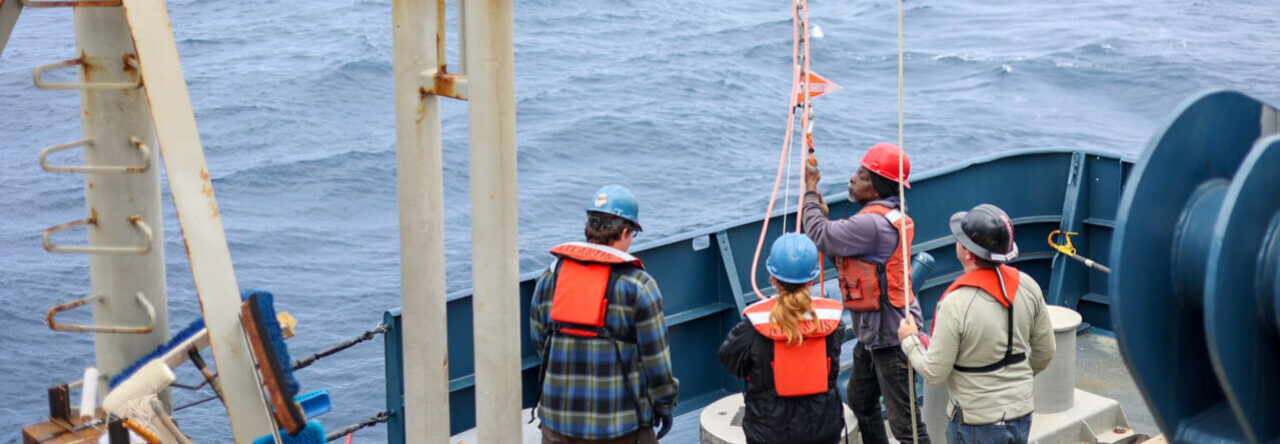
The longest I have remained at sea is eleven days. This cruise will be for ten. On open ocean, the horizon is a crisp, deep blue and surrounds us in a perfect circle that is only interrupted by an occasional cargo ship. Floats of sargassum drift by. A seabird appears in a flash of white, then darts away. Life at sea is peaceful and quiet, and it doesn’t bother me that everywhere I can roam and everyone I will interact with for the next week are within a hundred-foot radius.
The group of scientists on board are from Johns Hopkins University. For their research, they have recruited Sentry, an Autonomous Underwater Vehicle (AUV) which is owned and operated by the Woods Hole Oceanographic Institute (WHOI) in Massachusetts. Scientists from other institutions have the opportunity to request the use of Sentry for research purposes. The researchers who are fortunate enough to be granted rental time receive both the eight-million-dollar robot and the humans that can care for and maintain it properly: a package deal.

Nick admiring Sentry
Sentry is designed for deep water descents. Its electronics are encased in a bath of oil that protects against large changes in pressure and water damage, allowing it to dive up to six thousand meters. Its armor is hydrodynamic, so it can rise and fall smoothly in the water column. Contained within the armor are a collection of sensors and computers, and depending on the research project, additional sensors can be mounted on the outside.
For this cruise, Sentry will be pilot testing a new underwater navigational system. Underwater navigation is problematic, primarily because global navigation relies heavily on satellite communication, which is unable to penetrate the ocean’s surface. Traditional AUVs must surface between dives to recalibrate their navigation systems, or rely on a vessel stationed on the surface. Unfortunately, this system is prone to error and is not energy efficient.
To navigate using the current system, the AUV will let out a chirp, letting the ship know Hey, I’m over here! This ping is released at regulated intervals, so the scientists on board can track the AUV’s progress over time. This process is referred to as One Way Travel Time (OWTT). To interpret the chirp into information, an instrument called an Ultra Short Base Line (USBL) is used. The USBL is an array of transducers that operates similar to a set of ears. It is able to identify the direction and distance from which the chirp originates, which lets the scientists know exactly where the AUV is.
The new system adopts these two navigational tools and inverts them. Now, the ship lets out a chirp letting Sentry know Hey, I’m talking with a satellite right now, so I here is exactly where I am! Then, the USBL on Sentry can calculate exactly where it is. Theoretically, this allows for a single, unmanned surface vehicle communicate with multiple underwater vehicles. If it works, the OWTT-iUSBL will reduce underwater communication by half, increase navigational accuracy by an order of magnitude, and extend dive time and operational range among a fleet of AUVs.

Emily messing around with electronics
Compared to the last cruise, there are few deck operations. Sentry is deployed at sunset and recovered at sunrise. The mission takes all night and recharging takes all day. To keep me preoccupied during our down time, Nick has assigned me a project. I am to set up an automated valve on deck that can be opened or closed from up on the bridge. The task is simple enough, but since I have little to no understanding of electrical engineering or coding or plumbing, it is still a challenge. Between deployments and recoveries, I immerse myself in this project, and it takes me days of trial and error to figure it out.
Finally, I hit a breakthrough! I race down to deck to tell Nick, but instead, I find the lead scientists gathered around Sentry, tinkering with a homemade looking contraption attached to its back. Turns out, the USBL they had been testing wasn’t operating the way they had anticipated. Over the course of the day, they engineered, manufactured, and mounted a completely new instrument from materials on the ship that is now ready to be deployed to a thousand meters beneath the surface. It is immediately humbling.

Explorer at sunset
Days pass and the weather keeps getting calmer. There is no wind whatsoever and the waves become smaller and smaller until the whole ocean mirrors the sky. The only interruption to this perfect stillness is the Explorer, sending vibrations out to sea with every roll.
Out of the corner of my eye, I notice something out of place: small quick waves moving towards us. A blue shine, a yellow tail: Mahi. Its wake is headed to our bow, where movement at the surface suggests fish are schooling below. Predator meets prey in a sudden explosion of water, and as soon as it began, the ocean is flat and silent once more.
Thousands of feet below, at the bottom of the ocean, Sentry roams.