Hello all,
Wow, what a week! I’ve definitely been put to the test with endless amounts of dredging. Who would have thought that dredging would be back breaking work. From the moment you wake up to the moment you sleep, dredge, dredge, dredge. Nothing but eat, sleep dredge, repeat. I’ve never been worked so consistently as this, with 6-on and 6-off, all you want to do it sleep. I couldn’t imagine doing 12 hours straight.
Let’s begin where I left off. Sunday and Monday (5/26-27), more of HABCAM. I’m realizing now, I haven’t explained what the HABCAM is or does. Since, I didn’t do much on my side, I probably should explain it. The HABCAM is a metal vehicle, equipped with a multitude of sensors, such as fluorimeter, altimeter, sonar, side-scan sonar, temperature and salinity probes, two cameras, and four strobes for the cameras. This system is used to take pictures of the benthic environment, processed for color and then annotated by the science team. This is a less invasive approach to estimating scallop populations then dredging, which I’ll get to later. The science team annotates for fish, rays, skates, and scallops. Since each image has a depth from the bottom using the altimeter, the relative size of the scallop can be estimated from the field of view. Thousands of images are taken and subsequently thousands are annotated by the science team. This system is pretty sensitive due to the type of cables that are used, mainly fiber optics, meaning the ends of the cable need to not have any pinch points of the 10 micrometer glass fibers could break and no information can be transmitted from vehicle to server. Issues have been continual with the HABCAM from the sonars not working properly, to strobes going out, to even camera loss. Some issues like the cameras has been fixed on and off, but the strobes have yet to be corrected. To get decent images, the HABCAM should hover around 2.0 m off the bottom. Since the benthic topography is variable, the science team has access to wire in and wire out to keep it in the sweet spot. As they say, its like playing a delicate game of the claw from an arcade. The only difference is the vehicle is much more expensive than a one-dollar toy. Occasionally, it will crash briefly on a sand bank, but it always recovers immediately. Once the images are annotated, post processing needs to be done on land to then estimate population, in tandem with the dredging.
Later in the day around noon on Tuesday (5/27), we arrived in Woods Hole, MA where most of the NOAA survey team are based out of. For this leg, it will be mostly a refueling mission, but work on the HABCAM will also take place. I’ve been to Woods Hole in the past as a tourist, so being on the research side here was a dream come true. We tested out two pumps, one gas powered, the other electrical. Although, I was told, if we bring on enough water to use either pump, we have bigger problems. I hope we never actually have to use them. Both worked like a charm, the electrical one, was way stronger than I expected with water shooting four feet up. Shortly thereafter, time for a needed break in Cape Cod. A few of the crew went on out to the local wing house for wings of course. We didn’t stay out very late due to needing to get out early in the morning.
On Wednesday (5/28), we shipped out later than expected around 1500. This mainly had to due with trying to troubleshoot the issues with the HABCAM such as the strobes, sonar and fiber optics. Our next test sight was 10 hours away to dredging. We checked our surface monitoring system and echosounder, everything checks out.
On Thursday (5/29), the day has finally come to start a mass of dredging. After breakfast, Christian and I had about an hour until all hell broke loose. We had to tie down the HABCAM with rachet straps and pull enough slack cable to not get hung up when the A-frame payed out. Then we had to reconnect the Starboard winch to the dredge with a shackle.
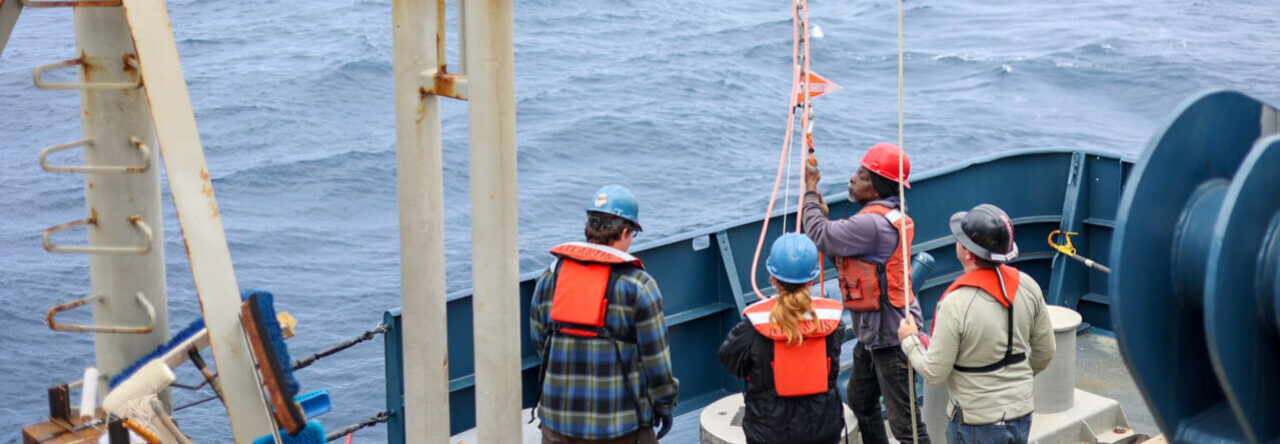
Soon we were in position and ready for our first cast. On went our foul weather bibs, steel toe deck boots, gloves, work vest, and helmet. We quickly went outside for some good ol’ fashioned hard work. The dredge needed to be disconnected from the tugger and up went the dredge, then went down to the specified depth from the science team. After 15 minutes or so at the bottom it came up.
This is the choreographed part of the dredge that takes much time. First, we need to hook the dredge on ramp with the tugger and two lifting straps. Once its on board and pulled as far as it can, we hook a lock chain to it. A scientist then removes a small device that test for pitch, roll and temperature. Then the straps come off and hook the tugger to the bungee/cable on the center winch block on the A-frame. Then we feed the tugger and pull the bungee to get the cable over and hook it to the chain on the back end of the dredge. The dredge goes up to dump its contents, in which Christian and I shake it down with rakes. Then, the end goes down and we pay in the tugger to get the bungee/cable through the winch and free up the tugger. Lastly, we remove the lock chain and the dredge goes back down the ramp where we secure it was some tag lines. All of this takes about ten minutes; quick to learn, but you should go fast. I had to keep jumping over this rock ramp to get to my station on the starboard side. I always fear of falling in at this point, but I’m secure in my abilities to keep me going.
The fun part begins with shoveling the pile of benthic organisms to the sides of the table for sorting by the scientist. Anything from scallops (the main thing we’re looking for), rays, skates, sand dollars, crabs, hermit crabs, flounder, hake, starfish, shells and many more. Everything needs to be sorted with a majority being in the category of “trash.” All invertebrates have a separate category by species.
Once all the species were sorted, and the science team has moved all their baskets and buckets into the science van, Christian and I would clean the deck of all excess debris. Christian on the hose and I on the brush, moving all the critters back into the sea. The first couple of dredges were very light with maybe a couple scallops. Our first watch we had enough time for three dredges. Then it was off the bed, leaving Shaun and Huxley with the CTD cast and more dredging.
For the next couple of days, all we would do is wake, eat, dredge, repeat. Boy what a time to be alive.
On Thursday, today was very eventful, but also very tiresome. For both watches we did nothing, but dredge, dredge, dredge. A couple of CTDs were sprinkled in, which is very simple. To cast, we would prime the Niskin bottles, take off the cap to the fluorescence, remove the syringe from the pumps filled with Milli-Q water, remove the safety chains, turn the deck box on and start recording. We would signal to the bridge that we were ready, and by using the Knudsen, explain what depth to submerge it. As it is put in the water, the pumps would start, and we would lower it to five meters to remove bubbles and back to the surface to go down again. Christian and I would watch the graphs with salinity, temperature, fluorescence, depth, and oxygen. When recovering it, the bridge would pull it from the water, with Christian and I securing the safety chains, cover the fluorescence, and fill the pumps with Milli-Q water. After the scientist got a water sample, we would re-cock the Niskin bottles and rinse with freshwater. Lastly, we processed the data from the cast using a script that gives us a smooth graph that’s adjusted for ranges and shows only the up-cast.
After four more dredges for dredging on the first watch and three on the second, the day was over. This was a day of eat, sleep, dredge, repeat. We did see some interesting creatures along the way like a torpedo ray that has electrical discharge of 400 volts to kill fish, which is crazy. I learned how to shuck scallops, which turns out to be quite easy. You have to run a knife along the body until it pops open, then remove the skirt by pushing it up over the meat. Then cut off the meat into a pale. Boy did we have many scallops for some of these dredges. The last one before bed had six or so baskets. We only ever had enough time to do maybe one full basket. From what the other watch told us, they didn’t have very many scallops, mostly trash.
For Friday, we finished up the last bit of dredging before a couple of days of HABCAMing. When it was pulled up, it was a crazy full. It has not yet been this full since starting. All the way to the brim full of sand dollars. Amazing how much could fit into it. Someone suggested it could hold 2000 lbs. when full. This was definitely full and difficult to get out of the bag. We had to get five guys to shovels some of the contents out to the edges of the table. Some had shovels, some had rakes. All in all it was painstaking process. We eventually got it all out and got the dredge secure. The next major thing was shoveling it all to be sorted. Christian and I were doing our best, but at some point, Christian got down to start moving baskets to the edge of the deck. We eventually got it all, washed the deck and finally were done. Next was the process of unrigging the dredge to get the HABCAM back into the water. We hooked to dredge to the tugger and pulled it on board. We hooked it to the lock chain and rachet strapped it down. We unhooked it from the starboard side winch, and it was as good in place.
Once getting to the location, a CTD cast was in order and just like before, got it ready, cast it, captured bottles, recovered it, cleaned it, and processed the data. All was smooth moving. Now came time to drop the HABCAM. No issues in dripping, with rest of day for some relaxing time after the past few days of nonstop work. We went back to dredging on Saturday, on our second watch, with a total of three cast getting boulders, scallops, and mussels.
A hard week has passed with a few more to come. I’m seeing the important hard work that goes into surveying. Every task has its purpose and varying level of difficulty. I’ve had to keep my mind straight for the task at hand to keep everything moving smoothly, even with little sleep. Sometimes, sleeping is very difficult with the rocking, but we all power through. We strive for the best data we can collect. I appreciate this experience, no matter how hard it may be at times. Just keep swimming, just keep swimming.
Best,
-Sebastian D.