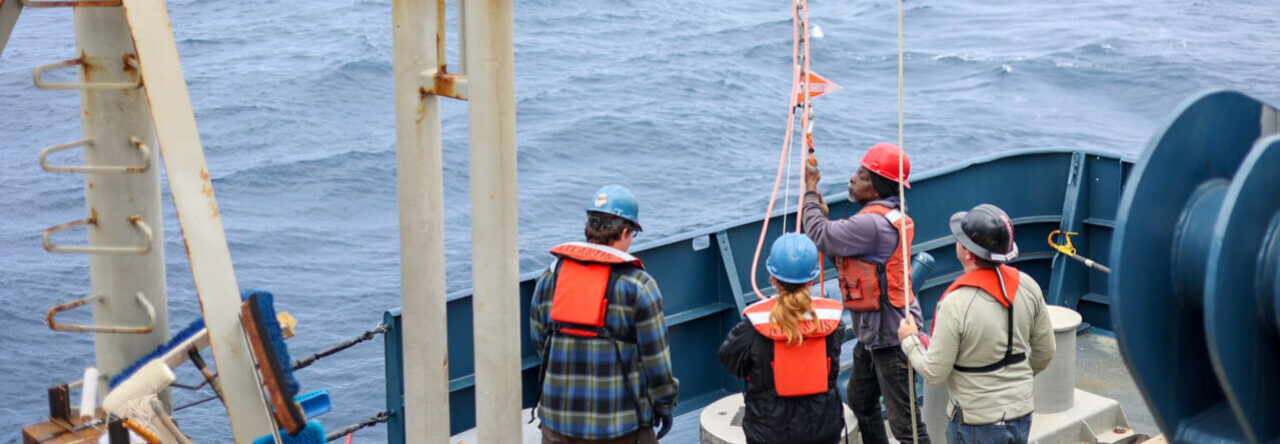
Greetings! I have just completed the fourth and final week of my internship with the Alvin Group aboard the Atlantis. It’s been an incredible time packed with new experiences, new friends, and the discovery of a large coral reef off the coast of South Carolina!
(Note: All previous posts have been updated with pictures taken while at sea. Enjoy!)
Wednesday was our third to last dive, and pre-dive/launch went very smoothly. We woke up early and got everything done ahead of schedule, so I was able to enjoy a bit of the sunset as well. During Alvin’s dive, I worked to clean the mech shop once more and also worked on cleaning some of the corroded tools and chain binders in the hangar. I used wire brushes to scrub all of the loose rust off and sprayed the larger parts down with a rust-eating chemical. I placed the smaller parts in the de-rusting bucket that was filled with a rust-eating liquid as well. After some scrubbing and re-greasing of threads, the equipment worked smoothly again. The recovery and post-dive went well and when I checked the Main Ballast Blow Box, the leak seemed to have stopped. We were able to knock off early since we got the post-dive checks done very quickly and managed to update the basket with ease. After some hangar cleanup, I knocked off and enjoyed playing a game of Settlers of Catan with Max and Nick to end the day.

Thursday was a long day due to some miscommunication with the plans on what was needed on the basket. The pre-dive and launch went well, and afterwards I worked on cleaning the rust off of more chain binders. I also went to top lab (room next to the bridge where someone is always stationed to communicate with the sub) to learn about the electrical systems on Alvin and how Alvin is powered. Bruce explained that there are many different ways of diagnosing electrical problems by isolating certain parts of the system and running down the line of components that could have failed. From the schematic we could see that Alvin’s electrical systems were very symmetrical and were full of safeties and alternative ways to work different parts of the sub. I also learned about the mercury trim system which consists of a pair of balls in the front and back of Alvin containing mercury and oil. The oil is pumped back and forth to displace the mercury and move it to adjust the sub’s trim. The system also includes check valves and relief valves in order to make the moving the mercury in one direction easier. After the sub recovery and post-dive checks, Nick and I worked on making a deployable camera stand so that Alvin could take a picture of itself during the next day’s dive. It had a weight plate base and used speed-rail joints as the mounting platform for the camera which was hose-clamped to the stand. The idea was that the sub would take this out of the basket and place it down onto a surface and then back away for the camera shot.

Friday was our last dive of the cruise. It was a special day because I realized that the cruise was coming to an end, and tried to cherish the last moments I would have. It was interesting because I felt that I had been at sea for much longer than I had been and knew I was going to miss my time at sea with Alvin. Nevertheless, we started the day by going through our pre-dive checks and prepping Alvin for the day. Per tradition, I also decorated a foam cup that would be placed in a bag and strapped to Alvin. We did this so that when Alvin returned from the dive, we would get a shrunken cup souvenir from the water pressure. After cleaning the windows for a final time, we rolled Alvin out onto the aft deck and attached the necessary weights. The launch went well and afterwards we power-washed the hangar. When it was time to prepare for Alvin’s recovery at about 1700, we gathered all the necessary tools and equipment out onto the aft deck. The final recovery went smoothly, but instead of giving Alvin a freshwater hose down, we stripped all the skins off and scrubbed them down with soap and gave Alvin a power wash until she was clean. Afterwards, we rolled her back into the hangar and went to have dinner. Since it was the final dive, we were able to knock off early (around 1830) and celebrate/relax. That night some of us sat out on the bow and watched the lightning light up the night sky and the dark waves.


Saturday was a day of transit as we didn’t have any more dives and worked to clean the mech shop and hangar. Since it wasn’t a dive day, we started the day at 0800 and worked on storing/taking stock of materials that we would need for the next Alvin cruise. We also worked on figuring out why our spare Titan manipulator was acting sluggish. We set up the manipulator on a testing bench and I watched as Bruce and Danik tested to see if any of the issues were caused by the master arm. Afterwards, Danik changed out the main board in the arm that connects and controls all of the servo valves for the joints to see if it was an electrical problem. We did not find that it was an issue of the master arm or the electrical board, which helped us progress further into diagnosing the issue with the arm. After some discussion, everyone decided it would be best to wait until we got back to Woods Hole to figure out the issue. Todd also showed me some footage he had from his days of working on Deep Submergence Rescue Vehicles with the Navy. It was very interesting to see the way they conducted their operations and hearing about all the exercises and work they did around the world. Overall, it was a very relaxed day that consisted of housekeeping and some manipulator diagnostics.
On Sunday, we arrived in Woods Hole at around 0930. It was the first time I had seen a land formation in about two weeks, and the sun was shining down on us. As we pulled into port, everyone watched from the side of the ship as we approached all the smaller ship traffic in the area and I watched as all the smaller boats sped around us. When we finally approached WHOI, the crew worked on tossing mooring lines to workers on the dock and set up the steps and gangway for people to begin loading and unloading equipment. Science had spent the previous day and night packing and preparing to offload their gear. When we were completely docked, we carried aboard new supplies for the next cruise and spent much of the day storing them in the forward van and in the mech shop. The starboard crane was also being used a lot to carry many crates off the aft deck. At the same time, the crew were prepping parts of the Atlantis for the upcoming ROV Jason cruise. After bringing aboard new supplies and offloading our old supplies, I worked with Danik and Jefferson to clean the forward van and organize the materials/consumables inside. It was a fairly short day since we had just finished the cruise, and we knocked off at about 1400. In the evening, we had a barbecue hosted by the scientists to celebrate a successful cruise and the discovery of a large coral reef.
Monday was my final day at WHOI with the Alvin Group. It was a very short day of work since it was Labor Day. The first part of the day consisted of completing some of the six month maintenance checklist. Nick and I worked to inspect and clean the emergency sleeping bags as well as the lithium hydroxide emergency CO2 scrubbers. After doing that, we worked on cleaning out our rooms to make sure that they were prepared for the next cruise. It was strange feeling knowing that I would be leaving the ship and going back to school soon. I reflected for a bit on everything I just experienced in the last month and the profound things I learned about myself and the world of marine engineering/science over the course of this internship. After we were all done with our work, we had dinner at a restaurant in Woods Hole, and said our farewells.

Looking back at this past month, I can honestly say that I’ve had the time of my life and have learned plenty of new skills. I’ve learned more about what it means to work on a tight-knit team to ensure that Alvin works properly and is safely launched/recovered, and I’ve learned what it’s like to live and work at sea. I loved learning about and working with the sub’s hydraulics systems and finding out about the reasons why Alvin works the way it does. I feel that I’ve also developed a better work ethic from this experience as well as a stronger interest in marine engineering and operations. I am grateful to have been a part of this cruise and will never forget the people I’ve met and the lessons I’ve learned from this experience. Thanks for following my experiences with the Alvin Group as we sailed along the East Coast aboard the R/V Atlantis!
-Nick Ellis


