
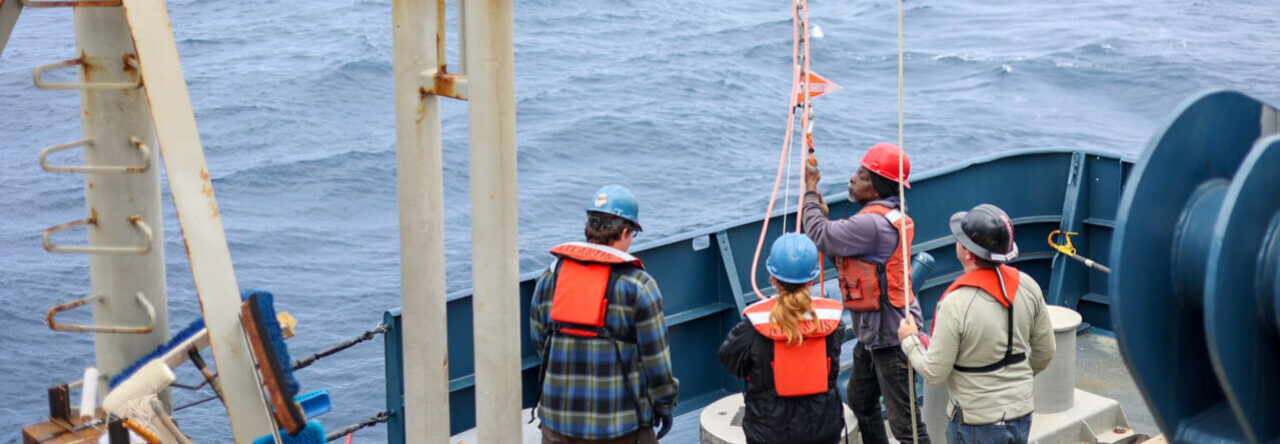
R/V Hugh R. Sharp
Leg one of scallop population survey
June 22 2013
Days at sea: 9
Time: 1859
Weather: Sunny and 69.89oF with 76% humidity
Wind Speed 5.1kn
Sea State: 1-2ft swells
Position: 39 34.35N x 073 26.78W
The Basics
Just as if I had blinked my eyes and held them closed for a second too long, the entire first week at sea has seemed to pass over the time span of just a few watches. The rest of the crew is itching for our return to land and completion of the first two week leg where some of us will have only a day to put our feet on solid ground, and where others from both the ship’s crew and the science crew have completed their time on the Sharp until the next cruise calls. Luckily I feel like I have just gotten started with my summer here on the Sharp. In a way, this is true as we will be aiming to go further north towards Georges Bank and will be sailing all of July.
So much has happened thus far so I will start with the descriptive basics. I stand watch with technician Ted C. during the day watch. While some science cruises choose to adopt a six hours on watch six hours off watch schedule, we all opted for the 12 on 12 off, with day watch beginning at 0530-1730. The reason for the long watch is sea slime. While I expected to come off the cruise smelling of scallops, I really could not have expected how fully covered I could get, head to toe, in sea-slime from the various organisms that make it to the surface in our dredges. The scallops themselves are not too slippery, but the sea-stars ooze immensely, the sand-dollars foam a spring-green liquid, and the fish flop in their own secretions. Shower time at the end of watch (instead of every six hours) comes only second favorite to dinner time.
For the Good of Science
There are two main science motivated goals of the cruise. The first being to physically dredge the bottom of the ocean floor for scallops at mostly random locations along traditional scallop fishing territories. The second, still with scallops in mind, is to tow a specialized real-time camera a few meters above the ocean floor to continually photograph the scallops in their natural habitat.
This camera is called the HabCam. One ability which makes the R/V Sharp unique is that it has a deployable fiber-optic cable that attaches to the HabCam and is capable of communicating real-time data back to the ship. This allows the science crew to treat the HabCam as a remote operated vehicle in a sense as they can change its position by letting more or less of the cable release from the ship’s winch while viewing data in the ship’s lab.
I may have painted an incorrect image of the trailing HabCam, it is much larger than just a camera tossed overboard. The camera is mounted on a rectangular steal frame, somewhat cage shaped with the addition of a ‘second-story.’ Overall the HabCam configuration weighs ~3500 lbs leading to an awkward deployment and retrieval which takes place on a ramp secured to the port side of the stern.
Besides the camera itself and the four strobes which bring light to the camera, the frame of the HabCam is also equipped with multiple CTDs (the classic oceanographic instrument which measures conductivity, temperature, and depth from which one can calculate salinity) one of which is taking dissolved oxygen readings. There is also a side-scan sonar which produces a relatively detailed image of the ocean floor and an instrument set to specifically measure the wavelengths indicating chlorophyll and CDOM which correlate with the photosynthetic primary producers in the ecosystem. A full spectrum spectrometer records the remaining wavelengths, and the altimeter and GPS report back on the HabCam’s position. There is also a sensor photographing plankton in the water column, primarily zooplankton.
HabCam N’ Scallop’n
Life on the ship takes on a different pace during a scallop dredge than when the HabCam is in the water. We began this leg with a multiple day HabCam track, then went to several days of dredging, and currently the HabCam is back in the water and has been for the past two watches.
When the camera is in the water I focus mainly on helping Ted maintain the winch readouts (which we have had some significant trouble shooting issues around…it was discovered that a circuit board was damaged by a voltage leak and we will be replacing it when we come into port on Monday) or with any other small projects necessary. Thus far I have worked on mapping out quite exactly the set up of the wet lab, and the back deck where we dredge. Having a map is a good reminder for both the crew and science and hopefully it will be helpful in future cruise planning and setup. I am also responsible for testing the CTD daily and recording air temperatures, humidity, and data from the ship’s GPS and ADCP (Acoustic Doppler Current profiler, used to measure ocean currents). Everyday I also check the filter and flush fresh water through the ships flow through system. This system takes constant data from the surface waters as we are underway, such as seawater temperature, salinity, and fluorometer readings.
It is currently 1800 and we just finished dinner-I want to go into descriptive detail about scallop dredging as it has been the most active, and a quite favored part of the trip so far, but I think It will have to wait for the next post.
To give some insight about dredging I have included a selection from my daily journal, written three days ago:
Journal Entry:
June 20 (and writing for the 19th)
0107
Nearly each trawl brings up a new mix of organisms. Today things were a little less “back-to-back” with about an hour between every transect. I would imagine as large as the ocean is that this amount of time would not lead to such variable a catch. Even yesterday when our transects were closer together, almost no dredge brought up the same. While Science has to remain unbiased, a dredge full of scallops is undeniably what gets the crew most excited. When Evan is on watch the fisherman in him is always there looking down on us with his binoculars that moment the dredge gets inverted on the table. The mounds of scallops at their largest have taken up about one quarter of a table maybe a foot and a half high. To me, especially when I’m on the table shoveling them, this seems like a lot of scallops but the boys tell me this is just a warm up compared to the third leg on Georges bank. I am working on my arm muscles now!
The dredge after dredge which has been dumped onboard carrying mounds of sea-stars or mounds of sand-dollars and mud show me how the commercial scallop fishing must take skill and knowledge. The scallops apparently are very particular in their environment and favor a specific temperature, substrate composition, and often importantly depth.
Thanks for reading!
Love to the family my Mom, Dad, Alan, Omi and Gram. I’m excited to come land-side soon to give you all a call…Happy Summer. I still sleep very well on ships, missing R.C.S.