
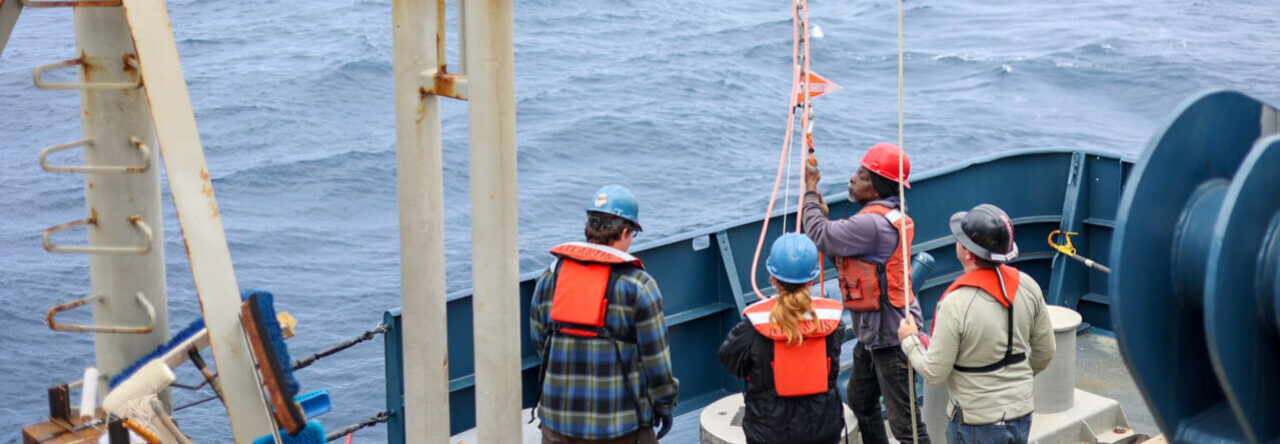
R/V Hugh R. Sharp
Leg two of scallop population survey
July 06 2013
Days at sea: 7 since leg two
Time: 0021
Weather: Fog, 59.99oF with 96% humidity
Wind Speed 13.7kts
Sea State: 1-2ft swell
Position: 41 10.08N x 066 38.81W
The Happenings
Leg two of the survey began June 24thand left from the Sharp’s home port in Lewes Delaware. Coming into port cracks the crew’s smiles as they get to sleep in their own beds, reunite with those people and pets they miss, and of course unwind from their twenty-four-hour floating “office.” While I have not gotten too truly homesick, and continue to learn every day, I have gained a higher appreciation to those who spend at times up to two thirds of their year at sea. Seasons pass, children grow, and tomatoes ripen.
After taking care of some cleaning and the morning projects, I was given the afternoon off in between leg one and two to explore onshore. I managed to stay on land long enough to get eaten alive by bugs, buy some new books, and order various beverages…an americano included. I walked away from the Sharp and onto the hot humid beaches of the bay. Beach umbrellas and horseshoe crabs put a different beach flare than what I am used to, just another reminder that I am on the east coast. Everyone seems very friendly in small town coastal Lewes and ready for their summer.
The intention of the second leg is essentially the same, to dredge and film scallops, this time north off the southern side of Georges bank. While I expected all to be the same, the second leg has taken on a totally different character. The switch of crew both on deck and for science is partly responsible. I attest the rest of the change to weather and darkness. I now stand the night watch, 1730 to 0530 and so I begin my days with sunset and await the peek of dawn. Both night and day have been shadowed in cool fog which is different from leg one’s sunny days with “bathtub” swells.
Those who became seasick for the first few days could affirm the rougher seas. The Sharp notoriously is a rocky ship. This is due to her small keel combined with the heavy high tower used as a marine mammal observation platform. Working on deck with in the darkness and the occasional wave crashing on deck was exciting. With weather getting worse, and the anticipated 12+ foot seas and 30 knot winds the bridge decided to dock in Woodshole Massachusetts.
The unexpected three days in port so soon after leaving has made seemed to cut the trip nearly in half. We are already headed south and homeward and are currently re-tracing our dredge cruise track with the HabCam. I enjoyed my time in Woodshole and was not expecting so much onshore travel during my internship. I spent a day visiting a friend from school who is interning at WHOI for the summer. I also got to pay my respects to the tallship SSV C. Cramer of Sea Education Association (SEA). The last time I was in Woodshole was about three years ago when I was a student with SEA, I had nothing but good memories flooding back. The seas have continued to calm and we have been able to continue dredging as usual.
Marine Technician Meets Marine Critter
The most notable marine technician related events of leg two have been the failures of two ADCPs, changing the batteries on the sound velocity probe, and training to run the multi-beam sonar.
The ADCP (Acoustic Doppler Current Profiler) computer was failing to communicate with the instrument at the end of leg one. Technician from the R/V Blue Herron who was onboard helped Ted determine that the problem was a bad connection by looking at the system’s various com ports. So, once on land we pulled the ADCP out of the water where it is attached to the bottom of the keel. The keel on the Sharp it is attached to large air filled bladders which allow us to raise it. Once out of the water, large pipes on the keel where the instruments are mounted (and with cables connecting them to the ship) can be lifted out of the water using the crane.
Upon detaching the ADCP it was apparent that the cable connection had failed, as white electrolysis goo surrounded the connection. We installed the second ADCP kept on board and during our short trip from Lewes to Woodshole this one failed as well. When we pulled out instrument for the second time, we could see the same problem beginning. After some investigation as to what may be causing the problem it appears a change in cable manufacturing may be to blame. The cable itself has male and female parts (pins and holes) so it is imperative that they fit together properly. It seems that the newly designed cables have an added piece of plastic for reinforcement. This ‘bump’ can lean on the cable connection causing the holes to become more oval and putting pressure on the pins. Alas, we have no ADCP running currently. One handy trick I learned was to mix cayenne powder with the grease that coats the instrument, this slows growth of barnacles and other bio-fouling.
As far as a little midnight project goes working on the sound velocity probe was interesting. You would think changing batteries would be simple, not so. The only way Ted and I could see to get this task done was to cut the old battery free, use a wire stripper, and solder the new battery to the instrument’s wires. I watched as Ted did the real surgery and acted as his assistant. I am not sure if this was the correct way of changing the battery, but with no advise from the recent instrument servicer, it seems to have worked.
This evening, now that the dredging for this leg is complete, Ted has been training me how to start the Multibeam Sonar program. Instead of a single sound beam used to sweep the ocean’s floor like most sonar instruments, the multi-beam sends out many separate sound signals. The sonar must ‘listen’ for all of these beams as the bounce back off of the ocean floor. We will be using this program in the future and I am sure I will write more about it. To help with my training, Ted and I just composed a program procedure which I can follow (as we will no longer be on the same watch) if the system becomes overwhelmed with data and crashes.
Here is another snippet from my daily journal on my experience with dredging and deck life:
Journal Entry:
July 3rd
Time: 0239
Two pilot whales caught my eye’s with their big black fins. I had never seen a pilot whale and I considered it to be a shark at first, but the angle at which the fins disappeared under the surface, and their bearing right for our ship redirected my identification. A hop up to the bridge confirmed my sighting. Evan asked me “how did I see them?” I should have responded “I have good eyes.” Its amazing how trained the human eye can be. A person staring at the gray ocean for hours, the same in all directions, can pick out an anomaly within seconds. This trip so far I have seen numerous plastic bottles, floats or buoys, a large log, a bucket, and Ted has seen a wood pallet with a thresher shark alongside it.
Earlier this evening we did about four dredges. Notable is what the scientists term “seed.” Two of the dredges turned up ‘seed,’ petite baby scallops, no larger than a thumbnail. While difficult to count and measure, noting these “next-generation” scallops gives the scientists a good feeling especially in open fishing areas. While the these droplets of new scallops are more than numerous, they also face a high mortality rate. Mixed in with the seed were also the smaller three inch scallops which will be ready to fish in a few years. The scientists sub sample to estimate actual numbers of the baby scallops by measuring about half a liter of them-a minuscule amount compared to the multiple five gallon buckets worth. I think the seed numbers reached 60,000 for this tow.
Ok, thanks again for reading, its about 3am so I think I’ll mug-up and snoop around for a snack in the galley. I’ll try and write again soon- so far so good!