July 17
Days at sea: 10 since leg three of NOAA scallop survey
Time: 0312
Weather: clear, 65.69oF with 90% humidity
Wind Speed 8.1 kts
Sea State: 0-1ft swell
Position: 41 24.68N x 069 53.71W
Leg three to the northern edge of George’s bank began July 9thfrom Woodshole MA. Let me begin by saying on the tech side of things, most of the wrinkles for this cruise seemed to have been ironed out. All systems have been running smoothly. I continue to do my daily checks on the CTD sensors, and clean the filter on the ship’s underway surface water sampling system. On our HabCam runs I have written a procedure guide for these daily checks to be added to the ship’s technician manual.
For two or three watches we had the HabCam in the water but since then we have been dredging almost non-stop. The most notable change to our dredging routine was the addition of the off-ship shoot. The dredges have been bringing up boulders and rocks. We have attached this large metal slide to the dredge table on the starboard side and we then use it to push/shove/roll/tumble the boulders down, right into the sea. Its times like these that I wish the Sharp had its own supply of ogres, these rocks are heavy. Our first tow of this leg pulled up 20-bags worth of scallops, but they were also a little on the old-side.
Scallop productivity continued to be high on this part of the bank as we have pulled up more scallops in this past week during our dredges than we did for all of leg-one and leg-two combined. The grand total for all three legs has come to 192 dredges. It seemed for the past three days we were doing maybe 7-10 dredges an evening, with a CTD every three stations. I have barely had time to run into the galley for a midnight snack, or stay out-of my foul-weather overalls for more than half an hour at a time.
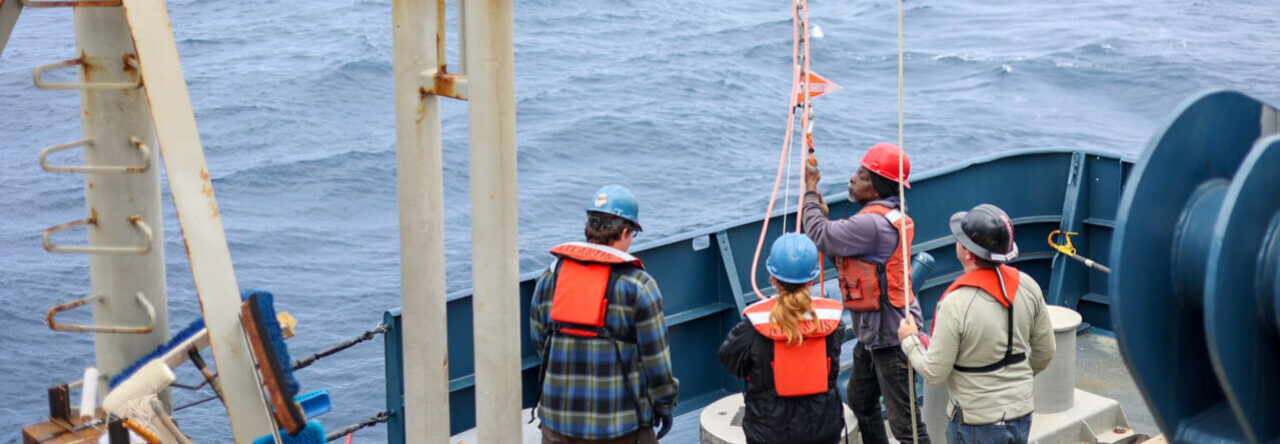
While I cannot say that every station has brought up a bag full of rocks, those that do keep us plenty busy. Usually we have just been able to finish sorting the catch, and to get the deck hosed down before we arrive at the next station. To ease the trouble of boulders slightly “rock-chains” are added to the mouth of the dredge. These are simply a grid of chain meant to keep the larger rocks from filling in our catch. From the rocks which do make it into the dredge, they do a hefty damage to the net-like liner (used to catch the small fish, crabs, sea stars, baby scallops, substrate, snails, hermit crabs, etc) inside of the dredge. During leg one I remember saying “science can’t possibly need three dredges and this huge pile of liners,” I now stand corrected. During the transit time we had to switch the dredges out multiple times so that the science crew could work on repairing them. We do this with the help of the engineer on duty who uses the crane move the dredge on and off the sorting table. While the weather (I still don’t want to say this for paranoia of a shift) has been more than pleasant, calm waters and comfortable air, we still use tag-lines to guide the dredge into position.
The technician John, from Savanna, has stood in for Ted as my watch partner this leg. It has been a pleasure working with him and hearing about the ways in which his boat is different, both on deck and with tech-systems. It was an interesting feeling beginning a watch with someone who knew less about the Sharp’s set up and the dredging operations. I got to act in part as a teacher while simultaneously being a student.
The other benefit of staying on all three legs of the trip is the continuing interaction with the science crew. As more people have left the ship and others have joined us, I have gotten to meet several sets of scientists. For example, on leg one I met the lead scallop researcher, on leg two the computer programmers and now on leg three on of the engineers who designed and built the HabCam. All involved on this leg have been really enjoyable to work with. We make sure to plug in our music during our sorting sessions, and everyone works really hard. A lot of hands, minds, and attention have been used from all sides, both volunteer and professional, to make the monetizing of scallop fishery possible.
We are currently headed into port to Woodshole Oceanographic Institute as we have finished the dredging for the trip. It will be a quick turn-around. The plan is to offload all of science’s equipment including the sorting table, the rock slide, the three dredges, numerous buckets shovels and rakes, computers, and all of the organism measuring tables, leaving only the HabCam onboard. We will then HabCam all the way back to Lewes DE for the remaining two days of this cruise. After that, the summer sea portion of the NOAA scallop survey will be complete.
I am so lucky to have been placed on this boat in particular for this survey. I have loved bringing up the dredges and watching what comes out of them. I still am the biggest fan of shucking and popping a raw scallop into my mouth for a quick snack. Being able to couple dredging with HabCam seems like a perfect balance. The camera allows the scientists to observe the scallops in their natural habitat while dredging keeps us from missing any essential details. In addition I have learned how operate the CTD and have peered into the world of data. Bravo overall!
I’m missing the family and my friends, I hope you are all doing fantastically! Thank you again everyone for all of your support- it’s been good-ol’-hard-work out here.
Until next time,
-MG