So after cruising for a couple of days, we are now in the study area where we will be spending the next five weeks. If you have read my previous blog then you know that I was seasick for the first day. Well, thankfully the Pacific Ocean has been living up to its name, because the water has been perfectly peaceful. Therefore, I am able to operate on all cylinders again! Unfortunately, there is a plethora of other types of illnesses traveling around the ship now. Nonetheless, the show must go on!
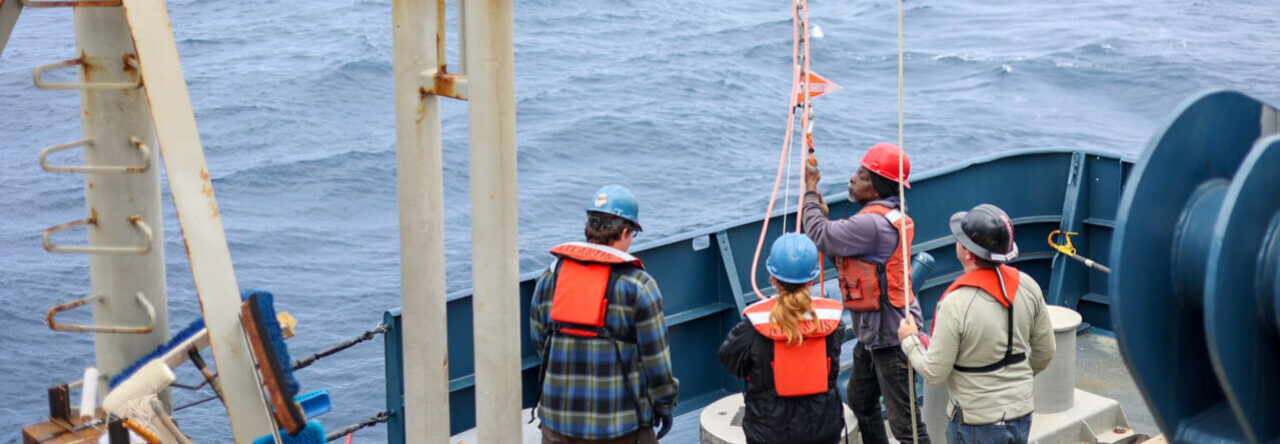
We spent the first couple of days retrieving lots of moorings that were in the ocean taking measurements for a year and half. The moorings are extremely long cables that stay vertical in the water between an anchor and a buoy. Along the line there is an instrument that crawls up and down taking measurements of the entire water column. Due to all of the components of this system, it is a very complex operation to get these things onboard. It usually takes two or more hours from start to finish, which can feel like a long time out under the tropical sun.
After learning what these instruments can do I started to get curious about the area that we are studying. So I sat down with someone from the science team and got a better understanding of why we’re collecting all of these data. He told me that the region we’re in is called the Samoan Passage and it is a very important spot for the Pacific Ocean’s thermohaline circulation.
Ocean circulation plays a critical role in the global climate. For example, most of Europe would be much colder if it weren’t for the Gulf Stream bringing up warm ocean water from the tropics. So understanding how ocean circulation works is imperative. There are several ways that the ocean circulates, but this study addresses the thermohaline circulation in the Southern Pacific Ocean. All of the cold water near Antarctica sinks to the bottom and starts slowly traveling back to the equator. At one point along its journey, the Samoan Passage is the only place deep enough for the very cold and dense Antarctic Bottom Water to travel northward. So it is squeezed through this passage that is only a couple of kilometers wide in some places. The science party is quantifying the amount of mixing that is happening in this passage. They call themselves the ‘wave chasers’, because the cold Antarctic Bottom Water is passing over these very deep ridges which form standing waves that are seen best in our temperature profiles. These standing waves are similar to the ripples you see over shallow rocks in a river or stream, except the amount of flow over these ridges is several times greater than that of the Amazon River. It is truly exciting stuff, and I am sure that I will learn much more about the Samoan Passage over these next couple of weeks.
The science party would be hard pressed to get the data they needed without the crew and, of course, the marine techs. This week I learned quite a few new things from both of them. The crew taught me how to hand-line fish off the back of the ship after seeing tuna and marlin one morning. Thus far, we have been unsuccessful in getting any fish onboard the ship. As for my main job, I learned a very valuable skill for a marine tech: how to splice a wire and make it waterproof. Normally, I just twist two exposed electrical wires together, maybe put some electrical tape on it and call it a day. However, we had some problems with our CTD and had to splice a wire that we are sending 5000 meters under the sea. This poses quite a challenge. Even so, we were successful in our waterproof splicing. We used a newer method that consisted of crimping, soldering, hot gluing, heat shrink tubing and then electrical tape. I never thought I’d be using hot glue and a blow dryer (for the heat shrink tube) for electrical work.
So now that I have spent about a week developing my marine tech skills and have good understanding of the science, I feel like I’m becoming a viable member of the ship! I still have a very long way to go until I get to the level of competence that my supervisors Jason and Brandi have, but I am confident that I can get there!