
R/V Marcus G. Langseth,
27-May-13, Near the Study Site off the Coast of Portugal
Hard Days of Work
Hello everyone, I am sorry that took me a bit longer than expected to post but in the last four days, we have worked a total of 55 hours!! Yes, we have been doing a lot of work, but it needed to be done and now that the really long days are out of the way, it should be a little easier.
So, what have I been up to? Well to put it simply, we have been working on the streamers to make sure the streamer 1 and streamer 2 (which haven’t been used for months and months) were up and running smoothly. We worked on streamer 2 on Friday, Saturday, and Monday, worked on streamer 1 on Sunday
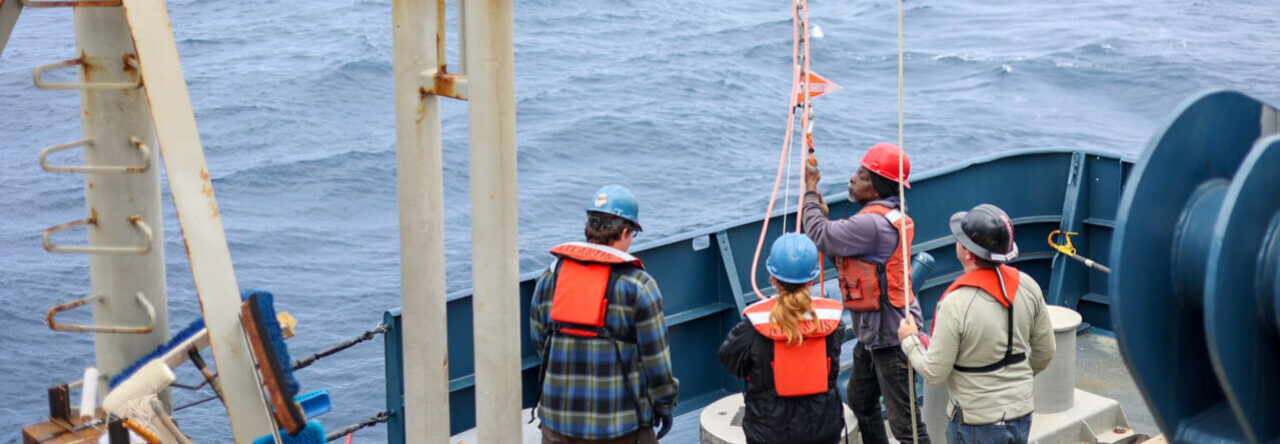
On Friday, and Saturday, we had to let the whole of streamer 2 out into the water trailing behind the boat. Whilst doing so, we had to check the serial numbers on the sections and the modules, as well as test the coils. Each section is approximately 150 meters long and at the end of each is a connector where a module is placed to connect two sections. In each section, there are two coils where a bird or acoustic device is attached. As such, we had to stop twice during each section, lift a bird up and radio down to the main lab to have them check if they could see the bird. Then, we would stop in between each section to check the modules.
Not only did we have to stop at each section to check the modules, we had to switch out some of the modules. In order to do this, we would secure the tail end of the streamer and disconnect the modules. Once this was done, we would connect the tail end of the streamer to the deck power to see if the streamers still worked properly. Once this was done, we would connect the module and run the deck power through that to make sure that this was working properly as well. Finally, we would then reconnect the boat-end section to the module and the rest of the tail-end sections and make sure everything was working. We checked /replaced about 12 of the modules (there are about 39 modules per 6km streamer).
Finally, once we had made it through the entire streamer, we had to remove the old lead end and replace it with a new one. The lead end is the part at the boat-end of the streamer that is wrapped around the reel. It provides a connection and allows us to attach the streamers to the wings (wings will unfold from each side of the boat to increase the length of the stern so as to spread out the streamers) once deployed. The lead-end for streamer 2 was old and so to replace it, we had to wind it off of the reel holding streamer 2 and onto a spare reel. Once this long process was done, we had to use the hydraulic wheel to wind on the new lead end. Whilst winding it on, myself and another crew member, Josh, had to hammer the lead end so that it was wound tightly. This took a long time, but finally, we had completed the task.
After the lead end was reattached to the streamer, we wound some of the streamer in and had to then stop and remove two sections. Again, we had to unwind the three sections whilst winding them onto a spare reel. This took some time, but was completed and then the rest of streamer 2 was reeled in. We had to take the birds off while streamer 2 was coming in and so we had to stop about every 300-350 meters to pull off the birds.
On Sunday, we worked on streamer 1. It was supposed to be a routine, check similar to what we did on streamer 2, without removing the lead end, removing the sections, and checking/replacing the modules, but part way through we noticed that the lead end wasn’t situated on the reel correctly. As such, we had to let the entire streamer out, then let all of the lead end out so that we could fix the way the lead end was on the reel. Once this was done, we could then re-spool the lead end and bring in the rest of the streamer.
On Monday, more problems with streamer 2 arose. To fix these problems, we had to let part of streamer 2 out again and work on the modules once more. This time, the problem was that part of the streamer was not getting enough power and we couldn’t figure out why. The power would end in section 28 which means that 12 weren’t getting power. To check which section wasn’t getting power, we removed the modules and plugged in the deck power cord directly into each section and tested it. Then, we put the module back on and plugged the deck power into the module and the section and tested those. If all worked then we reconnected the sections and let out the next section and repeated the process.
This should, in theory, have worked and the problem resolved quickly. However the problem was more complicated than originally thought. As such, we did a lot of checking and re-checking of sections we had already checked before we realized we had a bad section that acted good and messed up what was beyond it. To solve this problem we unwound the bad section, removed it, added three good sections (to replace the two we had already taken off), and reconnected those sections to the remainder of the streamer. Then, all that was left to do was to pull in the rest of the streamer stopping along the way to remove the birds.
Even though this was a lot of work, it was all worthwhile because now, our trip out to the study site after going to Port in Vigo to pick up supplies should be easy as pie. Not only that, but since all of the streamers are now in good working condition, we should be able to put them in the water without a hitch and then the mapping of the ocean floor can begin.
That’s all for now. If you have any questions, post them in the comments and I will try to get to them in my next post. By the time I post again, I will be in Spain and hopefully enjoying some nice weather. Take care everyone!
– This is Tyler Poppenwimer, singing off –