Category: R/V F.G. Walton Smith Page 4 of 9

Walton Smith Week 1: Arrival and first cruises

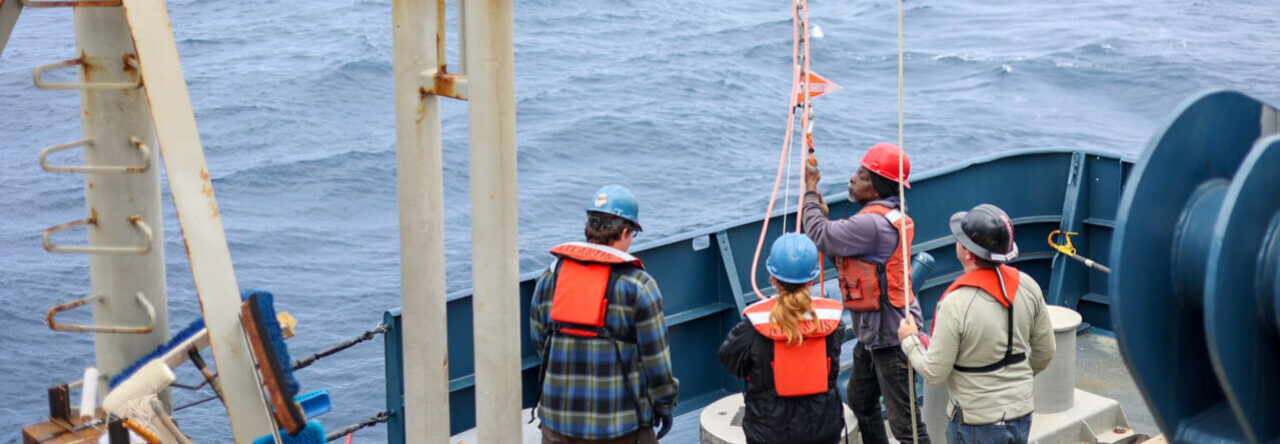
To start my MATE internship, I boarded the R/V F. G. Walton Smith Monday afternoon and set out for a cruise that evening. The mission of this cruise was to recover 3 moorings, that were deployed over the past 5 years, and deploy 2 others in Jupiter, FL. My job for this cruise was to stay within close proximity to the divers with the vessel while they were in the water because our vessel was flying the dive flag. Before we left the docks I was able to help the chief engineer with the pre-departure checklist and starting the engines and generator.  As we were leaving Miami Channel I got to see about 8 dolphins riding the bow. That night as I was on watch we lost the port engine, it wasn’t until early the next morning that it was able to be turned back on. We finally made our way to Jupiter that evening before sunset and the divers were able to located and tag one mooring to recover the next morning. Having engine problems, we were only able to deploy one mooring and recover instruments off another. We were able to limp back to port on one engine and about an hour to two hours out from the university we were able to restart the port side engine to have full maneuverability to get to the dock. After docking, I met the other MATE intern and we helped the engineer with trying to troubleshoot the engine problem. We swapped the actuator from the starboard engine to the port issue engine to see if that was the problem, but unfortunately not, it had to be the engine computer. To fix this I was able to crimp wire to run from the battery to the engine. Before we left for the next cruise I was able to help with the fuel delivery, replacing the racor filters for both engines and added a switch to the wire that was place the day before Sri the port engine. 
 

For this second cruise, the scientists onboard ere collecting data on red tide aloof the Florida keys and into the Gulf of Mexico along the western coast of Florida up to Saint Petersburg area. They are performing net tows, CTD casts, and collecting water samples to observe trace metals. For this cruise I am helping in the bridge with bringing the boat from station to station, holding the boat steady with the wind off the stern for CTD casts, and helping out on deck with steadying the CTD upon entering and exiting the water. So far for this cruise, the only wildlife I’ve seen was a sea turtle and a bunch of pelicans. I’m still on the hunt to see more aquatic life everyday.


Dolphins off the bow. 
 

Pre-Cruise Introduction


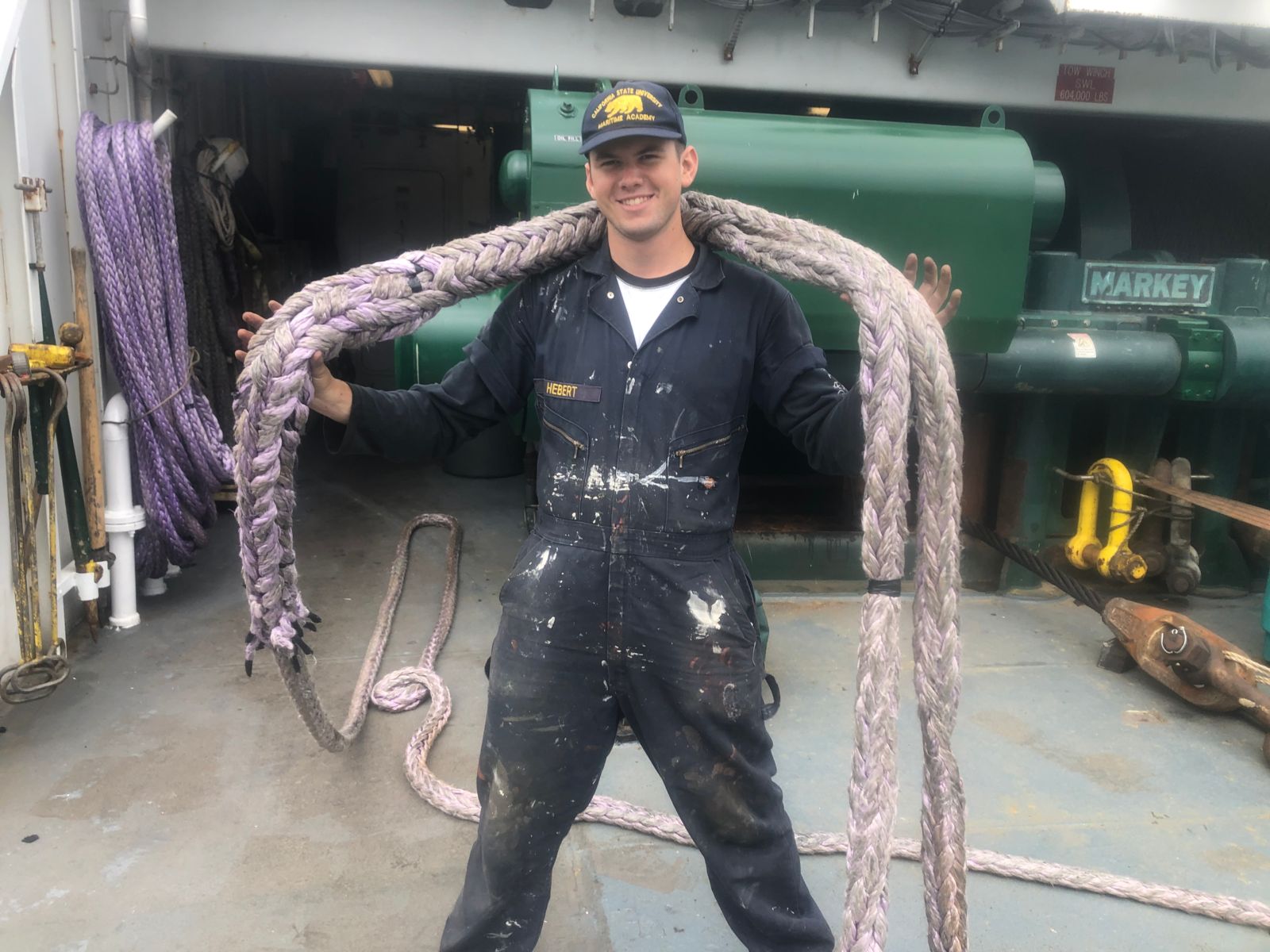
My name is Kyle Hebert. I just graduated from the California State University Maritime Academy as a Marine Transportation major with a minor in Marine Science and a US Coast Guard 3rd Mate unlimited tonnage license. While at Cal Maritime, I enjoyed blending my experiences as a deck cadet learning deck safety, cargo operations, and how to manuever vessels with scientific studies. Including optimizing a methodology to measure ammonium concentrations in the Carquinez Strait, maintaining a YSI 6600V2 Sonde in collaboration with San Francisco State University, and going out on research cruises with the R/V Questary throughout the San Francisco Estuary. I have found a passion collecting samples and working in the lab that has given me direction for my future. I am extremely grateful for the opportunity to work with the Rosential School of Marine and Atmospheric Science at the University of Miami onboard their research vessel, F.G. Walton Smith. I hope to be a helpful hand wherever I am needed and to soak up the knowledge and expertise required to be a well-rounded Marine Technician in the UNOLS Fleet. 

Pre-Cruise Introduction

Hello everyone! 

My name is Alesha Gregoire and I am a recent graduate of Maine Maritime Academy. I graduated with a Bachelor of Science degree in Marine Biology and Small Vessel Operations where I got my able body seaman certification and a 200 ton mates license.

I am excited to join the Rosenstiel School of Marine and Atmospheric Science at the University of Miami aboard the F.G. Walton Smith. I am excited to help out with anything on board, as I have prior deckhand experience and some engineering experience through school. This is perfect for the engine replacement project that is scheduled while aboard.

More about myself, I am a certified PADI SCUBA diver, I love being on or around the ocean (whether that is boating or performing science or sitting at the beach), and during the winter time I enjoy skiing. I recently completed my undergrad project on investigating the clearance rate of microplastics in the Jonah Crab’s digestive system.

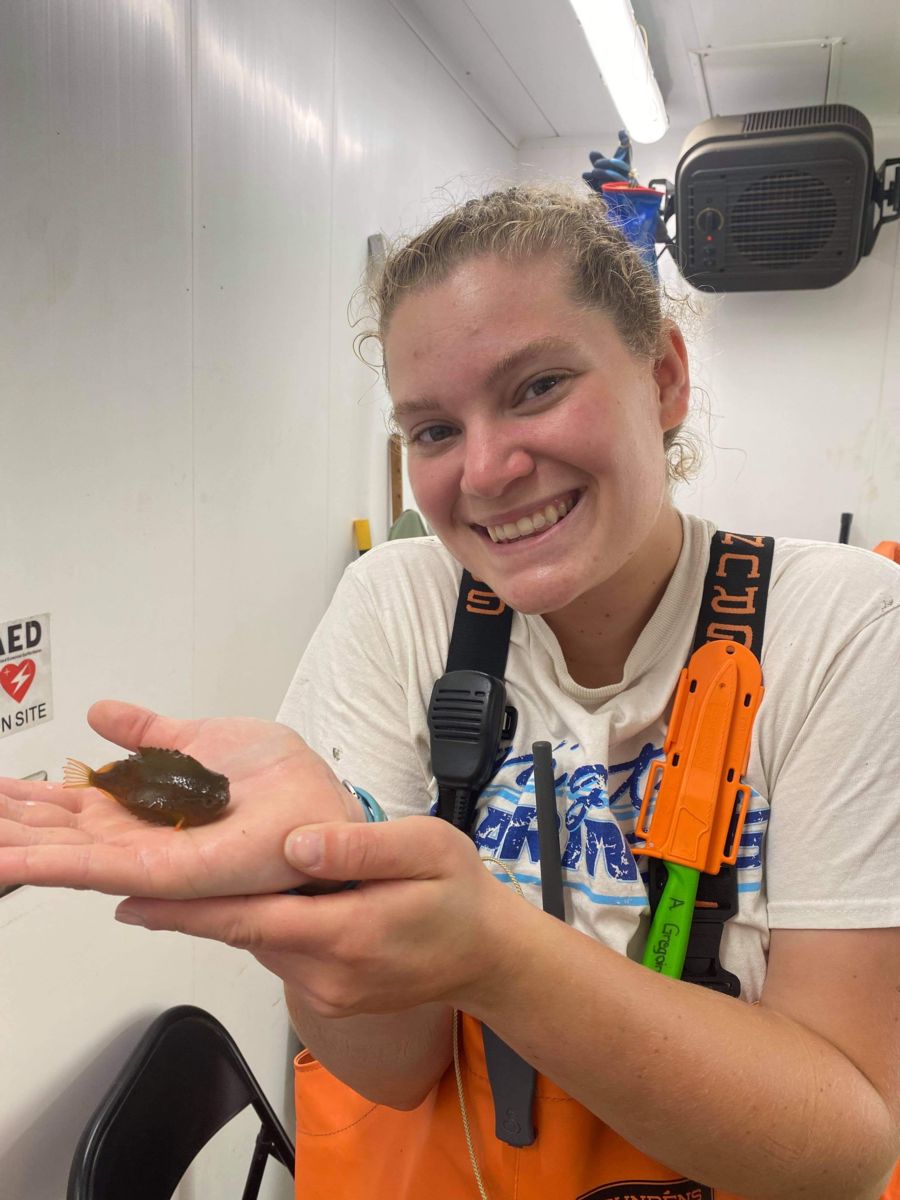
A small lump fish that was recovered during salmon treatments, Summer ’21. 

Week 35 & 36: On The Walton Smith

We had another hurricane developing in the caribbean and it was projected to hit Miami. So we were preparing the ship to go up the river on Friday. On Friday morning we started up the engine and generators but we were not getting any power from them. We had to start troubleshooting the system to find the problem. After a few hours we narrowed it down to the exciter windings inside the generator. We checked everything else just to confirm we checked all the diodes in the rectifier and they all looked good. This took use most of the day so we were not going to be able to fix the generators in time to get shelter from the storm. So the next morning we had 2 tug boats come and tow us up the river to merrill stevens shipyard. We then did not have power close by so we needed to make a 200 foot shore power cord which took a few hours. Because the cord was so long we had to reduce the power to the ship so we would not overload the cord. We finished around 9pm. The next morning I got up and took apart both generators on my own. I removed exciter windings from both generators. The winding did look bad, they were burnt and had melted parts, which was a good sign for us that we found the problem. If this had been one generator it would have not been that strange but because it was both it was strange because they are on separate systems. A few weeks back lightning struck close by to where the ship was normally docked and it fried some of the dock lights. So it is possible lightning blew our generators. There was also a load test performed on the part of the grid our boat is normally plugged in. This could have also caused damage by overloading our system. We got two new exciter windings ordered. I checked the shore power cord pretty often to see how many amps we were drawing to make sure we would not get overloaded. There was a section of the cord where there were two parts plugged together where I could have access to the individual weirs. This was very good for testing. But as I was checking the weirs I discovered another major problem with the ship’s power. I found that we had a large amount of electricity flowing through the ground weir which should have no electricity going through it. I told Don the head engineer so we started to trace everything to figure out why electricity was going through the ground. It took a few days but with the help of a tech we found that the ship’s isolation transformer had been burnt out in the past and it was just bypassed and weird back together around it. With this being done the neutral was weird to the ground for some reason. In the meantime we got the new exciter windings. Don and I installed them together. We then fired up the gens and they both worked. But then one of our big breakers broke so we had to fix that. Then we had another issue that was preventing power getting to our system. It took use another day but we evenly found a problem with the electronics. Once the generators were up and running we got off shore power. We will not be able to use the shore power again till we fix the isolation transformer. The fact that the isolation transformer was not connected is another reason electricity got by to burn out the generators to start with. We then went back down the river to our normal dock on Saturday. 

Week 34: On The Walton Smith

We made it back to Miami on Sunday afternoon. We tied up the ship and helped the scientists unload equipment. Then we cleaned up the deck and 

We have been looking into installing exhaust fans for the engine rooms. Most ships have good exhaust fans in the engine room to keep good air flow and pump the bad air out. Our engine rooms have supply fans but not exhaust fans. So our air flow is not that great. So we looked into installing fans. We ordered two large fans. We are looking to install them on the top of our exhaust stacks. The top of the stakes have large vents on their aft sides so we decided it was the perfect place to mount the fans. We unbolted the vent cover on the starboard side to access the top of the stack to get all our measurements. We also looked at our braker panel to figure out how we were going to wire the fan in. We found an open breaker to wire the fan and I calculated the wire gage we would need for it. We then bolted on some spacers to the frame of the fan so it would fit perfectly with minimal movement when we had it mounted in. We attached the weirs to the fan before we lifted it into place. We then had to hoist it up into place and bolt it in. Once it was in we wired it to the ship’s power with a switch. We could then put the vent cover back into place. The fan worked great. Now we will just have to do the starboard fan once we have some more time.


This is the fan in place!

Week 33: On The Walton Smith

We left the dock at 8am on monday morning. Once we were out of the channel we went to our normal cruising shifts. Everything was going pretty smoothly till tuesday night. I went down to check the port engine room. I saw water spraying out from around the propeller shaft and the water was already at foot and a half deep. It was all the way up to the bottom of the engine and the gearbox. I went and alerted the crew then went back down to the engine room. I shut the engine down then located the source of the leak. Our propeller shaft dripless seal had failed. Lots of water was pouring in. I was able to clamp the two parts together with my hands to stop the water till the crew and engineer could come down to help. Once help arrived Don and I worked at stopping the leak with clamps and the crew got to work pumping the water out. It looked like there was no damage to the seal, it had just come loose for some reason. We worked all night and the next day to try and get it back together. But everything had to be perfect to get a good seal. We didn’t have all the tools or knowledge to do this on our own. So we had the technician that installed the coupling while we were in the Tampa shipyard come to Fort Myers to meet us. We picked up the tech in our small boat and brought him out to the ship. With his help the three of us fixed the seal. We did a sea trial and then brought the tech back to Fort Myers. After that the rest of the week went pretty smoothly.

Week 32: On The Walton Smith

I coated the port engine with rustlock to help prevent future rust. I then used a high temperature paint to add a new fresh coat. I let it dry for the day, then the next day I added another coat of paint.

 Our transducer came back from california where it was being repaired and updated on Thursday. We then set to work getting everything ready and set up to re-install it. We bolted the transducer to the mounting plate and used 5200 on all the bolts to keep it sealed from water. We let it sit overnight to dry. The next day we installed it in the bottom of the transducer well. We used pipe dope and teflon tape to make a good seal around the mounting bolts. We decided we would let this sit over the weekend to dry and we would add water and test everything out on Monday.

Week 31: On The Walton Smith

I coated the port engine with rustlock to help prevent future rust. I then used a high temperature paint to add a new fresh coat. I let it dry for the day, then the next day I added another coat of paint.

 Our transducer came back from california where it was being repaired and updated on Thursday. We then set to work getting everything ready and set up to re-install it. We bolted the transducer to the mounting plate and used 5200 on all the bolts to keep it sealed from water. We let it sit overnight to dry. The next day we installed it in the bottom of the transducer well. We used pipe dope and teflon tape to make a good seal around the mounting bolts. We decided we would let this sit over the weekend to dry and we would add water and test everything out on Monday.

Week 30: On The Walton Smith

This week we worked on cleaning up the port engine room. We scrubbed everything down with degreaser. We also cleaned the bilges. Once the engine was cleaned I removed all the rust from it and prepared it to be painted. I also found 5 different wires that were just cut and not dead ended properly along the engine room wall. I tested them to make sure there was no power coming from them. Then I taped them off and marked them so they can be removed later. We did a test on our fore peak bilge and found a hole about a quarter of an inch around on the overboard pipe. I made up a patch and fixed it.

Week 29: On The Walton Smith

We were working on Tatiana, the ship’s small boat. There has been a problem with the motor tilt. There are two controls, one on the console and the other is on the outboard motor itself. I started trouble shooting the trim. While I was working on it I noticed one of the ground weirs from the engine to the hull was starting to overheat. This meant there was a grounding problem as well. I went though and tested all the weirs with an amp clamp meter. To find where the electricity was finding its way back through the hull. There are two batteries on the boat, a start battery and an auxiliary battery. The start battery was grounded to the aluminum hull with two weirs for some reason. I looked closer and tested all the battery cables and discovered that they were wired completely wrong. The tilt was getting its power though the starter cable from the start battery. The problem is the negative return was attached to the auxiliary battery negative. The auxiliary negative cabe was hooked up to the start battery. So the two were switched. This is why the power was finding its way back to the stat battery through the weirs that grounded it to the hull. The fact that the battery was grounded to the hull was weird. There is no good reason for it on this boat let alone the fact it was done with two wires is even stranger. The batters should have been wired in parallel which they weren’t which gave me a hit to what the two ground weirs were from. Whoever did the wiring for the battery last used the paralleling wires as a ground and then switched up the two negative cables. I re-wired everything correctly and removed the battery ground from the hull. There is no good reason to ground the battery on this aluminum boat with two batteries as the only power source. First it caused me problems with figuring out the tilt issue. It’s also a fire hazard because the grounding wire that the power was going through was too small for the load and started to smoke from all the amps going through it. This could start a fire if it went on long enough. Another problem this presents is the battery ground could cause a shock hazard. If you were touching the hull and then touched the engine or something else that was getting power to it you could get a shock. Without a battery ground this would be impossible the only way you could get shocked is if you were touching the negative battery post while touching the engine or something else receiving power. Once I finished rewiring the batteries I tested everything out and everything worked.

Page 4 of 9

Powered by WordPress & Theme by Anders Norén