Category: Host Page 70 of 85

Week 3 Aboard the R/V Sharp

This has been a very busy week aboard the R/V Sharp. The first couple of days on the 2nd leg of the cruise was spent running HAB CAM operations. I have been going over the ship’s weather system, winch system, VIDDS system, and Flow Through system with KG. My job has been to create schematics of each system in power point to update the ships manual. Also, every day I record the data from the underway system, and use a sling psychrometer to get a relative humidity reading. I have to change the filter on the flow through system, and give it a fresh water flush about every other day.

After the first couple of days on the cruise, the HAB CAM was recovered, and we jumped right into dredging. We have been working a busy schedule, averaging in the neighborhood, of one dredge every hour. The science team has set up dredge stations in protected areas, that are closed to fishing, as well as areas that are open to harvesting scallops. The science team records the scallop catches, as well as any predators that feed on scallops, such as sea stars and crabs.

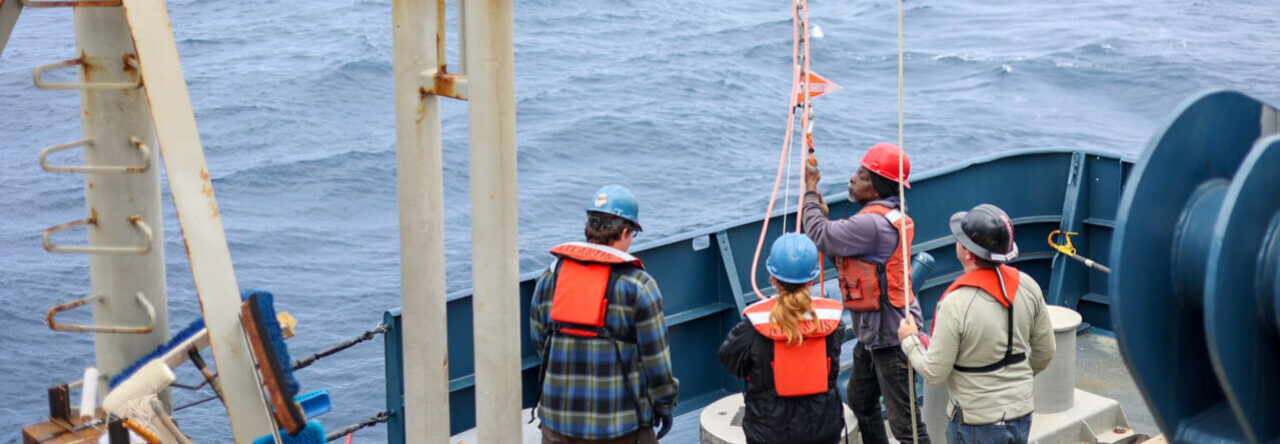
I have enjoyed working on deck assisting in deploying and recovering the dredge, and after the dredge hits the deck, we help the science team sort through the catch. We have also performed CTD cast at some of the stations, and KG has allowed me to prep the CTD to enter the water, as well as work on the computer end of things in the tech lab.

Yesterday, I got the chance to assist with performing a termination to the EM cable that goes to the CTD. On the last cast attempt we made, the EM cable jumped the sheave, and damaged the cable, so we had to repair it.

We are currently in port at Woods Hole, Massachusetts, and the next group from the science team are coming aboard. The weather offshore may keep us at the dock an extra day. If it does, we may get to tour the new research vessel the Neil Armstrong, which would be pretty cool.

Till next time,

Chris Petroff


Hydrostation Time!

So this past week has been filled with lots of fine tuning to get everything ready for our trip to Hydrostation S which is part of BATS (Bermuda Atlantic Time Series). BATS is the longest oceanographic research time series in the world which is an awesome event to be a part of. Another MATE intern (Elizabeth) has hopped onboard so we have been running heavy with MT’s the past few days. 

This past Tuesday we took off and made our way to the Hydrostation with the seas being a little rougher than normal. First deployment was a custom made incubator ran by a scientist from Old Dominion University. This device had many serenges that would draw water in with each on having different agents in them to give specific details of the water. It had a long line with a weight pulling the device down and an acoustic release for when they are ready to recover the device which will be June 30th. After making sure the device was on the bottom (talking to it through a transducer) we made a CTD cast to the bottom collecting water samples in our Niskin Bottles on the way up.

After the bottom cast we made a 3 hour transit to the hydrostation were we would spend most of our time. The longer the trip lasted, the worse the weather and sea conditions got. We made a hand full of CTD casts throughout the day getting plenty of water samples for the BIOS science team. Once we started working into the night it started getting really rough and wet on the deck. It was the first time I had seen our crew use three tag lines just for a CTD cast and it was completely necessary. When coming back to dock we had to make a special trip around the island and spend a day in St. George because it was to windy to come in through our normal channel. All in all it was a great experience working in those conditions, makes one really appreciate calm days.

Now we are getting ready for a 7 day cruise with the BATS team from BIOS and we will be taking off June 12th (Sunday). We have only minor preparations to touch on tomorrow and then we will be ready to rock in roll. After this I will only have one more blog but I love the crew here and am so happy I was given this opportunity to work with BIOS.

All the best,

Mason Schettig

The End or the Beginning?


This is the last week of my internship experience aboard the R/V Sikuliaq. In fact, today we have left the Jason ROV’s worksites area and have now begun the last leg of our journey that started in San Diego and went up the west coast to Victoria, British Columbia, Canada.

There have been seven Jason dives on this trip. Due to the transformer breaking and also due to weather issues, the Jason group was not able to dive as many times as they wanted to. However, we were able to get other data, such as multiple CTD’s, Multibeam surveys, and underway data.

I have been assisting with the CTD deployments, XBT’s deployments, and an extra assistant for the Jason deployments. I have also learned how to monitor the data received from the sensors, sonars, and other instruments and how to tell bad/abnormal data from good/normal data. I have learned many other things as well, such as; basic maritime knots, how to create a water-tight cable splice, and how to manage and save data. I was even able to fly the Jason around for a little while (picture attached below).

This experience has taught me more than just technical skills. It has taught me about living life on the water and the pros and cons of it. It has also taught me how to live and work well with many other people all stuck together in one 216 foot long space. It has been a great learning experience that I couldn’t have gained in many other places.

I am quite saddened to be going home and having to end this awesome experience. Despite the issues with the Jason ROV, this cruise went very well. No one was injured, there were no major issues on board, and everyone seemed to have a great time.

Despite the fact that I will be boarding a plane and going home in two days’ time, I know that this is an experience that I will carry with me and that will influence my life for many years to come. It is the end of this cruise and of this internship, but it is only the beginning of my career on the water. I am truly honored to have been given this wonderful opportunity to be a part of this R/V Sikuliaq cruise. It has been quite the adventure!

 -Hannah Klooster

A Quick Update


The Jason ROV is all fixed and ready to go! We left Newport, Oregon, yesterday morning at 11:00 am and reached station for the Jason ROV’s worksite 01 around 4:30 pm yesterday afternoon. The Jason’s first dive took place at 4:00 am this morning. Before it was deployed, the Jason group had to calibrate the USBL on the centerboard deployed underneath the ship using triangulation.

The Jason ROV is bigger than any ROV I have personally worked with before, so it was quite exciting to be a part of. The live feed of the Jason’s cameras are broadcasted on multiple different televisions throughout the ship, so everyone can watch what’s happening. It is all quite incredible to finally see everything working.

 – Hannah Klooster


Week Three – Back at the Dock

So last Friday the R/V Atlantic Explorer made it back safe and sound from a very successful cruise. It was a great learning experience seeing how things are wrapped up at the end of a science research cruise. Once back at the dock it there was still a fair bit of work to demobilize. The spectacular Filopino crew worked quickly and efficiently using the crane to hoist the heavy equipment off the vessel and on the dock. I gathered with the other MT’s to the tech lab to clean up the data folders, organize it in a neat/orderly fashion, and then all of the data collected was burned on to a CD with two extra copies. 

After the hustle and bustle of the demob, we gathered with the science crew to get opinions of how the cruise went (very successful I may add) and just talked about things other than work before they made there way back home. Luckily for me I had the following two days off (Saturday and Sunday) to relax as well as explore Bermuda (it is a travel destination after all). I borrowed one of the Marine Technician’s bikes to get around more efficiently since its not too big of a island.The waters all around are bright turquoise blue with rich culture and history around every corner. I stayed moderately close to BIOS so I wouldn’t risk getting lost or too worn out to make it back safely. I managed to find a secluded beach were I decided to swim around and cool off. The water was warm, clear, and quite inviting. After many miles on the bike I made my way back to BIOS. The remainder of the weekend was designated to touching base with loved ones and catching up on some sleep.

The first day back at work we hit the ground running to get everything in order for the upcoming cruise. First task to tackle was reassembling our CTD and doing some fine tuning to make sure everything is running properly. After a couple cable splices and troubleshooting we had all of our sensors working well and then all that was left was to mount on the Niskin Bottles which was an easy task. 

After taking care of the CTD we moved on to the next mission critial task which was fixing the issue with our 12 kHz Depth Sounder. This proved to be an easier than expected task. After searching through the ceiling panels we discovered the plugs were not connected to anthing and just had to made a terminal box for them to plug into. A few soldered wires and connections later it was back up and running. 

At this point we have knocked off all the tasks needed for our next departure so we have been working on smaller issues that just have been pushed to the back burner. We will be leaving next Monday for a day cruise to a Hydrostation that will be a quick out and back trip. That is all for now but will have more next week!

Week 2 Aboard the R/V Sharp

Hello Everyone:

This week has been an awesome experience here aboard the R/V Sharpe. This week we spent several days prepping the vessel, for a search and recovery mission to reclaim the HAB CAM that was lost when it struck a shipwreck while being towed. We discovered the shipwreck to be the Bow Mariner. The Bow Mariner is a tanker ship that sank when the ethanol it was transporting exploded. The ship is 500+ feet long, and is lying in around 220 feet of water off the coast of Virginia.

The ROV technicians that the science team hired for this mission were Dennis and Kevin from the University of Connecticut. The name of the ROV is the Kraken 2. The ROV technicians took the time to show me the basic set up of the Kraken 2, and discuss with me the engineering design of the vehicle, and the routine maintenance procedures that had to be performed after each dive, as well as basic troubleshooting methods. All the electrical wiring throughout the ROV is encased in oil which does not conduct electricity, and does not compress. This particular vehicle was equipped with a hydraulic arm, pressure sensors, altimeter, lights, and several cameras showing views ahead, above, and below the unit. The ROV of course can to conformed and outfitted with many other sensors, and altered to perform a variety of task.

My duties this week consisted of making wire runs that were needed to support the ROV lab, assisting in loading the ROV and its supporting equipment, securing equipment to the deck, assist with the deployment and retrieval of the ROV, and stowing away lines and tools used for the day’s work, just to name a few.

When we arrived on station the ROV was deployed and I was allowed to watch the entire operation in the control lab with Dennis and Kevin. It was really neat to see, and a very tedious process coordinating the ROV’s movements with the ship, and the currents. To make a long story short the HAB CAM was located nose up in the wreckage, and the winch operator lowered a clip down to the ROV, which was attached to the CAM and brought to the surface. Keep in mind this whole process is not as easy as it sounds, and it took hours of tedious work to get this process done.

KG and Chip have also been working with me explaining the electrical systems aboard the R/V Sharp. Also, we have drawn up a schematic, of the winch systems throughout the vessel in order to familiarize me with the setup. The plan is to go through each system step by step as the internship moves along.

Well that is it for now, and as I am typing this up we are headed offshore with the HAB CAM, and dredge to begin the 2nd leg of the cruise. Talk to everyone latter.

Just a quick note. I have some pictures to share with everyone, but KG has not been able to locate his camera cord to allow him to upload the pictures.

Till next time,

Chris Petroff


A Slight Change of Plans


Today we had planned to reach the first of six worksites for the Jason ROV. However, a change in plans was called for when the transformer for the Jason ROV failed. A replacement has been shipped and we will pick it up in Newport, Oregon. Instead of just going into dock at Newport, it was decided instead that we would do some Multi-Beam Sonar survey grids and some CTD (Conductivity, Temperature, and Depth) profiles for the six worksites. This will be the first time for me deploying the CTD, so I am quite excited.

Since my last post, I have done quite a bit aboard the R/V Sikuliaq. I have performed, with my mentor Steve, three XBT’s (Expendable Bathythermograph’s – to determine the speed of sound in a column of water). I have also been using the EM302 Multi-Beam Sonar program, the Olex 3D mapping program, and the TOPAS Sub-Sea Depth Profiler program.

I have, as of yesterday, passed the one week marker of living aboard the Sikuliaq. So far, it has been quite the adventure. This internship has marked the longest that I have ever been away from home as well as being a milestone in my schooling career, due to the knowledge that I have already gained in just one week’s time. In my down time, I have spent quite a bit of time on deck and on the bridge, watching for whales and/or dolphins. They have proved, however, to be quite elusive. I do hope that in the coming days before my internship is over, that I will at least see one whale.

I am not sure how long it will take before the Jason ROV is back up and running, and is ready to be deployed onto the worksites, but until that time, it looks like we will have plenty to do and monitor.

I have also attached a photo of myself in front of the Jason ROV taken by my mentor, Steven Hartz.


Week 01


Alright, I promised an update and since this is the last day in San Diego before the R/V Sikuliaq departs, I figured it was a good time for one. I landed in San Diego on the 25th of May around 11:00. I was picked up from the airport by my mentor, Steven Hartz, who gave me a brief tour of San Diego before we went to the ship. I was a little nervous, but everyone that I have met on the R/V Sikuliaq has been kind and very helpful. Steve gave me a tour of the ship and after only getting lost once, I think I have finally learned my way around; the R/V Sikuliaq is honestly larger than I thought it was going to be.

I have now spent two full days on the ship assisting where I can as everyone is preparing to leave port. It has been a bit hectic and crowded on deck and so far there hasn’t been too much for me to do. I’ve helped out with unloading boxes of food for the voyage, loading a box with a float for the Jason onto the crane, and lowering the Center Board with the transducer into the Safe position. I have also been learning about the different computer programs and systems that the R/V Sikuliaq has, such as the Olex 3D mapping system and all of the CCTV security cameras. Steve has also had me reading about different subjects and technologies on the ship, such as Serial Ports and the Acoustic Doppler Current Profiler.

I have spent time walking around deck and was also able to get off the ship for a while and bike around San Diego and Coronado Island, which were both amazing. The San Diego area is beautiful and with the temperature at around 60-65 degrees, it’s perfect. However, I am more than ready to finally “set sail” and truly begin my internship.    

Until next time, 

– Hannah Klooster

Week Two- Change of Plans

The second week at sea has been much like the first, very busy. There was a change in plans however which required an entire day of transit to a new work site and our waypoints were made up on the fly. This didn’t slow down operations however once we arrived to the new location. Along with tons and tons of CTD’s we have been deploying and picking up a Woods Hole Glider (measures Internal waves, surface waves, wind speed and direction), Wire Walker (Surface wave spectra), and more of the OOBS (Ocean Observing Buoy System). Most of these devices are dropped off and left to collect data for roughly a day or so and then we get a GPS fix on them and go pick them up. 

Weather wise, its been pretty inconsistant which is to be expected in this area. One moment it will be clear and sunny then next it is stormy with sideways rain and lightning. For the most part the seas have been forgiving with smaller swell sizes so the ship hasn’t been rocking too hard.

Today is actually the last day at sea and we are currently in transit back to Bermuda. We should be making it back tomorrow (May27) around roughly 1300. It has been a great first cruise with BIOS and an amazing science crew to work with. All the guys from John Hopkins as well as Scripps have maintained great, positive vibes and are nothing less than respectful to the crew and the intern (me). I could only hope to work with a team like this in the future.

Picture of me getting ready help recover a Woods Hole Glider
*Photo taken by Nick Mathews


Week 1

Hello Everyone:

This first week of the internship has been a busy one. On May 16th I arrived at the airport in Salisbury, Maryland and was picked up by Tim Deering the Oceanographic Coordinator for the University of Delaware’s Marine Division. We had to travel by car for about 45 minutes to arrive at the ship’s home port. The route we took us through the country, and I have to say we passed through some very beautiful country side. When we arrived at the port Mr. Deering gave me a complete tour of the grounds and the research vessel. I got the chance to meet the crew as well, and everyone seemed really nice and accommodating. The rest of the afternoon we discussed the dredge set up and CTD operations which we would be performing during the four different legs of the cruise. 

I have spent the first part of the week assisting the crew with load testing all the cable and winch sytems that will be used to deploy the equipment, making wire runs throughout the dry lab, helping the science team load some of their equipment aboard, and installing lab tables for the science team’s computers, just to name a few. I have never gotten to engage in all the pre-cruise activities before, and I learned alot about the attention to detail and careful planning that goes into an offshore trip.

The dredge system we will be using is a NOAA Schallop dredge. Also, the science team will be employing the use of a HAB CAM video system to provide visual images of the sea floor to assess schallop populations. We will also be using the SBE 11 Plus CTD to collect water parameter data from the water column.

We departed the dock to head to our first station at 1950 on May 13th. The HAB Cam was deployed at 0230 on Friday morning, but after towing it for about five hours we lost the insturment when it struck an object lying on the seafloor. The next several hours was spent taking multi-beam images of the area in which the incident occured. After several hours collecting data we begin heading back to port to regroup. On the way back in the first dredge was performed as well as a CTD cast shortly after.

We are currently at the dock with plans to head back out Monday or Tuesday. An ROV will be used to locate, and hopefully retrieve the CAM.

Talk to everyone again soon.

Chris Petroff


Page 70 of 85

Powered by WordPress & Theme by Anders Norén