Author: Keegan Brophy

Bouncing around THE BAR

Well with just over a week left in my journey in the Pacific Northwest, its been a trip of a lifetime! I’ve seen places and things that never would have been possible without the MATE internship program.Going out to sea through The Bar in 15-20ft steep waves that were just stacking up, waiting to be plowed through on this 275ft ship. Waves breaking over the bow which sits 21ft above the water line.

As far as this current cruise goes, its been fairly slow for me. Reason being, we are using a laser which has been mounted on the bow and comparing it to a new radar that has been installed. With these two new systems,we are comparing wave heights and what the waves are doing within the Columbia River mouth plume. So for the most part we are going across the plume(riding in the ditch,making for a bumpy ride) and in and out of the river mouth while the two systems mentioned above collect data.

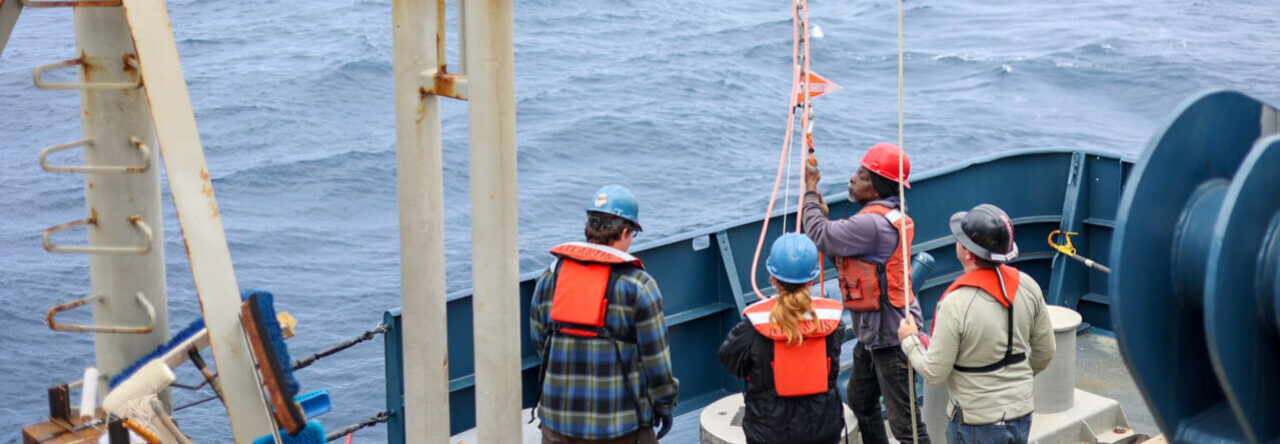
Though collecting data has been the name of the game for the most part, I have been able to conduct some science here and there. Twice a day, we are needed to do an XBT(seen in the picture)that corrects the differences in the sound velocity profile. This is basically a lead weight with a very thin copper wire attached to it. This sends a signal to the computer that the canister is attached to and we correct it from there. A few days ago we conducted a series of yoyo(up and down and up and down) CTD casts on the inside of the river mouth as the tide came in to see where the salt water and fresh water sits in the water column through the duration of the tide. My roll in the this process was exciting. I was at the “driver” seat watching the graphs of real time data. The scientists were there too, they would tell me where they wanted the CTD in the water column and I would relay the message to the winch operater via radio who was three decks above me. During deployment and recovery of the CTD I would man a tag line so nothing got broken or people hurt. All the while recording what activities we are doing on the ships wiki page.

We have also been deploying tracking drifter bouys on the inside of the mouth and recovering them on the outside daily for the past few days, a recovery is about to happen shortly after I get done writing this. So in about a week I’ll be east bound and down. Back in the south and ready to get back in the saddle and get to work. Hope you have enjoyed my story telling, until next time-Brophy out!

Leaving Town with Lasers

Well, it’s been a week of much of the same as it has been for the past month for the most part. Getting the R/V Thompson ready for months of cruises, but for me its the last one. This trip is going down to “The Bar” at the mouth of the Columbia River in Oregon. For those of you who don’t know about The Bar, it’s where the Coast Guard does their big wave rescue training. What are we doing there you may ask? Well, I will tell you. Originally, this was suppose to be a Scripps trip, but was past on to us. A laser has been mounted on the bow of the boat and it collects wave height, period data etc. at a very fast pace. More about that next week, as we are not even out of the Puget Sound yet.

As far as the past week, I started out by climbing the mast to take down a meteorological sensor. This system consisted of 3 parts, two remote sensors and a control box plus the wire that was used to control the sensors. The following day was spent calibrating more oxygen bottles, fun fun! Next was running more cat-5 cable to the new radar computer rack, which had to be snaked throughout the ship to get to its final destination. Also, I took down a rain catcher from the front of the boat.

Yesterday was spent cleaning the ship up from the last month and preparing for the next trip. Mostly storing old wire that we had pulled from within the ceiling tiles and putting all the tools we had used in their proper place. This morning we pulled away from the dock at around 0900 and made our way through the lock and dam and into the Puget Sound. Soon we will be in The Straight of Juan de Fuca, followed by the North Pacific. This has been a great experience, one of a lifetime, but I’m worn out and looking forward to seeing my girl and my dog! That being said   this should be a great cruise spending the next two weeks going in and out of “The Bar”. Until next time-Brophy Out.


Ship and Shop Maintenance

It’s been a mix of rain and sunshine here in Seattle for the week of 5/13-5/17. To start out the week, I was tasked with taking apart and cleaning a titrater which is a liquid dispenser that lets out very small controlled amounts. After that, we had to make a new wet end for our CTD on the R/V Barnes with included soldering wire and making a waterproof mold to encase the soldered connection.

Next was cutting old CTD wire cable into 4ft lengths for disposal. Following this task, I finished cleaning the titrater and replaced some parts for good ones. It worked just as well as if it was new after the Broph got done with it.

Then it was time to clean and calibrate oxygen bottles and there was a stack of them to be done. Calibrating bottles is a fancy way of weighing them with and without liquid. A process that I still have to finish. Yesterday the guys from Scripps showed up to start installing a laser on the bow of the Thompson for our next trip to the Columbia River. This laser will collect wave height data for the duration of the trip. So to prep for their arrival, we had to pull out abunch of old Co-ax and Cat-5 wire from the bridge to make room for a new radar and its wire that will accompany the laser. I also had to build and install a computer rack to hold all the CPU’s for this equipment. Time to get back to work!!!

R/V Barnes Day trips and More

Hey Guys,

Brophy’s back with another report from The U-Dub in sunny Seattle! Since my last blog, I’ve been doing a verity of tasks. To start out with, I was assigned to outfitting the CTD on the Thompson with new lanyards. The lanyards on the CTD are the links that connect the closable ends of the Niskin water collection bottles to the electromagnetic triggering mechanism on the Rosette which the bottles are mounted on. So in short, when the CTD is at a desired depth within the water column, the operater can hit a “fire” button on a computer and a signal is sent to the triggering mechanism via an armored conducting wire cable. The signal releases the trigger which inturn releases the lanyard and the bottle closes, and vuala, the water in trapped in the bottle at that depth.

The following day was spent reterminating the electromagnetc wire cable on the R/V Barnes, UW’s smaller research boat,that is awesome!! This was quite a task that has to be done slowly and carefully for a beginner like me. The cable has two wraps of steel wire strands, one with a right hand lay and the other a left hand lay. These two wraps must be peeled back to where the termination will take place on the wire. From their a kind of “squirrels nest” is created with the peeled back strands small enough to fit the inside diameter of the stainless steel connecter. Once the squirrels nest of wire is fitted inside the connector, we poured a type of meltable metal alloy called Serro-bend inside the connector the secure everything in place. The following day was spent running SVGA cable through the Thompson and mounting flatscreen computer moniters in various labs. This happened without a hitch, with my years in the electrical field serving me well.

The next three days where spend on the R/V Barnes out in the Puget Sound. Doing two trips a day, taking students of UW out for exposure to science operations on the water. I had a blast for these three days on that little ole tug!!! The weather was warm and clear for the most part, with mount Rainier on one side behind Seattle and the Olympic mountains on the other. Jim my mentor, Bob the Captain and Greg the mate are great guys and I truly enjoyed my time on that boat!!! During these trips I handled lines along side Greg as we went through the locks and while docking and undocking, with Greg on the bow and myself on the stern. During science operations I assisted Jim in showing the students how the operate the equipment before, during and after their deployments. While on the topic of scientific equipment, lets talk about what we did. To start out, we would to a CTD cast, usaully in about 180m of water. After that, we switched the wire on the winch from the EM cable used for the CTD to normal wire cable. This cable was then attached to a plankton net which the students used to collect phytoplankton. After the net tow, we switched to the Van Veen grab. This is a bottom grab device used to collect sediment from the bottom in an 8in x 14in area. Once collected, the sediment is sifted through using a water hose to see what was caught. Then, it was off the change the group of students for a new group. The same eqiupment was used again, but in opposite order. Overall it has been a great week here at The University of Washington, well until next time, Chow!

In port

Well guys, we’re back in Seattle for a couple of weeks. Since my last post, we finished our survey for internal waves with SWIMS the towfish off the Washington coast with the group of scientists called “The Wave Chasers.” We got back to Lake Union, where the University of Washingtons’ dock is located, last Friday. Lucky enough for me I have family in the area, so on my off time I have received the grand tour of the state of Washington. 

So after the weekend off, I reported for duty on Monday morning. We started off by tracing some Cat-5 cable (Cat-5 is commonly used for internet connections and linking different computers together) because of some networking issues. Once we had traced our wires out, I was tasked with clearing the dock of some junk that was no longer being used, a fun task indeed!

After cleaning the dock, I found out that the machine shop guys were trying to get their shop repainted after an electrical upfit. Needing to have it repainted before Thursday, I offered my services. Painting is what I have been doing for the last few days, breaking for a few hours for a Mar Tech staff meeting to discuss things to get done while in port. Once I am done writing this, I will be replacing all the lanyards on the Niskin water sample bottles that are mounted on our rosette. Well until next time, Brophy out! 

Internal Waves and Whales

Hello all:

It’s day three of the first of two cruises in the North Pacific. The sun is shining and the weather has been good so far. The food on the Thompson has been awesome, with suchi for lunch and dinner that you would find in a find dining resturant. 

Since leaving port, we did CTD casts for the first 24hrs of the cruise. Starting in  the Strait of Juan de Fuca, which seperates Canada and the US. My job was to prepare the CTD by cocking the Niskin bottles which are used to collect water samples at a given depth in the water column. Then we would deploy the CTD, firing the bottles at the depth that the scientists require. Once back on board I assted the scientists in collecting water samples to find the nutrient content of the sample.

Yesterday evening as we recovered an AUV (autonomous underwater vehicle), Grey Whales were spotted off the port bow,water spouts flying high in the sky. Then this morning a pod of Orca’s came very close to the ship as a Sea Lion hugged the Thompson trying to avoid detection from the killer whales.

After breakfest this morning (4/24/2013) we began the search for internal waves. Internal waves are very similar to the waves found on the sea surface, but travel within the water column. To do this we used a combo of a side mounted echosounder along with a towfish called “SWIMS” that is towed from astern. I assisted in the deployment of SWIMS by manning a tag line while it was guided into the water. I shall report again soon, hopefully with a better internet connection so I can include photos. Well, until next time!!

Northwest Bound

 It’s 80 degrees and sunny in Wilmington, NC and I’m soaking it up as much as possible. In a day and a half, I will be on a plane heading toward Seattle and the R/V Thomas G Thompson for what promises to be a trip of a lifetime. A five day trip off the Washington Coast, working in the Strait of Juan De Fuca then after a few weeks in port, we are off to the Gulf of Alaska for a three week trip! Warm clothing will be essential because the North Pacifc and Gulf of Alaska are unpredictable places even in the Spring/Summer months. I’m making a list and checking it twice! Well, until next time, Sayonara!!

Powered by WordPress & Theme by Anders Norén