
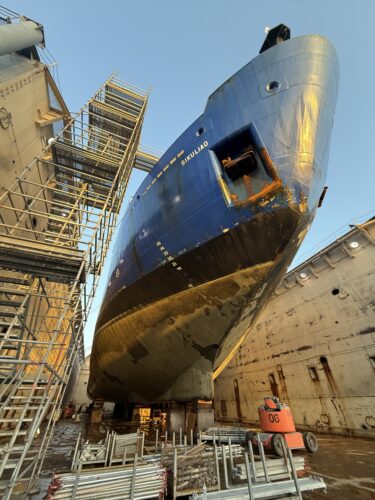
We have officially made it into drydock! Early in the morning, a group of tugs helped push R/V Sikuliaq off our docking into the submerged drydock structure. The drydock is a large structure designed to lift large ships out of the water by pumping water from a submerged platform beneath the ship.
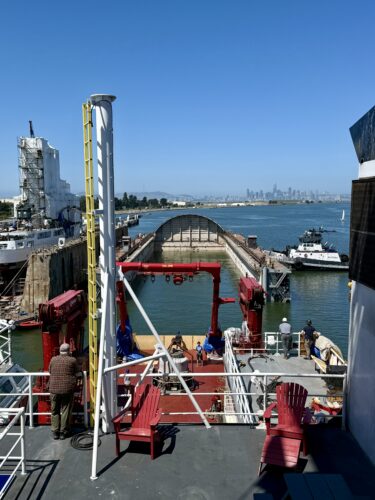
Getting out of the water has allowed the team to move forward with many projects. In our first few days dry, we were able to remove all of the ice windows and sonar systems from the flat region of the hull dedicated to sonar systems. This area is called the sonar flat. We removed the 75 kHz ADCP, OS 150 kHz ADCP, EM 302 multibeam transducer array, EM 710 multibeam transducer array, and TOPAS PS-18 parametric sub-bottom profiler. The transducers and the ice windows that protect the scientific equipment from polar ice impacts are both extremely heavy and extremely sensitive. There is just over 5 ft between the hull and the dock, leaving very limited room to work. We had to support the heavier instruments using wooden dunnage and support the lighter sonars by hand.
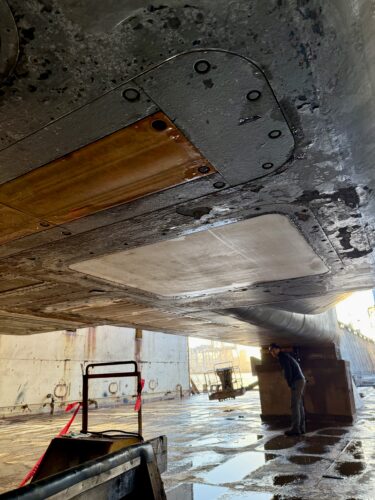
(Above) Sonar flat with ice windows and transducers still in place.
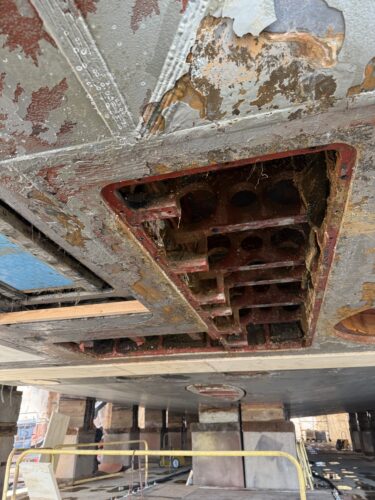
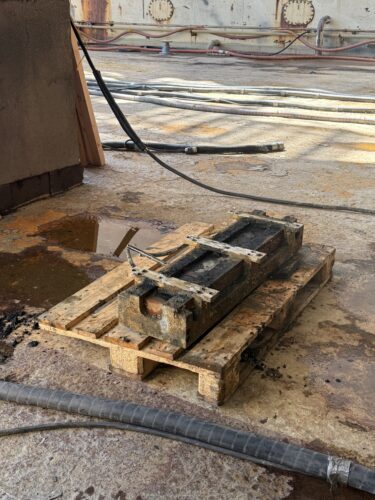
(Above) One portion of the EM 710 multibeam transducer array was removed.
All of these sonars are synchronized through a system called K-Sync, preventing the sonars from pinging at the same time. I have really enjoyed seeing how this system is physically connected throughout the ship. Working directly with the instrumentation has helped me clarify the transition of a sonar ping from physical signals to electrical signals that are carried to the lab through carefully considered cable routing.
-Paige FitzPatrick