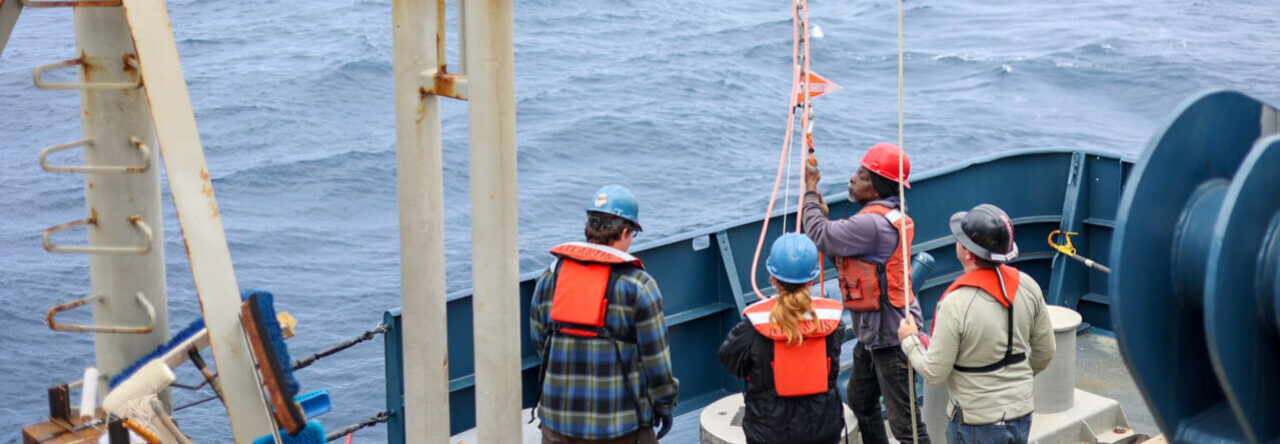
As we approached the third and final week of the voyage, I was beginning to fear that the lack of fresh vegetables and lettuce as well as limited sunlight might have a permanent effect on my psyche. I also knew that that the chances of seeing Arctic wildlife were diminishing by the day. So I was I was filled with mixed emotions as we wrapped up the research and began our journey home. Over the course of the trip, we had completed 13 CTD transects for 183 CTD casts and, as we headed back towards Dutch Harbor, the last few days of the cruise were spent relaxing and catching up on much needed sleep. I also finally got the chance to stand on the bridge and was lucky enough to spot several whales, most likely humpbacks, three pods of porpoise and two ringed seals, one of which was eating a large crab of it’s chest. The time also gave me the chance to reflect on how lucky I was to have had the opportunity to join the scientific crew aboard the Healy. Not many people can say that they have traveled above the Arctic Circle, cruised along the International Date Line, conquered the Gumby suit, witnessed the loss of sunlight at the rate of ten minutes/day, fallen asleep to the pitch and roll of 20 foot swells or listened to the eerie sound of miles upon miles of meter thick frozen ice being broken apart or dropped a personally decorated Styrofoam cup to the depth of 3,000m and seen it return as a perfect miniature of its original self, all while learning about and assisting with important scientific research. Now that I am back on land, I can truly say that I will miss life onboard the Healy and would jump at the chance to return for another expedition. The experience was one that I am extremely grateful for and will be difficult to forget for all the right reasons. There are so many memories that I want to hold on to—some big, such as the confidence I built up in learning to operate the CTD or seeing the Northern Lights—others, small moments such as clumsily walking into a Conex box and scarring my forehead, thus giving inspiration for a hastily put together Halloween costume as a blind mouse. I would like to thank everyone who supported me along the way, especially, Bob Pickart, Carolina Nobre, Scott Hiller and Alex Quintero for putting up with my slow learning curve of both the CTD and the science, the US Coast Guard for providing support for important research, the MATE program for providing me with the opportunity and the science team (Tanja, Lauran, Liza, and Maria) and crew (Brian, Kevin, Mo, Gianna, V-dub, and Jeremy) for keeping me honest, helping me laugh at least once a day and appreciating the simple things. A very special salute goes to the Coasties, who do such an amazing job operating the ship—I am in awe of their discipline and efficiency. Thank You.