Time is weird and often feels nonexistent when in the middle of the sea in perpetual daylight. While I frequently don’t know what day of the week it is and am now used to eating my third meal of the day at midnight, time must be progressing anyway, as last week we hit the mid-way point of the cruise! In stride with that milestone, we also concluded mooring operations this week. (If you haven’t already, check out Micah’s blog for an awesome detailed operation summary!) Throughout this, it’s been really interesting to learn more about the science behind them and how that interfaces with the work we do as techs.


The scientists onboard use the moorings to research pockets of the ocean where sound travels more efficiently, called sound speed ducts. Underwater sound speed is affected by variations in water temperature, salinity, and pressure, causing these ducts to form in warmer, saltier, and deeper (higher pressure) waters. The researchers communicate with the moorings that are collecting these observations through acoustic pinging. To avoid interference while they chat, we turn off our acoustic instruments for that time, including the multibeam and ADCP.
But, after we complete a successful CTD or XBT cast, we can use the temperature, salinity, and density profiles we collect to enhance these instruments using the same sound speed velocity that the science team is studying. By updating this profile in acoustic instruments like the multibeam, it can more accurately understand how quickly its pings are traveling through the water and provide us with more accurate seafloor depths and bathymetry (seafloor topographic features). Pretty cool!


That said, we did indeed conduct some more CTD casts this week. One cast happened late enough in the afternoon that my mentor, Tyler, and I got to prepare it, which involves climbing around on the frame and muscling bottles clipped open, so that they are ready to snap closed later to collect water when they’re 2000 meters away. On previous casts, we had noticed that one bottle wasn’t closing correctly and therefore wasn’t collecting water, so Tyler and I did some troubleshooting. I hypothesized that the lanyard connecting the top and bottom lid was likely too short, causing the bottom lid to be pulled too high and get stuck on a lip that the others sat below. We measured and crimped together a new, slightly longer lanyard that we then installed, and on the next cast, it shut perfectly! A win for for the scientific method.


The casts this week were also accompanied by some classic oceanography shenanigans. Because styrofoam cups have so much air in them, if you send them down with the CTD to the bottom of the ocean, the intense pressure crushes all that air out, leaving you with an adorable, tiny, shot-glass-sized version! Micah, Maya, and Christina organized the process to great success. The cup decorating skills around the Healy were impressive to see, and I’m stoked that I got to make two of my own. Under the pressure of about 3800 meters of seawater in the Beaufort Sea, they shrank to a little less than half their original size!


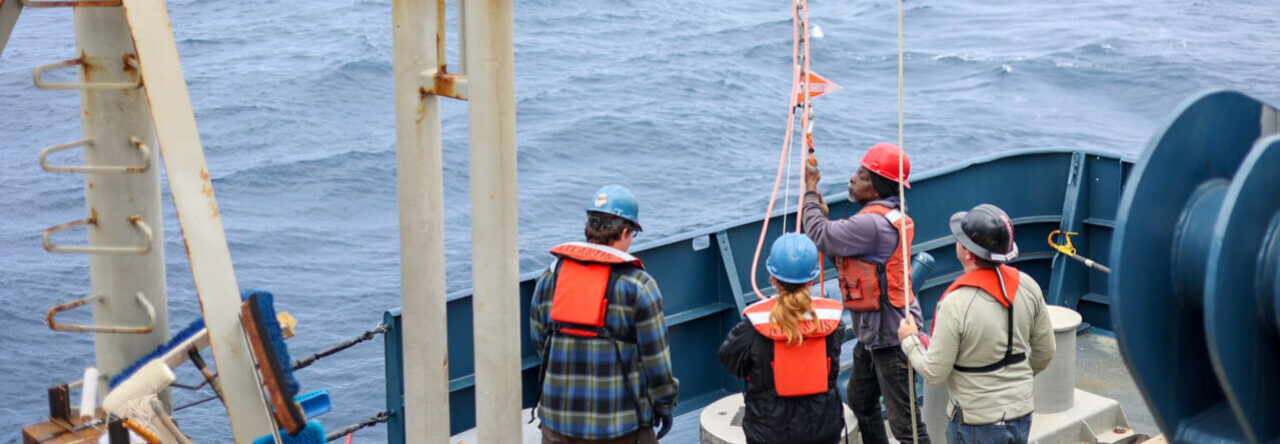
While I’ve still been grinding on the ship diagrams and got to deploy an Argo float myself (my first on-deck bowline knot!), the biggest project Tyler and I have been tackling this week is the “cable factory.” We’ve meticulously inventoried all the STARC cables living in drawers and storage tubs across the ship, tested them, labeled them, documented them in the spreadsheet, and stored them in new, organized homes. Shoutout to Micah for finding a real laminator to replace my janky heat gunned QR codes for the inventory lists!
This project has taught me a lot about the use and maintenance of all sorts of scientific equipment cables: CTD cables, water wall cables, sea cables, test cables, Y-cables, pigtails cables, you name it! It’s also given me a chance to better understand the workflow of how often they’re used to determine how accessible to leave them and what organizational systems are most effective onboard. Additionally, it was just pretty satisfying to complete, and will hopefully make life easier for the next techs onboard. Everyone go look at the newly organized drawers and say ooh-ahh. Thanks!


This project has also meant a fair amount of time in the science hold, which is a big area in the hull of the ship that we access through a little porthole in the floor right onto a staircase. When icebreaking, you can really hear the thrash of ice all around you, which is pretty awesome. Micah and Maya have been absolutely crushing the inventory game for literally everything else onboard, so Tyler and I naturally have been complicating it by rearranging the sprawling collection of boxes down there and consolidating some more CTD parts.


The festivities of the week gave us plenty of enrichment breaks from the “cable factory,” given two important holidays occurred: Coast Guard Day (which was celebrated jovially around the ship) and National Intern Appreciation Day (which had slightly fewer accolades). Coast Guard Day brought a feast of meats and sweets alongside a cornhole tournament on the flight deck, which Tyler and I promptly were obliterated at. However, we did secure second place in Star Wars trivia thanks to Tyler’s expertise, winning a new friend: Decibar the Inflatable Shark! The biggest win of the week for me, though, was that for one night, the galley served breakfast for dinner. Brekkie, oh, how I’ve missed you. Until next week!


Polar bear count: 0*
*Holding out hope as we return closer to land here soon…
