R/V Marcus G. Langseth,
04-June-13, The Study Site
R/V Marcus G. Langseth: Letting out the Streamers
Hello everyone! As promised, here is another blog post about what I have been up to whilst on the Langseth.
Just as a quick recap, since I lasted posted, the Langseth picked up the rest of the crew who are all part of the science team. These are the people who are actually using the gathered data to examine the ocean floor to see if their hypotheses are correct and or learn new information about the continental crust and plain. Their team is led by Dr. Sawyer from Rice University. I will take part is some of the data analysis, but for the most part the geophysical aspects of what they are doing and the examinations of the data are beyond my scope. Nevertheless, it was interesting to hear Dr. Sawyer talk about the mission goals and talk about how much work has went into this mission. It turns out that he proposed this mission over 10 years, got funding for it 3 years ago, and then had to wait until the Langseth was in the proper ocean so they didn’t have to pay to move it across the world.
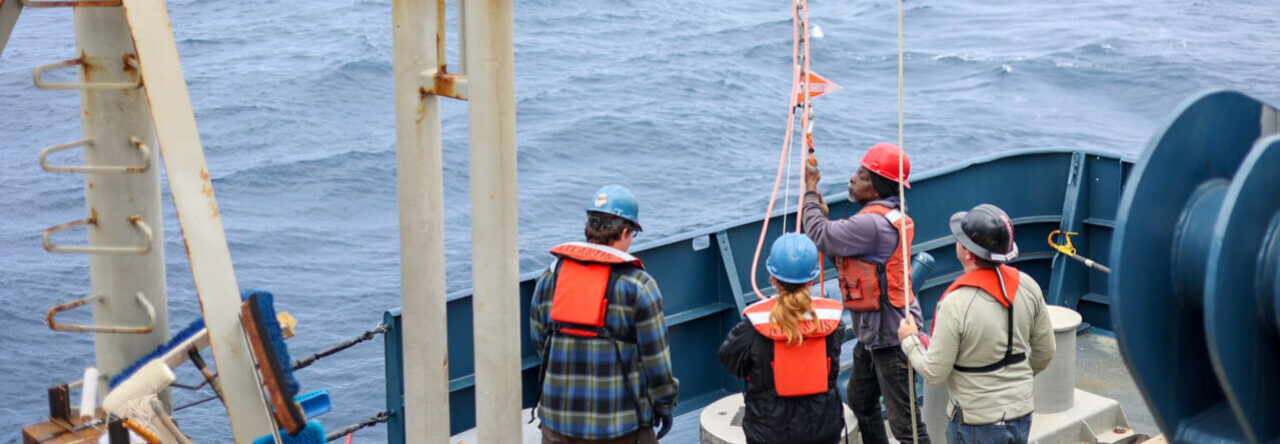
After we picked up the crew and had our discussion about our mission, we then departed from Vigo, Spain and headed out towards the study site. Once we arrived at the study site, we began shift work. I am working the shift of midnight to noon, which is a difficult schedule to get used to it, and I am still not completely shifted over to that sleeping schedule. Well, with shift work starting, we began to deploy the streamers. It was similar to what we had done before, but this time the streamers, rather than being out for a few hours, will be out for about 35 days. Thus, we had to make sure that everything was in complete working order. Of course, there were some issues with some of the streamers that had to be sorted out. We had to take some sections off, add some new ones, but today, after my shift ended, we had streamers 1, 2 and 4 deployed.
During my shift, we have graduate students who are there to assist us during their four hour shift. What is interesting about working with the graduate students is that they like to ask me a lot of the questions regarding how the equipment works, what the plan is for their shift, and how the seismic data is captured. Since, I have been on here, I can tell that I have learned a great deal since I can readily and easily answer most of their questions. Not only this, but the graduate students are now being given the hard labor tasks while I am given charge of operating the hydraulic reel for the streamers. My job now is to let the streamer out and then stop it occasionally, when Bern, my main mentor, tells me that he needs to check serial numbers, add a bird, add/remove weights (to help control buoyancy), and add/remove collars (for the birds). I use a remote control and when I stop the streamer, I let the grad student know what it is they are doing, are they adding a weight, removing a collar or adding a bird. They then set to work, while I wait for them to finish and once complete, I use the remote control to let the reel out. I never thought that while I was on this internship I would be having grad students do the work while I got the easy jobs.
Well, that is what has been going on here. I am sorry that this post is a bit short, but with 12 hour shifts and trying to get onto the right sleeping pattern I am pretty beat after work. I will post again soon. Take care everyone.
– This is Tyler Poppenwimer, signing off –